
































Cannabis test results can vary within a batch because the material is not perfectly uniform, the samples contain different portions of that material, and laboratory preparation and measurement introduce additional variation. A certificate of analysis describes the sample tested under the stated method—not every package in the batch. In 2026, the practical question is whether the sampling plan, laboratory methods, and reporting basis make the results meaningfully comparable.
- Cannabis testing sample variation reflects differences in material, sample collection, preparation, and laboratory measurement.
- A certificate of analysis describes tested material; it does not establish that every package is identical or safe.
- Dubcharge cannabis testing education is for adults interpreting reports, not selecting products by potency.
- Compare batch identifiers, analytes, units, reporting basis, methods, and dates before comparing headline percentages.
Why can cannabis test results vary within a batch?
A batch is a defined group of material, not a guarantee of identical composition. Different portions can contain different cannabinoid concentrations, moisture levels, or contaminants. Laboratory results also depend on how those portions are collected, combined, prepared, and measured.
These sources of variation answer different questions. A difference between packages does not automatically indicate a laboratory mistake, while a consistent laboratory result does not prove the original sample represented the entire batch. For help locating the relevant fields, see Dubcharge’s guide to how to read a cannabis lab report.
| Source of variation | What changes | What the result cannot establish alone |
|---|---|---|
| Material differences | Composition across flowers, pieces, or portions | That every portion matches the reported concentration |
| Sample collection | Which locations or packages enter the sample | That uncollected material has the same composition |
| Sample preparation | How material is mixed, reduced, or extracted | That preparation captured every original difference |
| Laboratory measurement | Instrument response, calibration, and method performance | That a numerical difference reflects a true batch difference |
| Reporting basis | Units, moisture adjustment, or analytes included | That differently reported numbers are directly comparable |
Why this matters
A batch report supports a defined testing decision. It does not provide a complete account of every chemical, every package, or every potential exposure. Treating its largest percentage as a universal property of the batch removes the context needed to interpret it.
For an adult reviewing a report in 2026, the useful distinction is what was measured versus what is being inferred. Cannabinoid testing, contaminant testing, and a regulatory pass decision each answer a narrower question than whether a product is safe for a particular person.
Why cannabis testing sample variation occurs
Five factors help explain why apparently related results differ. Each requires a different check; repeating an instrument measurement does not resolve all of them.
- Material distribution: Cannabis plant material contains different tissues and unevenly distributed resin-bearing structures. A portion rich in those structures need not match another portion.
- Sample collection: The locations, containers, and portions selected determine what reaches the laboratory. A convenient sample is not automatically representative.
- Sample preparation: Grinding, mixing, subsampling, and extraction affect what enters the final measurement. Consistent preparation reduces avoidable variation but cannot correct a biased original sample.
- Measurement method: Calibration, extraction efficiency, instrument performance, and method selectivity affect results. Laboratories need documented controls to assess those effects.
- Condition and reporting: Moisture, storage history, elapsed time, and reporting conventions can change the material or the numerical basis used to describe it.
Uneven contamination needs separate attention
Contaminants do not have to be distributed like cannabinoids. A localized contamination problem can be missed if the collected portions do not include affected material. A cannabinoid result therefore cannot stand in for microbial, pesticide, heavy-metal, or residual-solvent testing.
A combined sample also answers a different question from an individually tested portion. Combining material can support an estimate for the collected composite, but it does not reveal the concentration in each contributing portion. A composite result is not a package-by-package inspection.
How does sampling affect the result?
Representative sampling starts before the laboratory instrument. The collection plan must define the material being represented and explain how portions are selected. Without that connection, a precise measurement can describe the wrong slice of the batch.
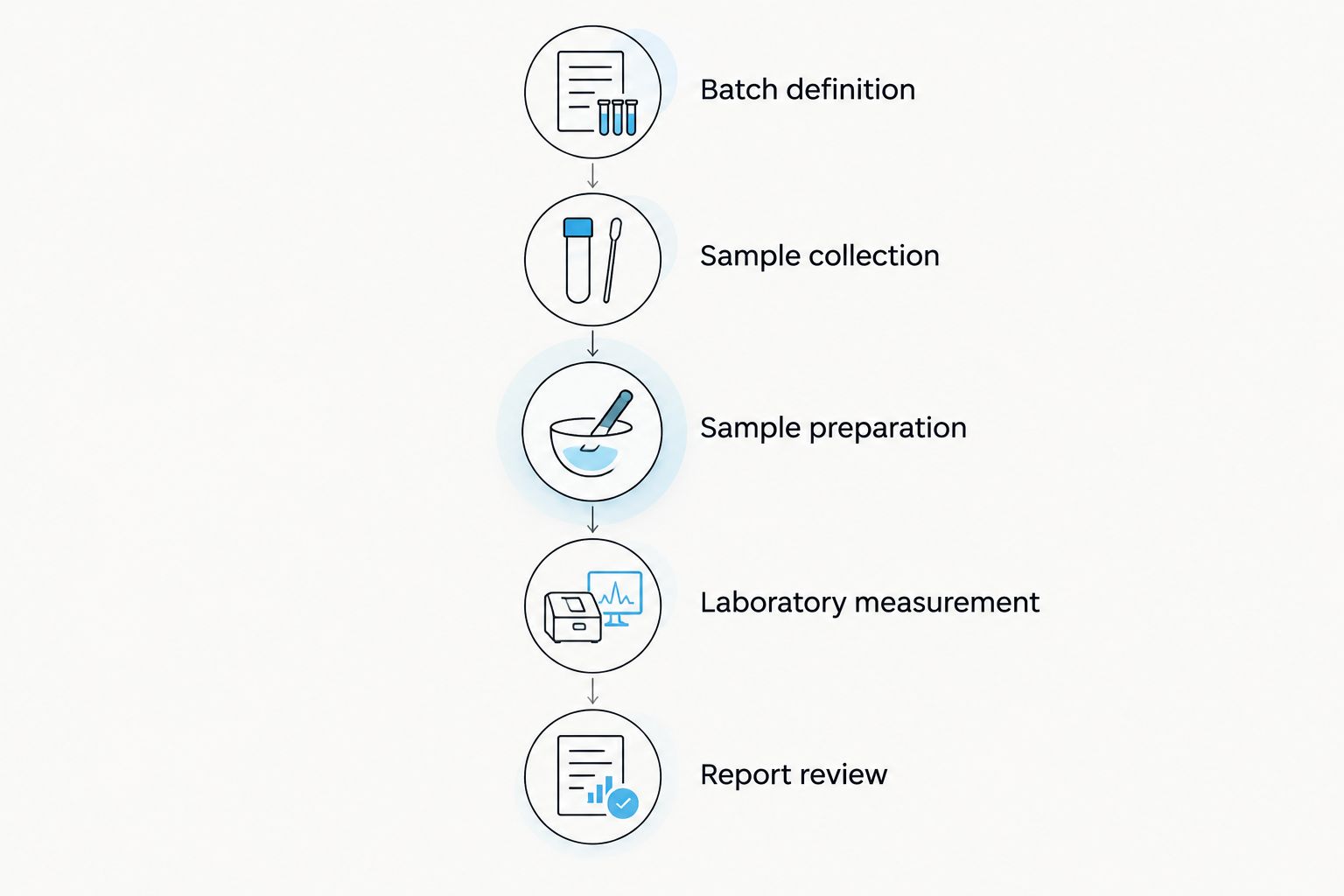
The following sequence shows what to look for in sampling documentation. It is a report-reading framework, not a substitute for a jurisdiction’s required sampling procedure.
- Batch definition: Confirm what production lot or group of material the report represents. Match identifiers rather than relying on a shared product name.
- Sample collection: Check who collected the sample and whether a documented procedure governed selection. Distinguish regulatory sampling from material submitted for other purposes.
- Sample preparation: Look for information about combining, homogenizing, and reducing the collected material. Preparation should connect the original sample to the portion actually tested.
- Laboratory measurement: Identify the analytes, methods, units, and any stated limitations. A potency panel is not interchangeable with a contaminant panel.
- Report review: Check dates, sample condition notes, amendments, and the applicable reporting basis. Resolve mismatched identifiers before interpreting numerical differences.
A missing detail is a reason to request documentation, not proof of misconduct. Conversely, a polished report does not replace a traceable connection between the batch, the collected sample, and the analytical result.
Why can laboratories report different results for the same material?
Laboratories can differ in sample preparation, extraction, calibration, analytical methods, and reporting conventions. They can also receive portions that are not compositionally identical, even when both portions carry the same batch identifier.
NIST’s Cannabis Quality Assurance Program addresses measurement comparability through interlaboratory exercises involving cannabis-related materials. Its scope matters: comparing laboratory performance helps identify analytical differences, but does not establish that a consumer package matches a separately collected batch sample.
Repeatability is not the same as representativeness
Repeatability describes agreement under specified repeat conditions. Representativeness concerns whether the collected sample adequately reflects the material about which someone wants to draw a conclusion. These are related quality questions, not synonyms.
A laboratory can repeatedly measure a well-mixed test portion and obtain closely agreeing results. If the original collection excluded part of the batch, that agreement does not repair the collection problem. Ask which stage was repeated before treating a retest as independent confirmation.
Accreditation has a defined scope
ISO/IEC 17025 addresses competence requirements for testing and calibration laboratories. Accreditation should be checked against the laboratory’s actual scope, including the relevant methods and materials—not treated as a blanket endorsement of every possible test.
Accreditation also does not certify that cannabis use is harmless. It concerns laboratory competence within a stated scope; health risk remains a separate question.
What should you compare before comparing percentages?
For a 2026 report review, establish that both documents describe the same thing. A percentage without its analyte, units, and reporting basis is an incomplete comparison.
- Batch and sample identity: A matching product name is insufficient if lot identifiers differ.
- Analyte: THCA, delta-9 THC, and a calculated total are different report entries.
- Units: Percent by mass and milligrams per gram express concentration differently.
- Moisture basis: Dry-weight and as-received results use different mass bases.
- Dates and condition: Collection, receipt, and analysis dates help establish what material was tested and when.
- Method and limits: Check the analytical method, detection or quantitation limits, and any uncertainty statement supplied.
For unit conversion alone, 1% by mass equals 10 milligrams per gram. Likewise, 0.1% by mass equals 1 milligram per gram. These are mathematical equivalences, not potency recommendations, dosing instructions, or evidence that differently identified samples are comparable.
Changing the reporting units does not change the material. Changing the moisture basis, however, changes the denominator used to express concentration. Do not label a numerical difference a laboratory disagreement until those reporting choices match.
Does a passing cannabis lab report prove safety?
No. A passing result means the tested sample met the applicable criteria for the reported tests. It does not establish the absence of every hazard, guarantee every package, or predict an individual’s response.
Detection limits matter here. “Not detected” means the method did not detect the analyte under its stated conditions; it does not establish absolute absence. An untested substance is a separate issue entirely and should not be treated as covered by a pass designation.
For Dubcharge readers, cannabis testing education should keep this boundary explicit: an analytical finding is not a medical assurance. CDC guidance describes health risks associated with cannabis use; a batch certificate does not erase those risks or evaluate a person’s medical circumstances.
Rules depend on jurisdiction
In the United States, cannabis testing requirements differ across state programs and product categories. California’s Department of Cannabis Control, for example, publishes requirements governing licensed cannabis testing laboratories and sampling within California’s regulated system.
Do not apply a California requirement to every hemp or cannabis product sold elsewhere. When reviewing a report in 2026, identify the governing program and current rule before interpreting a pass designation, required test panel, or retesting procedure. A laboratory report alone does not establish universal legal eligibility.
What should you do when results conflict?
Start with the documents rather than choosing whichever percentage looks more convincing. Preserve the original reports and packaging information so the identities and dates remain available for review.
Ask the laboratory or responsible business to clarify these points:
- Whether the results came from the same collected sample or separate collections.
- Whether either report replaced or amended an earlier report.
- Whether both results use the same analyte, units, and moisture basis.
- Whether the laboratory can explain the difference using its method performance and stated uncertainty.
- Whether the batch is subject to an official hold, warning, or recall.
A second result does not automatically invalidate the first. If separate samples were collected, their disagreement can involve both sampling and measurement. Without comparable documentation, the size of the difference alone does not identify its cause.
If there is a safety notice, follow the issuing authority’s instructions rather than relying on an older passing certificate. Dubcharge’s educational guide explains how to check official cannabis recall notices. Do not use a suspect item to investigate whether the paperwork is correct.
Authoritative reference points for 2026
These sources address different parts of the question. None should be stretched beyond its scope to certify an individual product or explain an individual discrepancy without supporting records.
- NIST Cannabis Quality Assurance Program: Interlaboratory measurement comparability and quality assurance for cannabis-related materials.
- Eurachem, Measurement Uncertainty Arising from Sampling: The relationship between sampling, sample preparation, and uncertainty in measurement results.
- ISO/IEC 17025: Laboratory competence requirements and the importance of a defined testing scope.
- California Department of Cannabis Control: Sampling and laboratory requirements within California’s licensed cannabis system.
- CDC cannabis health guidance: Health effects and risks that a product’s analytical report does not resolve.
These references provide a framework, not a diagnosis of a specific batch. Explaining an individual discrepancy requires the relevant sampling records, laboratory methods, report details, and product identifiers.
FAQ
Can two packages from the same cannabis batch have different test results?
Yes. Two packages can contain material with different composition, and collection, preparation, and measurement can add further differences. A shared batch identifier does not guarantee identical contents.
Does cannabis testing sample variation mean the laboratory made a mistake?
No. Cannabis testing sample variation can arise before the material reaches the laboratory. Assess sample identity, collection, preparation, reporting basis, and method performance before assigning a cause.
Is a second cannabis test automatically more accurate?
No. A second test is not automatically more accurate because it is newer or reports a different percentage. Its meaning depends on the sample tested, the method, and the quality controls.
What does not detected mean on a cannabis lab report?
Not detected means the laboratory did not detect the specified analyte under the method’s stated conditions. It does not prove absolute absence or cover substances outside the test panel.
Can I compare a dry-weight result with an as-received result?
Not directly. Dry-weight and as-received concentrations use different mass bases, so compare results only after the reporting basis has been properly reconciled.
Does a passing cannabis certificate mean every package is safe?
No. A passing certificate reports compliance for the tested sample and listed criteria. It does not establish that every package is identical or that use is risk-free.
What should I check first when two cannabis reports disagree?
Check batch and sample identifiers first. Then compare analytes, units, moisture basis, dates, methods, and whether either document is an amended report.
One last thing
A more precise instrument cannot correct an unrepresentative sample. In 2026, the most useful question to ask about a cannabis report is: what material does this result actually represent?
Keep that question separate from whether the reported number looks reassuring. The sample-to-batch connection determines how far the result can reasonably be applied.


Leave a comment
This site is protected by hCaptcha and the hCaptcha Privacy Policy and Terms of Service apply.