















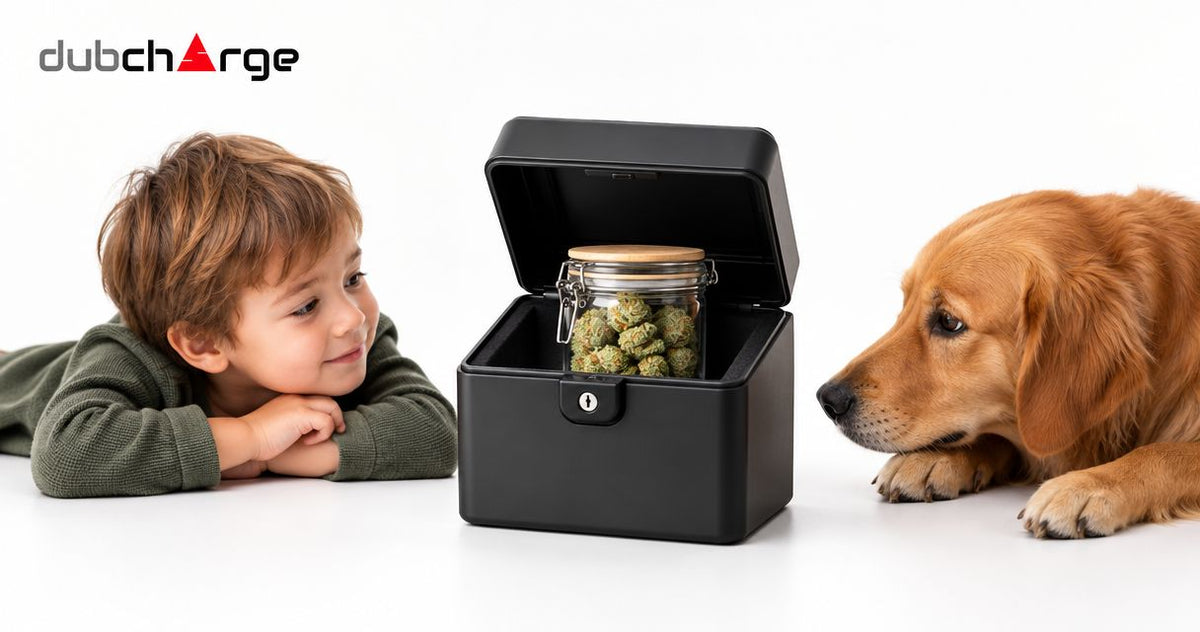
Keep cannabis in its original, clearly labeled packaging inside a locked container or cabinet that children and pets cannot access. Child-resistant packaging is not childproof, and a high shelf alone does not prevent access; if you suspect an exposure, contact Poison Control for a person or a veterinarian for an animal without waiting for symptoms.
- Dubcharge’s cannabis storage children pets safety guide prioritizes locked storage and original, clearly labeled packaging.
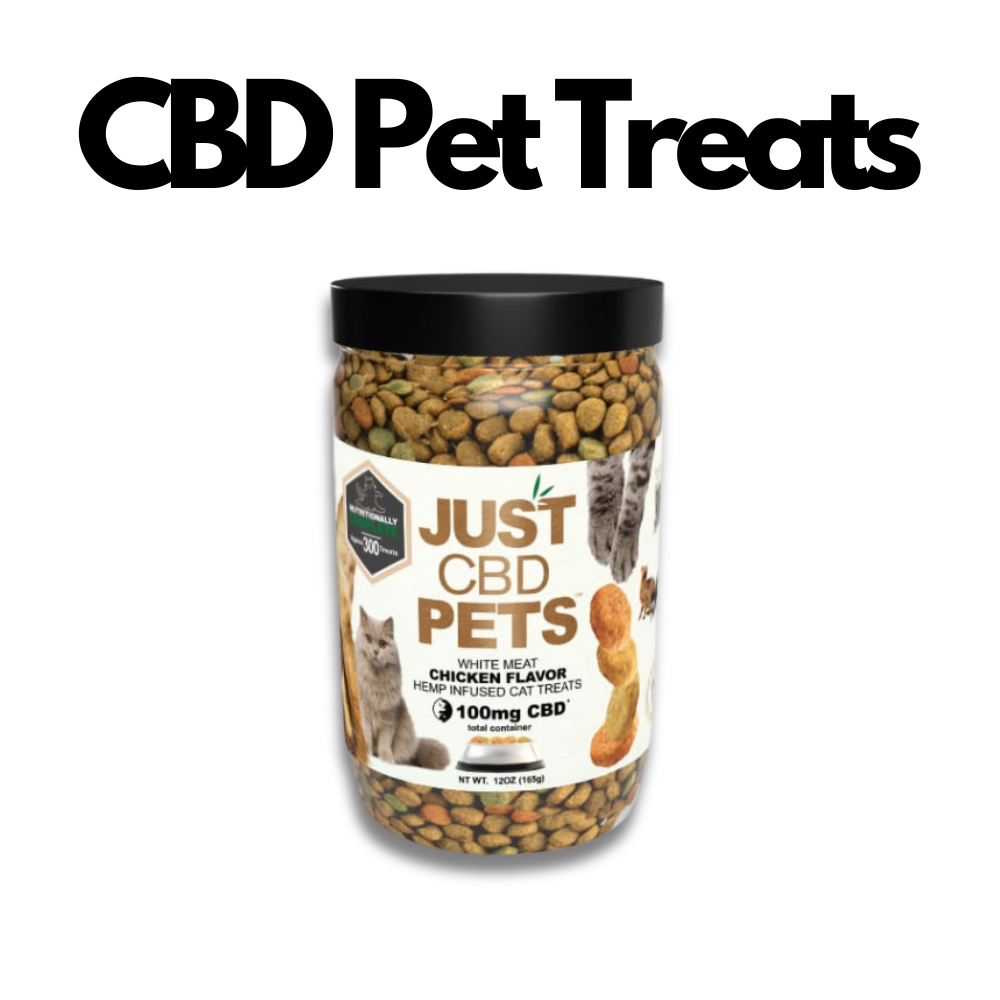
- Keep cannabis separate from ordinary food, drinks, medicines, and pet treats.
- Child-resistant packaging adds protection but does not replace a locked storage location.
- For suspected exposure, call Poison Control or a veterinarian immediately; do not wait for symptoms.
How do you keep stored cannabis away from children and pets?
Use a locked storage location, retain the original packaging, and secure everything again immediately after handling it. CDC and FDA guidance on accidental cannabis ingestion emphasizes keeping cannabis out of children’s reach and sight, including in child-resistant containers. Veterinary guidance likewise calls for preventing animals from accessing cannabis and discarded material.
Use this sequence when putting cannabis away:
- Keep the label. Leave cannabis in its original container so warnings, ingredients, and identifying information remain available.
- Close the package. Fully engage the child-resistant closure. A package left partly open does not provide its intended protection.
- Lock the storage. Put the closed package inside a locked container or cabinet, separate from ordinary food and pet supplies.
- Secure access. Keep keys away from children and do not share access codes with them.
- Check the area. Remove loose material, wrappers, spills, and discarded items before children or pets enter.
Apply the same approach to edibles, drinks, flower, concentrates, and cannabis-containing devices. Dubcharge’s educational guide to keeping cannabis vapes away from children addresses the device-specific part of this storage problem.
Why this matters
Cannabis edibles can resemble ordinary candy or baked goods. Drinks can also be mistaken for non-cannabis beverages, especially after someone transfers them to another container or leaves them unattended.
Children and animals cannot reliably recognize the difference. Storage should prevent access rather than depend on someone understanding a warning.
For a household safety check in 2026, include bags, visiting adults’ belongings, refrigerators, and trash—not just the usual storage cabinet. A locked cabinet does not protect against a package left elsewhere.
Which storage barriers help, and where do they fall short?
A lock and an original package serve different purposes. The lock restricts access; the package preserves identification and adds a closure barrier when it has a functioning child-resistant design.
| Storage barrier | Best for | Useful protection | Limitation |
|---|---|---|---|
| Locked container | Keeping labeled packages together | Restricts access when properly locked | A loose key or shared code defeats the barrier |
| Locked cabinet | Securing a dedicated household storage area | Separates cannabis from everyday items | Every adult must relock it after access |
| Original child-resistant package | Preserving warnings and product identification | Adds a barrier when correctly closed | It is not childproof and does not replace locked storage |
| High shelf alone | Keeping items out of immediate sight | Reduces obvious visibility | Children can climb, and pets can reach or knock down items |
Use barriers together rather than choosing between a lock and the original package. Do not assume an opaque container, an odor-resistant bag, or a difficult zipper is child-resistant unless the packaging is specifically identified that way.
Inspect closures and locks for damage. If a closure no longer engages, prevent access while arranging a suitable replacement; do not leave the compromised package on a counter.
Why household cannabis storage risk varies
The basic storage rule stays the same, but these household conditions change where access can occur:
- Food resemblance: Edibles and drinks can be confused with everyday food, especially outside their original packaging.
- Reach and climbing: Children can climb furniture, while animals can jump, investigate bags, or pull items down.
- Shared spaces: Visitors, caregivers, and other adults introduce additional bags and storage habits.
- Closure condition: An incompletely closed or damaged package loses an intended barrier.
- Handling interruptions: A package can remain accessible while an adult answers the door or leaves the room.
- Waste access: Wrappers, remnants, and discarded cannabis can remain accessible after the main package is put away.
These are access problems, not reasons to estimate a “safe” amount for a child or pet. Keep all cannabis inaccessible and seek professional advice after a suspected exposure.
Where should cannabis edibles and drinks be stored?
Keep cannabis food and drinks locked away from ordinary groceries, snacks, and pet treats. Do not transfer them into a cookie jar, lunch container, unmarked bottle, or other familiar food packaging.
If a product’s label requires refrigeration, follow that instruction while maintaining a secure barrier against children and animals. A shared refrigerator without restricted access does not become secure because the product sits at the back.
Keep identification with the product. If an outer package contains the warnings or batch information, retain it rather than storing loose portions without context.
A practical 2026 storage check is to ask whether a visitor could mistake the item for ordinary food. If the answer is yes, restore clear identification and secure it immediately; a handwritten warning alone does not prevent access.
How do you keep cannabis away from pets?
Keep cannabis and cannabis waste behind a lock, not simply above an animal’s usual reach. Dogs can investigate bags and trash, while cats can reach elevated surfaces.
Include visitors’ belongings in the household rule. A handbag or backpack left on the floor is not secure storage, even if its owner normally keeps cannabis locked away at home.
Do not give an animal a cannabis product intended for people. FDA guidance distinguishes approved animal drugs from unapproved cannabis-derived products; a retail label does not establish that something is appropriate for a pet.
Veterinary references, including the Merck Veterinary Manual, describe cannabis poisoning signs such as poor coordination, unusual sleepiness, and urinary incontinence. These signs are not a home diagnosis, and their absence does not rule out exposure.
What should you do if a child might have eaten cannabis?
Call U.S. Poison Control at 1-800-222-1222 immediately after a suspected exposure. Do not wait for the child to look unwell or try to calculate a harmless amount yourself.
Call 911 if the child collapses, has a seizure, has trouble breathing, or cannot be awakened. These emergency instructions also apply when you do not know exactly what the child encountered.
While getting help:
- Remove any remaining product from reach without putting yourself at risk.
- Keep the original package, ingredient information, and any remaining material available.
- Tell the professional what happened, when it happened, and what symptoms you see.
- Explain that the amount is unknown if you cannot establish it; do not present a guess as fact.
- Do not induce vomiting or give a home remedy. Follow the professional’s instructions.
Poison Control provides free, confidential U.S. guidance 24 hours a day. Save the number before an emergency so another caregiver can find it quickly.
What should you do if a pet might have eaten cannabis?
Contact your veterinarian or an emergency veterinary service immediately. For animal-specific poison advice in the United States, the ASPCA Animal Poison Control Center is available at 888-426-4435.
Keep the packaging and tell the veterinarian about all listed ingredients, not only cannabis. Some edible ingredients, including chocolate and xylitol, create additional hazards for animals.
Do not induce vomiting unless a veterinary professional specifically directs you. Do not give human medicines or attempt to treat unusual sleepiness at home.
If the animal is unresponsive, having a seizure, or struggling to breathe, seek emergency veterinary care immediately. Have another adult call the clinic while you prepare to travel, if someone is available.
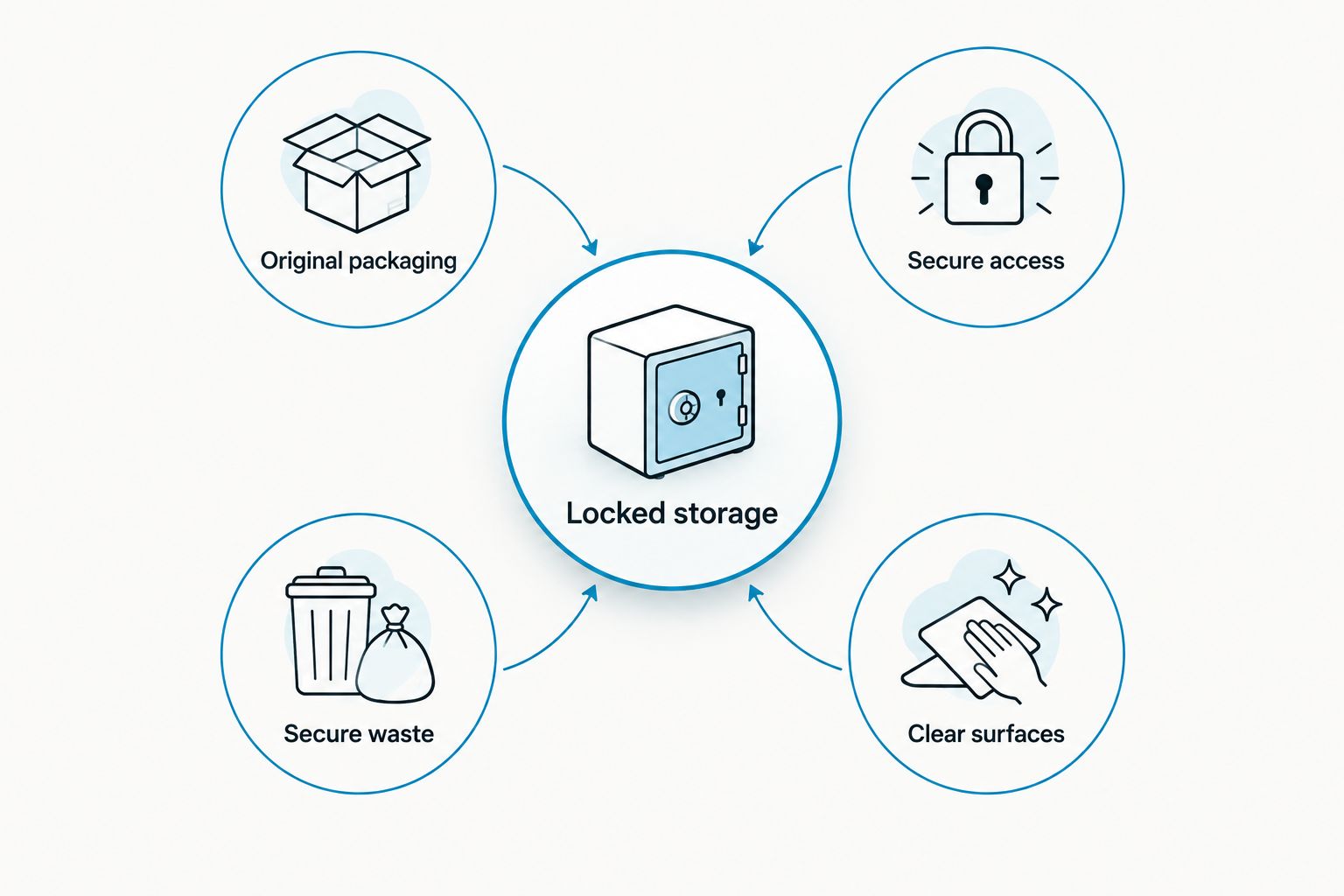
What should a household storage check include?
Use a physical check rather than relying on memory. Follow the route cannabis takes through the home: arrival, storage, handling, and disposal.
- Original packaging: Labels and warnings remain with the contents.
- Locked storage: The lock works and is engaged.
- Secure access: Keys and codes are unavailable to children.
- Clear surfaces: Tables, counters, bags, and floors contain no accessible material.
- Secure waste: Children and animals cannot reach discarded cannabis or packaging containing remnants.
These checks address different failure points. A secure package does not compensate for accessible waste, and a locked box does not help while its contents sit unattended elsewhere.
How should cannabis waste and damaged items be handled?
Keep waste inaccessible until it leaves the home through an appropriate disposal route. An open kitchen bin is not secure when children or animals can reach its contents.
Do not assume a used or apparently empty item contains no residue. Keep remnants, spilled material, and contaminated packaging away from food preparation areas and pet feeding areas.
Cannabis disposal rules differ by jurisdiction. Battery-containing devices also require attention to local battery or household hazardous-waste instructions; do not treat every item as ordinary household trash.
For a damaged or leaking device, prevent access and avoid handling exposed contents unnecessarily. Do not puncture, dismantle, or attempt to repair it, and follow local disposal guidance rather than improvising a disposal method.
Does a passing lab report make storage less important?
No. A passing lab report does not make cannabis safe for children or pets. A report describes specified testing of a sample; it does not prevent accidental ingestion or establish that exposure is harmless.
A label such as hemp or THC-A is not a household safety exemption. Keep these products secured using the same access controls rather than inferring safety from the category name.
For a 2026 household review, check both access prevention and current recall information. Retain the package’s identifying details so you can compare them with an official notice if one appears.
Sources and limits of this guidance
This 2026 guide addresses U.S. household prevention and initial responses, not individual medical or veterinary treatment. Storage requirements and disposal rules depend on jurisdiction.
The authoritative sources supporting the practical guidance are:
- CDC: Cannabis poisoning prevention, accidental ingestion, and keeping products away from children.
- FDA: Accidental ingestion of cannabis-containing foods and the status of cannabis-derived animal products.
- Poison Control: Immediate U.S. exposure advice, emergency warning signs, and the national telephone service.
- ASPCA Animal Poison Control Center and Merck Veterinary Manual: Animal exposure response and recognized cannabis poisoning signs.
These sources support access prevention and prompt professional advice. They do not establish a household exposure threshold that makes it reasonable to delay calling.
FAQ
Is a high cupboard enough to keep cannabis away from children?
No. Keep cannabis in a locked container or cabinet because children can climb and reach items above their normal height. Retain the original packaging inside the locked space.
Does child-resistant packaging mean a child cannot open it?
No. Child-resistant packaging is not childproof. Close it correctly and use locked storage as an additional barrier.
Can I keep cannabis gummies with regular candy?
No. Keep cannabis gummies separate from ordinary candy and locked away in their original, clearly labeled packaging. Familiar food containers increase the risk of confusion.
What number should I call if my child eats cannabis?
Call U.S. Poison Control at 1-800-222-1222 immediately. Call 911 if the child collapses, has a seizure, has trouble breathing, or cannot be awakened.
Should I make my dog vomit after eating cannabis?
Do not induce vomiting unless a veterinary professional instructs you to do so. Contact a veterinarian or animal poison service immediately and keep the packaging available.
Do hemp and THC-A products need locked storage too?
Yes. Keep hemp and THC-A products inaccessible to children and pets. Their category names do not establish that an accidental exposure is safe.
Does passing laboratory testing mean cannabis is safe around pets?
No. A passing laboratory report does not establish safety for pets or remove the need for locked storage. Contact a veterinarian after a suspected exposure.
One last thing
Practice the handoff between adults. Tell caregivers and visitors where the household’s secure storage is, require them to keep their own belongings inaccessible, and make the emergency numbers easy to find.
Dubcharge’s cannabis storage guidance comes down to a repeatable rule: close the original package, lock it away, and check what remains outside the lock. Repeat that check when guests arrive, not just when you reorganize a cabinet.


Leave a comment
This site is protected by hCaptcha and the hCaptcha Privacy Policy and Terms of Service apply.