




No. A THCA label does not establish whether an edible is intoxicating: the finished food can contain THC or other intoxicating cannabinoids that the front label does not fully describe. You need a batch-matched laboratory report, clear serving information and the complete ingredient list to assess what is documented—and even those records cannot predict your response or prove safety.
- THCA edible label intoxication claims are not proof that a finished food is non-intoxicating.
- THCA and delta-9 THC are different compounds; a product name does not establish their measured amounts.
- A batch-matched certificate of analysis supports label checks, not a guarantee of safety or predictable effects.
- CDC warns that edible effects can take 30 minutes to 2 hours to appear.
Does a THCA label establish whether an edible is intoxicating?
A THCA label identifies a claimed ingredient or product category, not a verified intoxication outcome. THCA is the acidic precursor to THC and does not produce the same established intoxicating effects as delta-9 THC. That distinction does not establish what else is present in a finished edible.
Start with the finished-product evidence. The Dubcharge guide to reading a cannabis lab report explains the records relevant to that check; the key question is whether the report actually matches the food and batch in your hands.
| Evidence | What it helps establish | What it cannot establish |
|---|---|---|
| Front-label THCA wording | How the product is described | Its complete cannabinoid composition or effects |
| Ingredient list | Ingredients the manufacturer declares | Whether every declaration is accurate |
| Cannabinoid test results | Amounts measured in the submitted sample | An identical amount in every individual piece |
| Batch-matched contaminant results | Findings for the substances tested | Absence of every possible hazard |
| Serving information | The manufacturer's stated serving basis | A safe amount for a particular person |
A cannabinoid name is not an impairment test. In 2026, the practical distinction remains between a claim printed on packaging and evidence tied to the finished product.
Why this matters
An edible resembles food, but its effects are not necessarily apparent when you eat it. The CDC's Cannabis and Poisoning guidance states that edible effects can take 30 minutes to 2 hours to appear and warns that this delay contributes to poisoning risk.
That timing is a safety warning, not a consumption schedule. Feeling unchanged shortly after an exposure does not establish that the food was non-intoxicating, and taking more to test the label increases uncertainty.
Keep separate questions separate: what the food contains, whether it can cause impairment, whether it meets local rules and whether it is safe. A single label statement cannot answer all of them.
THCA and THC: what the distinction actually tells you
THCA and delta-9 THC are chemically related but are not interchangeable names. Heat can convert THCA into THC through decarboxylation. That chemistry helps explain why an ingredient description alone is insufficient evidence about a processed food.
A manufacturer might describe an ingredient as THCA without the front label explaining the finished product's measured THC content. The useful evidence is a cannabinoid analysis of the edible after manufacturing—not merely a report for flower, an extract or another starting ingredient.
Do not assume digestion converts all THCA into THC. Equally, do not assume that a THCA-branded edible contains only THCA. Neither conclusion follows from the product name.
Research on THCA is also not a substitute for product-specific evidence. Findings about an isolated compound do not establish the effects of a commercial food containing multiple ingredients, and they do not substantiate a health benefit for that food.
How do you check what a THCA edible label actually documents?
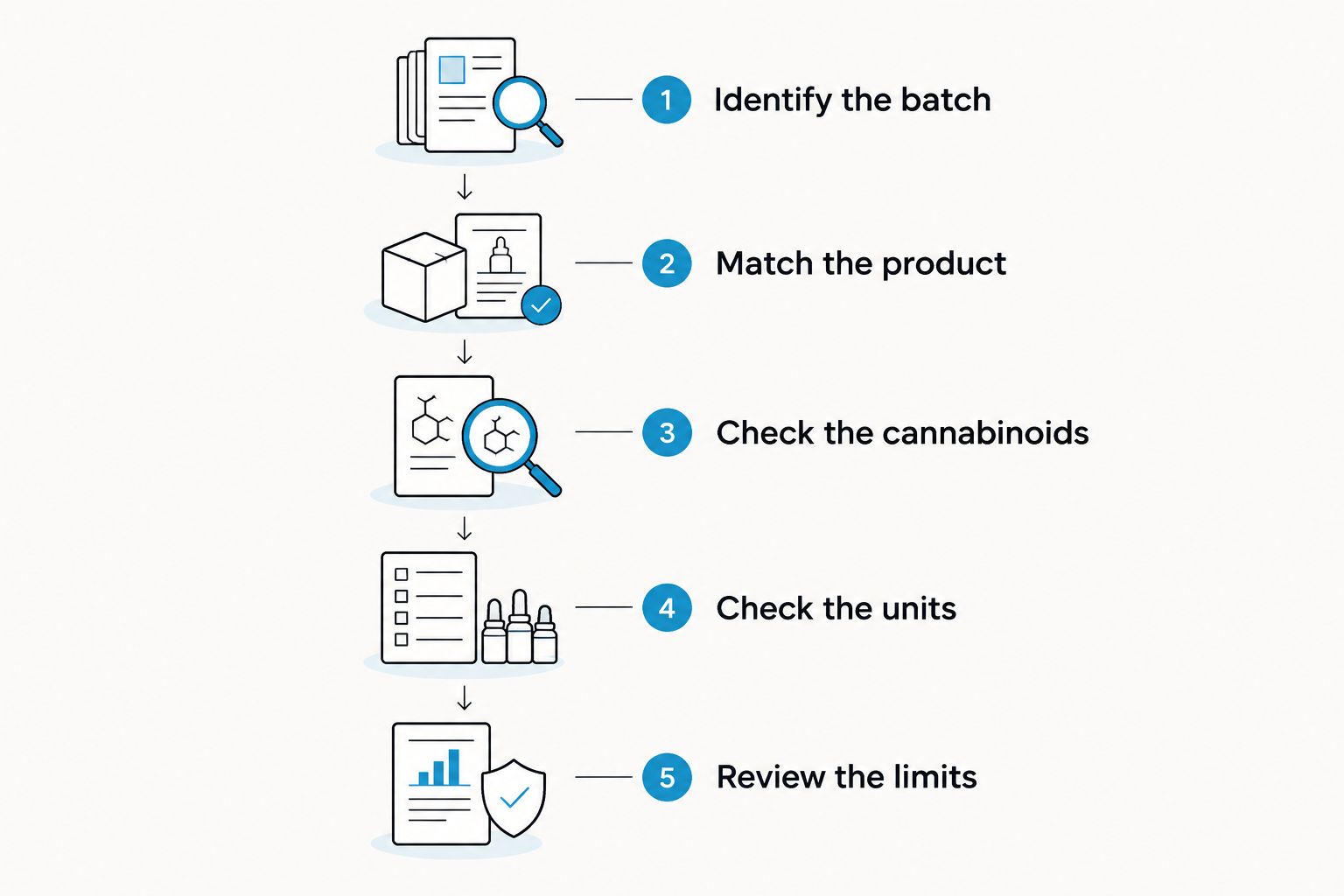
For a 2026 label review, follow the records from the package to the laboratory result. If the records do not match, treat the composition as unverified rather than filling the gaps with assumptions.
- Identify the batch. Find the lot or batch identifier on the package. A report for another lot does not verify this one.
- Match the product. Confirm that the laboratory's sample description identifies the finished edible. An ingredient report answers a different question.
- Check the cannabinoids. Read the separate entries for THCA, delta-9 THC and any other cannabinoids reported. Do not rely only on a combined total.
- Check the units. Distinguish milligrams per serving, milligrams per package and concentration by weight. Those are different reporting bases.
- Review the limits. Look for detection limits, the test panel, laboratory identifiers and report dates. Contact the laboratory through independently verified details if authenticity is in doubt.
A QR code is only a route to a document. It does not establish that the document is authentic, current or applicable to the package. A generic report reused across different products leaves the central identification question unanswered.
Why do intoxication risk and label certainty vary?
The uncertainty comes from several distinct sources. These factors explain why the same front-label wording cannot establish a uniform result:
- Finished-product composition: THCA wording does not exclude delta-9 THC or other intoxicating ingredients.
- Manufacturing history: Processing can change cannabinoid composition; a starting-material test does not document the completed food.
- Serving basis: A package total does not tell you the amount in an individual piece unless the serving information supports that interpretation.
- Sample variation: A laboratory tests a submitted sample, not every edible in the batch.
- Individual response: Other substances, medications and individual differences affect the risks associated with an exposure.
- Evidence limits: A report only addresses the analytes, methods and reporting limits it actually includes.
Do not collapse these factors into a simple stronger-or-weaker judgment. Some concern chemical composition; others concern whether the available paperwork supports any reliable interpretation at all.
Does a passing lab report prove the edible is safe?
No. A passing report documents specified test results against specified limits; it does not certify that eating the product is safe. Cannabinoid potency testing and contaminant testing answer different questions, and neither predicts an individual's response.
Read the panel names. A potency report alone does not establish findings for pesticides, heavy metals, residual solvents, microorganisms or mycotoxins. The appropriate requirements depend on the product and the jurisdiction; do not assume every laboratory report covers the same substances.
A result marked not detected also needs context. It means the analyte was not detected under that method's reporting conditions, not that its absolute amount is necessarily zero.
For a 2026 review, check the report date alongside the batch details and any official recall information. An older report is not automatically invalid, but a report issued before the finished product existed cannot document a later finished-product sample.
How do you interpret serving amounts without predicting a high?
First identify what the number measures. 1 gram equals 1,000 milligrams, but a gram of food is not a gram of THC. Product weight, extract weight and cannabinoid content are separate quantities.
A large milligram number on the front of a package needs an explanation: does it refer to a named cannabinoid, a blend, a serving or the entire package? Without that basis, the number does not establish the amount of delta-9 THC in an individual piece.
Likewise, a percentage expresses concentration, not a personal effect. A laboratory's total-THC calculation can account for potential conversion of THCA; it is not a direct measurement of what your body absorbs from eating that food.
Use serving information to understand the documentation, not to select an intoxicating amount. If the package and report use incompatible units or disagree about serving size, do not improvise a conversion to resolve a safety question.
Does a hemp claim mean the edible cannot cause impairment?
No. A hemp claim is not evidence of non-intoxication. Legal classification and pharmacological effects are different questions, and a product's marketing category does not establish its actual composition.
In the United States, federal and state requirements are separate. State rules can address cannabinoid composition, product formats, testing, labeling and sales differently. A statement about one jurisdiction does not establish compliance elsewhere.
Check current requirements with the relevant official regulator in 2026 rather than treating packaging as legal advice. This article does not determine whether a particular edible is lawful to possess, sell or ship.
What should you do if someone feels unwell after eating one?
Stop further exposure and get medical guidance. Do not drive, operate equipment or combine the product with alcohol or other intoxicating substances. Keep the package and batch information available for clinicians or poison specialists.
In the United States, call Poison Control at 1-800-222-1222 for a suspected poisoning, including an unexpected edible exposure. For a child exposure, seek advice promptly rather than waiting for symptoms.
Call 911 if someone collapses, has a seizure, has trouble breathing or cannot be awakened. Do not induce vomiting unless a qualified medical professional specifically directs you to do so.
An apparently ordinary candy or baked good can still be involved in a serious exposure. Tell responders what the package says, what was eaten and what remains uncertain; do not present the THCA label as proof that THC exposure was impossible.
How should you store, discard or check a questionable edible?
Keep cannabis edibles locked away from children and pets, separate from ordinary food. Retain the original labeled packaging inside the secured storage area. Child-resistant packaging is not childproof and does not replace locked storage.
If the batch is recalled, stop using it and follow the issuing regulator's instructions. Match the product name and lot identifier rather than relying only on a package photograph. A familiar appearance does not rule a recall in or out.
For disposal, follow the recall notice or local waste authority's instructions and prevent access by children, pets and wildlife. Do not give a questionable edible to another person or animal, and do not assume cooking it makes it safe.
For 2026 decisions, current official notices take priority over an undated screenshot or a seller's general reassurance. Save the packaging details needed to identify the affected batch before following disposal instructions.
FAQ
Can a THCA edible make me feel high?
A THCA-labeled edible can cause intoxication if it contains THC or other intoxicating ingredients. The label alone does not establish the finished food's composition or your response.
Is THCA the same thing as delta-9 THC?
THCA and delta-9 THC are different compounds. Heat can convert THCA into THC, but that relationship does not establish how much THC is present in a particular finished edible.
How long can edible effects take to show up?
CDC guidance states that edible effects can take 30 minutes to 2 hours to appear. A lack of immediate effects does not establish that an exposure was harmless or non-intoxicating.
Does lab tested mean an edible is safe?
Lab tested does not mean an edible is safe. A report describes the submitted sample and the tests performed, not every possible hazard or an individual's response.
What if the QR code opens a report for a different batch?
A report for a different batch does not verify your edible. Check the package's batch identifier against the laboratory report and treat an unresolved mismatch as unverified composition.
Does hemp-derived mean a gummy cannot impair me?
Hemp-derived does not establish that a gummy cannot impair you. Legal classification and intoxicating effects are separate questions, and U.S. requirements differ by jurisdiction.
Who should I call after an unexpected edible exposure?
In the United States, call Poison Control at 1-800-222-1222 for suspected poisoning. Call 911 for collapse, seizure, breathing trouble or inability to wake the person.
One last thing
The most useful detail on a questionable package is often the batch identifier, not the cannabinoid name printed largest. That identifier connects the food to a laboratory sample, a recall notice or an investigation. Photograph it before the packaging is lost, then keep the edible secured while you seek guidance.



Leave a comment
This site is protected by hCaptcha and the hCaptcha Privacy Policy and Terms of Service apply.