














Cannabis testing requirements differ by state in the contaminants screened, failure limits, sampling rules, laboratory oversight, and procedures for handling failed batches. In 2026, you must also distinguish state-licensed cannabis from hemp-derived retail products because the same testing rules do not automatically cover both. A passing certificate of analysis, or COA, documents specified tests on a sample; it does not establish that a product is safe for every person or use.
- Cannabis testing requirements by state differ in required panels, sampling, failure limits, and laboratory oversight.
- California, Washington, and Massachusetts use separate regulatory frameworks; their passing results are not interchangeable.
- Dubcharge’s cannabis testing guide is for adults checking laboratory reports, labels, and regulatory limits.
- A certificate of analysis does not prove universal safety, legal eligibility, or freedom from untested contaminants.
How do cannabis testing requirements differ by state?
The key difference is what a state requires a laboratory to test, on which sample, and against which limit. Two reports can both show a passing result while covering different contaminants or product categories. Start with the report itself; Dubcharge’s guide to how to read a cannabis lab report explains the fields you need to identify.
The comparison below covers state-licensed cannabis programs, not every hemp-derived product sold within those states. Use the named official rules as starting points for a 2026 review, then check amendments, incorporated testing protocols, and product-specific requirements.
| State and official source | Distinguishing feature | What you need to check |
|---|---|---|
| California — Department of Cannabis Control, California Code of Regulations, title 4, division 19, laboratory testing provisions | Pesticide rules distinguish Category I from Category II pesticides, with different failure criteria | The pesticide category, reported result, applicable limit, and product matrix |
| Washington — Liquor and Cannabis Board, WAC 314-55-102 | Quality-assurance requirements distinguish product categories and prescribe applicable testing requirements | Whether the panel matches usable cannabis, concentrates, or another regulated product category |
| Massachusetts — Cannabis Control Commission, 935 CMR 500.160 and 501.160 | Adult-use and medical testing obligations appear in separate regulations and use commission testing protocols | The applicable program, current protocol, required analyses, and batch identification |
These are examples of regulatory structure, not a complete national compliance table. Do not transfer a passing result from one jurisdiction to another without checking the destination’s rules.
Why this matters
A laboratory result has meaning only within its scope. A cannabinoid potency result tells you something different from a pesticide screen, and neither replaces a microbial test. A report that omits an analysis does not establish that the corresponding hazard is absent.
For adults reading labels in 2026, the practical task is to connect the package, laboratory sample, and applicable state program. A report for a different batch, a different material, or an earlier processing stage does not establish the condition of the package you hold.
Testing also has health limits. Cannabis can impair judgment and coordination, and contaminant testing does not remove those effects. CDC cannabis health information distinguishes these health risks from questions about product contamination.
California: check pesticide categories and the product matrix
California’s Department of Cannabis Control sets testing requirements for the licensed cannabis market. Its laboratory rules cover sampling, analytical testing, reporting, and criteria for determining whether a batch passes.
One useful distinction is California’s separation of pesticides into Category I and Category II. Those categories do not share a single universal failure rule. Reading only the word pass hides the underlying criteria.
Check the following together:
- Product matrix: Confirm that the report describes the material represented by the package.
- Required panel: Identify the analyses required for that product category.
- Pesticide criteria: Read the result alongside the applicable category and limit.
- Batch identity: Match the report’s identifiers with the package rather than relying on a similar product name.
California’s rules apply within its licensed system. A laboratory located in California does not, by location alone, establish that an out-of-state or hemp-derived product meets California’s licensed cannabis requirements.
Washington: check which product category was tested
Washington’s Liquor and Cannabis Board quality-assurance rule, WAC 314-55-102, sets requirements for the regulated cannabis system. The rule distinguishes product categories rather than treating every cannabis material as the same laboratory sample.
That distinction matters because processing changes what needs evaluation. Residual solvent testing addresses a different question from water activity or microbial testing. A report for plant material cannot simply stand in for a report on an extracted or finished product.
For a 2026 review, identify the category first and then check the required analyses. Read the relevant rule provisions alongside laboratory reporting information, rather than treating a familiar-looking COA as proof of equivalent coverage.
A Washington passing result is a finding under the applicable Washington requirements, not a national safety certification. It also does not answer whether a product is eligible for sale or possession elsewhere.
Massachusetts: distinguish adult-use and medical rules
Massachusetts places adult-use testing obligations in 935 CMR 500.160 and medical testing obligations in 935 CMR 501.160. The Cannabis Control Commission’s testing protocols provide additional detail about how testing requirements operate.
The practical point is to read the regulation and its referenced protocol together. A summary page or laboratory marketing statement is not a substitute for the requirements governing the product and program.
Check whether the report identifies the relevant batch, laboratory, sample, and analyses. Then compare the findings with the applicable commission requirements. A medical-program label does not, by itself, explain which tests were performed or establish that the product is appropriate for an individual patient.
For health questions involving medications, pregnancy, or an existing medical condition, ask a qualified clinician. A testing certificate cannot provide a personal medical assessment.
Why cannabis testing requirements vary
State programs make separate decisions about testing scope and enforcement. These differences explain why a single national pass/fail checklist is unreliable:
- Regulatory program: State-licensed adult-use cannabis, medical cannabis, and hemp-derived retail products can fall under different authorities and requirements.
- Product matrix: Flower, extracts, and finished foods present different analytical questions; not every test applies identically to each material.
- Contaminant panel: Rules specify which pesticides, metals, microorganisms, or other substances require analysis.
- Failure criteria: A listed substance can have an action limit, a detection-based criterion, or another specified decision rule.
- Sampling procedure: Collection methods and batch definitions determine what material a laboratory sample represents.
- Failed-batch procedures: Rules govern whether retesting, remediation, destruction, or another response is permitted and under what conditions.
These differences are documented in state regulations and testing protocols. They are not evidence that one state’s products are universally safer than another’s. That conclusion would require comparable outcome evidence, not just a comparison of rulebooks.
How do you check which requirements apply to a report?
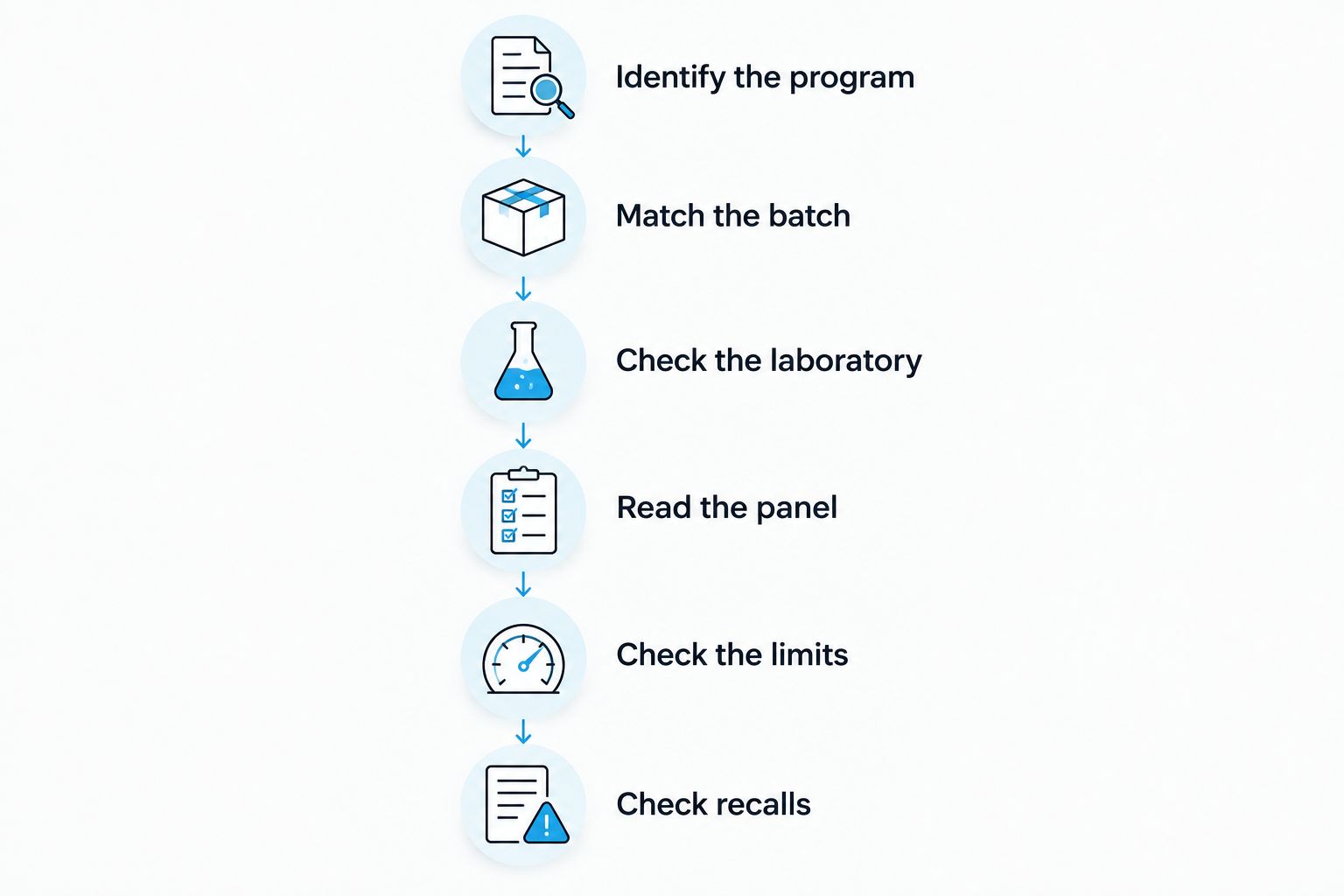
Use this sequence when reviewing cannabis testing requirements by state in 2026. It separates the legal scope of the report from the laboratory findings.
- Identify the program. Determine whether the package belongs to a state-licensed cannabis program or a separate hemp-derived product framework. Do not infer this from the words THC, THCA, or hemp alone.
- Match the batch. Compare the package’s lot or batch information with the laboratory report. A brand-level report without a matching batch does not resolve the package-level question.
- Check the laboratory. Use the relevant regulator’s laboratory licensing or certification information. Accreditation and state authorization are distinct checks; one does not automatically establish the other.
- Read the panel. Identify every reported analysis and distinguish a contaminant screen from cannabinoid potency testing.
- Check the limits. Compare results with the requirements for that jurisdiction and matrix. Keep the units and reporting limits attached to each result.
- Check recalls. Search the appropriate regulator’s current notices even when the report shows a passing result. Follow the instructions for the matching product and batch.
The strongest review connects all these elements. A laboratory name, QR code, or passing headline on its own leaves important questions unanswered.
Read units before comparing results
A result expressed in percent is not directly comparable with a contaminant result expressed in mass per mass. 1% by mass equals 10 mg/g. Likewise, 1 mg/kg equals 1 µg/g; those expressions describe the same mass ratio.
These are unit conversions, not acceptable contaminant limits or consumption recommendations. An actual regulatory limit must come from the applicable rule and must match the substance and product matrix.
Also distinguish not detected from not tested. Not detected refers to a method’s reporting capability; it does not mean absolute zero. Not tested means the report supplies no analytical finding for that substance.
Does a passing cannabis lab report mean the product is safe?
A passing cannabis lab report means the tested sample met the reported criteria; it does not prove universal safety. Sampling cannot establish the condition of every portion of a batch, and a laboratory panel does not measure every possible hazard. Health risks associated with cannabis also remain separate from contaminant results.
Do hemp-derived THCA products follow the same testing rules?
Hemp-derived THCA products do not automatically follow the same testing rules as state-licensed cannabis. USDA hemp production testing addresses crop compliance; it is not a universal finished-product contaminant-testing program. In 2026, check the applicable state’s finished-product rules separately rather than treating a hemp classification as a safety or legal guarantee.
Can a cannabis batch be recalled after passing testing?
A cannabis batch can be recalled after passing testing. Later findings, reporting problems, or other regulatory concerns can prompt action. A COA does not override a recall notice, so compare the notice’s identifiers with the package and follow the issuing authority’s instructions.
FAQ
Are cannabis testing requirements the same in every state?
No. States set separate requirements for sampling, contaminants, failure criteria, laboratory oversight, and failed-batch handling. Check the rules for the relevant program and product category.
Does a potency test include pesticide and heavy-metal testing?
A potency test does not by itself establish that pesticide or heavy-metal testing occurred. Read the individual panels and results rather than assuming that a cannabinoid result includes contaminant screening.
Can I compare passing lab reports from California and Washington?
You can compare their contents, but their passing labels are not automatically equivalent. Match the product matrices, tested substances, units, reporting limits, and applicable state criteria first.
Is an accredited cannabis laboratory automatically authorized in every state?
No. Laboratory accreditation does not automatically establish authorization under every state cannabis program. Check the relevant regulator’s current licensing or certification records.
Does not detected mean a cannabis product contains none of a contaminant?
No. Not detected means the substance was not reported as detected under the method’s applicable reporting conditions. It does not establish absolute absence, and it is different from not tested.
What should I do if my cannabis batch is recalled?
Stop using the affected product and follow the issuing authority’s recall instructions. Keep it secured away from children and pets while checking the specified return or disposal procedure; do not give it to someone else.
Where should I verify cannabis testing rules in 2026?
Verify requirements with the regulator responsible for the relevant state program, using current regulations, incorporated testing protocols, and official notices. Dubcharge’s cannabis testing guide explains the review process but does not replace those official requirements.
One last thing
A complete-looking report can still describe the wrong batch. Before comparing contaminant limits or reading a passing result, match the identifiers. That simple check determines whether the document is relevant to your package at all.
Dubcharge’s educational guidance does not turn a COA into a safety guarantee. If the identifiers do not match, do not treat the report as evidence about that package. Keep any questionable or recalled material secured away from children and pets, and follow the relevant authority’s handling instructions.



Leave a comment
This site is protected by hCaptcha and the hCaptcha Privacy Policy and Terms of Service apply.