







You cannot reliably identify cannabis contamination by sight or smell alone. Visible growth, foreign material, or an unusual odor are reasons to stop using a product, but a normal appearance and familiar smell do not establish safety. Laboratory testing and batch-specific recall checks provide evidence your senses cannot supply, although neither guarantees that a product is harmless.
- Dubcharge’s cannabis contamination guide is for adults checking warning signs, laboratory evidence, and recall information—not selecting products.
- You cannot reliably identify cannabis contamination by sight or smell; pesticides, metals, and microbial hazards require appropriate testing.
- A passing certificate of analysis covers the reported sample and tests, not every possible hazard.
- Stop using a suspicious product, secure it away from children, and check official recall instructions.
Why this matters
Looking normal is not the same as testing negative for contaminants. A product can have no obvious defect while containing substances that require laboratory methods to detect. Conversely, an unfamiliar appearance does not identify a particular contaminant or prove its concentration.
For adults assessing cannabis in 2026, the useful distinction is between a warning sign and evidence. A warning sign tells you to stop and investigate; evidence helps establish what was tested, what was detected, and whether your package belongs to the affected batch.
Dubcharge’s guide to how to read a cannabis lab report explains the document behind those checks. A cannabinoid percentage alone does not answer a contamination question.
Can you identify cannabis contamination by sight or smell?
No. Sight and smell can reveal some reasons for concern, but they cannot reliably identify cannabis contamination or rule it out. Different hazards require different analytical methods, and a sensory inspection cannot measure exposure.
| Check | What it can tell you | What it cannot establish |
|---|---|---|
| Visual inspection | There is visible growth, debris, leakage, or package damage | The identity or amount of an unseen contaminant |
| Odor | Something smells unusual or has changed | Whether pesticides, metals, microbes, or other contaminants are absent |
| Batch-matched laboratory report | Results for the listed sample, substances, and methods | That every package is identical or every possible hazard was tested |
| Official recall notice | Whether a named product or batch is subject to action | That an unlisted product is safe |
These checks serve different purposes. Use your senses to recognize a reason to stop—not to approve a product for use. A laboratory report supplies narrower, test-specific evidence rather than a universal safety certificate.
What does suspicious growth actually tell you?
Fuzzy, web-like, or spreading material is a reason to stop using the product. It is not a reliable home diagnosis of a particular fungus, and photographs cannot establish whether toxins are present.
Cannabis flower also has natural surface structures, including resin-producing trichomes. Distinguishing those structures from contamination through a photograph is not equivalent to microbial testing. Do not treat a visual comparison chart as permission to use something questionable.
What does an unusual smell actually tell you?
A musty or otherwise unexpected odor warrants caution, but odor alone does not identify the cause. Cannabis aroma varies naturally, which further limits smell as a diagnostic check.
Do not deliberately inhale closely from a suspicious package to investigate. CDC mold guidance advises against sniffing moldy items; closer smelling is not a substitute for testing.
Why contamination checks vary
The reliability of a contamination assessment depends on what you are checking and which evidence is available. These factors explain why a single photograph, odor description, or laboratory summary cannot settle every case:
- Hazard type: Microorganisms, pesticides, metals, and residual solvents are different testing questions. A result for one category does not answer another.
- Product form: Flower, extracts, and finished formulations have different physical properties. An appearance rule for dried plant material does not automatically apply to an oil.
- Sampling: A laboratory examines submitted samples, not every portion of every package. Sampling affects how confidently results describe a batch.
- Test scope: A report answers questions about its listed analytes. An unlisted substance is not automatically absent.
- Storage and handling: Moisture exposure, damaged packaging, and other changes after sampling can affect a product’s condition.
- Jurisdiction: Required panels, action limits, and recall systems differ across U.S. regulatory programs. A pass designation must be read within its applicable rules.
For a 2026 assessment, establish which jurisdiction governs the product before interpreting a compliance claim. Do not assume rules for a state-regulated cannabis program apply unchanged to every hemp-labeled product.
What should you check on a laboratory report?
Start with identity, not the largest percentage on the page. Match the product description and batch or lot identifier to the package, then examine the testing scope and individual results.
A certificate of analysis, often called a COA, is evidence about a sample. Its usefulness depends on whether it is authentic, relevant to your package, and sufficiently detailed for the question you are asking.
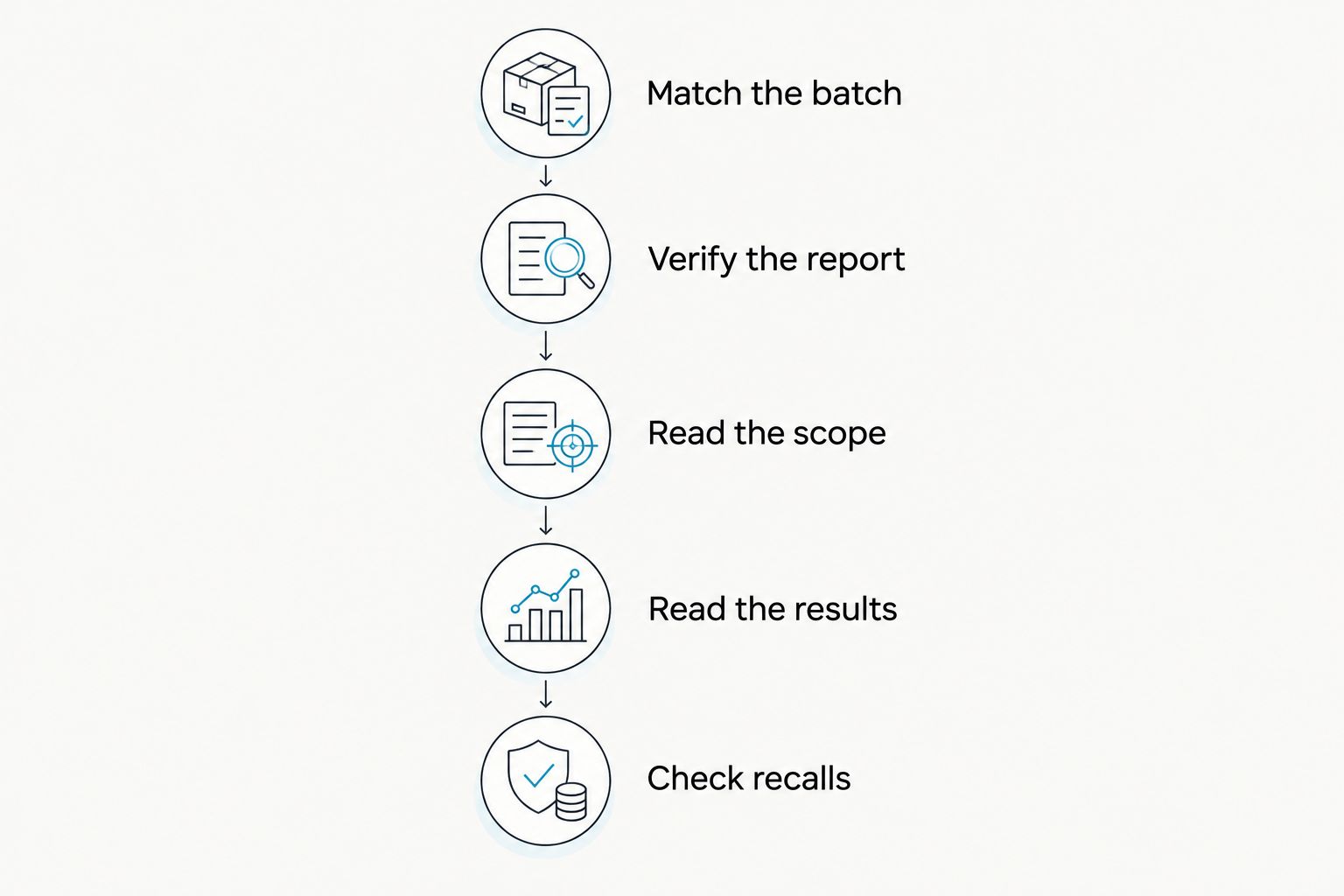
- Match the batch. Compare the package’s lot or batch identifier with the report. A report for a different batch does not establish your package’s results.
- Verify the report. Use the laboratory’s own verification process where available. A QR code or uploaded document alone does not prove authenticity.
- Read the scope. Look for the contaminant categories and named substances actually tested. Potency testing and contaminant testing are not interchangeable.
- Read the results. Check units, reporting limits, and the meaning of abbreviations. A pass label without supporting detail leaves important questions unanswered.
- Check recalls. Compare the package identifiers with official notices, including any instructions that supersede an earlier report.
A potency result is not a contamination clearance. A document reporting THC or THCA content does not, by itself, demonstrate testing for pesticides, metals, microbes, or residual solvents.
“Not detected” also needs context. It generally means the substance was not detected under the stated method and reporting conditions—not that the laboratory proved absolute zero. Read the report’s definitions rather than assigning a meaning to an abbreviation yourself.
Does a passing lab report mean cannabis is safe?
No. A passing lab report means the reported sample met the criteria applied to the listed tests; it does not prove that cannabis is safe for every person or use.
There are separate questions here: contamination, accuracy of labeling, and the health effects of cannabis itself. Passing a contaminant panel does not remove intoxication, impairment, medication-interaction, or inhalation risks.
FDA’s Cannabis and Cannabis-Derived Compounds: Quality Considerations for Clinical Research addresses quality considerations such as contaminants in its clinical-research context. It is not a consumer certification of individual retail products. CDC cannabis guidance separately describes health risks associated with cannabis use.
When reading a report in 2026, keep those boundaries intact. “Passed the listed tests” is a defensible description; “proven safe” is not.
What should you do if contamination is suspected?
Stop using the product. Do not taste it, burn a sample, or take another inhalation to decide whether the concern is real. A trial exposure does not identify a contaminant and can create an additional exposure.
Keep the product in its original packaging when practical, secure it away from children and animals, and record the identifiers before following return or disposal instructions. Avoid unnecessary handling of leaking material or visibly suspicious growth.
- Preserve the details. Photograph the package, batch identifier, laboratory reference, and visible concern without opening or disturbing the contents further.
- Check official notices. Use the responsible state regulator or other relevant public agency, not social-media reposts alone.
- Follow the notice. A recall can specify return, reporting, or disposal steps. Do not improvise a salvage method.
- Report the concern. Give the relevant regulator or seller the package identifiers and a factual description. Do not label a contaminant as confirmed without evidence.
- Seek health advice when needed. Tell the clinician or poison specialist what product was involved and whether there was ingestion, inhalation, or skin contact.
Dubcharge’s educational resource on checking official cannabis recall notices covers the information to compare. A familiar brand name is not enough: the affected identifiers matter.
Do not attempt to make suspect cannabis acceptable by removing a visible patch, washing it, heating it, or transferring it into another product. Those actions do not establish that contaminants have been removed.
What if someone feels sick after exposure?
Symptoms do not reliably reveal which contaminant, if any, was involved. Cannabis effects, another exposure, an underlying condition, or contamination can require different clinical assessments; do not diagnose the cause from smell or appearance.
In the United States, contact Poison Control at 1-800-222-1222 for exposure guidance. Call 911 if someone collapses, has a seizure, has trouble breathing, or cannot be awakened, consistent with Poison Control’s emergency instructions.
Provide the packaging and any available report to the treating team. Do not delay urgent care while trying to locate a certificate or identify a batch online.
CDC identifies people with weakened immune systems and people with lung disease as groups at greater risk from certain mold-related illnesses. A person in either group should discuss a suspected mold exposure with a clinician rather than relying on home inspection.
How should you store or dispose of a suspect product?
Secure a suspect product so another person cannot mistake it for something usable. Keep it away from food, children, and animals, and do not move it into an ordinary food container.
Follow the recall’s instructions first. If no instructions are available, ask the relevant local waste authority about the material involved; cannabis waste rules and collection options depend on location.
A cannabis device containing a lithium-ion battery creates a separate disposal issue. EPA guidance says lithium-ion batteries and devices containing them should not go into household garbage or ordinary recycling bins because of fire risk. Do not puncture, dismantle, or drain a device to separate its contents.
For disposal decisions in 2026, verify the current local collection instructions instead of assuming all cannabis products belong in the same waste stream. Keep a record of the product identifiers before disposal if an exposure or complaint needs investigation.
FAQ
Can I identify cannabis contamination if it smells normal?
No. A normal smell does not rule out cannabis contamination because odor cannot reliably detect pesticides, metals, or microbial hazards. Use batch-specific testing and official recall information rather than aroma as a clearance check.
Does white material on cannabis always mean mold?
No. White-looking material cannot be reliably identified from color alone, and cannabis has natural surface structures. Stop using a questionable product rather than treating a photograph or home comparison as a diagnosis.
Can I tell whether cannabis contains pesticides by looking at it?
No. Visual inspection cannot reliably establish whether cannabis contains pesticide residues. Appropriate laboratory testing is needed to assess the specific pesticides included in a test panel.
Does a QR code prove that a cannabis lab report is genuine?
No. A QR code is only a route to information, not proof of authenticity or batch relevance. Verify the report through the laboratory where possible and match its identifiers to the package.
Can heating cannabis remove contamination?
Heating is not a reliable way to make suspect cannabis safe. It does not establish that chemical contaminants or microbial toxins have been removed, so do not use heating as a salvage method.
Is cannabis safe if there is no recall for it?
No recall listing does not establish safety. A recall system identifies known actions, not every possible defect, so an unusual condition still warrants stopping use and investigating.
What should I do if a child swallows a suspected contaminated cannabis product?
In the United States, contact Poison Control at 1-800-222-1222 immediately for guidance. Call 911 if the child has trouble breathing, has a seizure, collapses, or cannot be awakened; do not wait to identify a contaminant.
One last thing
Save the batch identifier before discarding the packaging. An appearance description cannot connect your product to a recall as precisely as a matching lot number can.
The practical lesson from Dubcharge’s cannabis contamination education is simple: a warning sign can justify stopping, but an absence of warning signs cannot certify safety. For any 2026 investigation, keep sensory observations, laboratory findings, and medical advice separate—they answer different questions.


Leave a comment
This site is protected by hCaptcha and the hCaptcha Privacy Policy and Terms of Service apply.