















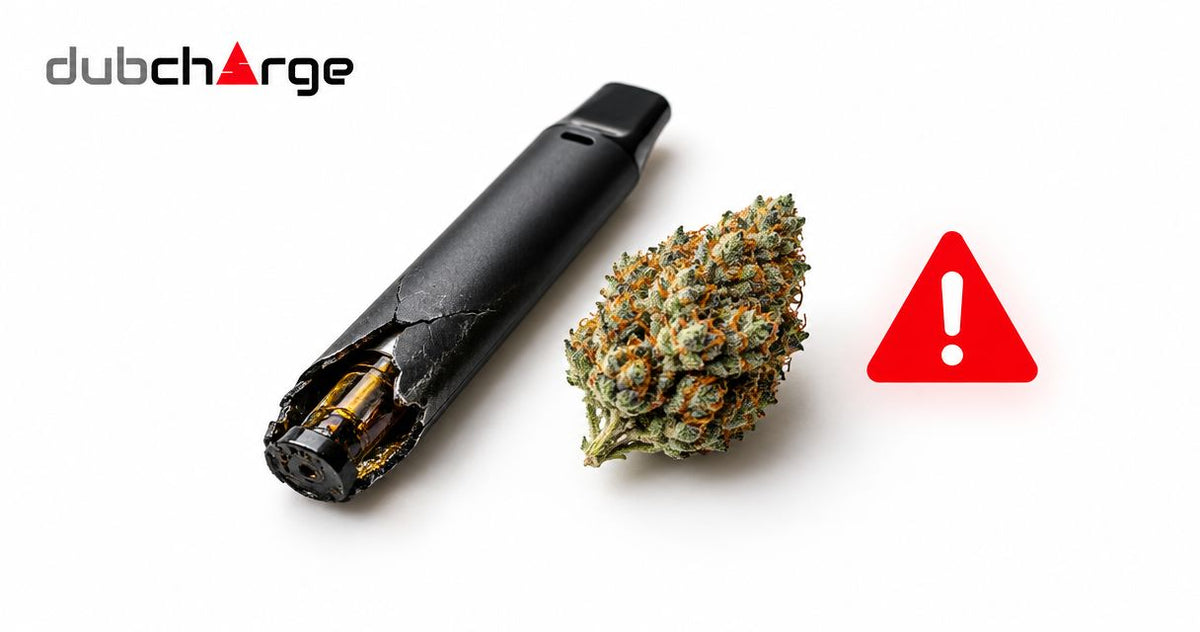
Stop using a cannabis vape immediately if it has cracked glass, leaking contents, a swollen or damaged casing, unusual heat, smoke, sparks, or unexpected activation. For damaged cannabis vape safety in 2026, stop charging as well as inhaling: a device that still produces aerosol can still present a fire, exposure, or injury risk.
- Damaged cannabis vape safety starts with stopping use and charging when damage or abnormal behavior appears.
- DubCharge’s cannabis lab report guide explains testing; a passing report does not establish damaged-device safety.
- Smoke, sparks, swelling, or rapidly increasing heat require distance, not troubleshooting.
- Seek medical help for breathing problems, chest pain, burns, or exposure to leaking contents.
When should you stop using a damaged cannabis vape?
Stop at the first sign of structural damage, leaking contents, or abnormal electrical behavior. Do not take another inhalation to check whether the problem has cleared. A successful activation is not a safety test.
| Warning sign | What it tells you | What to do |
|---|---|---|
| Cracked glass or broken mouthpiece | The part contacting your mouth or containing liquid is damaged | Stop using it; avoid broken edges and leaked contents |
| Leaking liquid | Contents have escaped their intended container | Avoid contact; keep children and pets away |
| Swollen, split, or crushed casing | The enclosure or battery could be damaged | Stop use and charging; do not squeeze or open it |
| Unusual heat, smoke, sparks, or hissing | A potentially dangerous battery failure needs urgent attention | Move away; call emergency services for fire or immediate danger |
| Activation without intentional use | The device is not operating as intended | Stop using and charging it; do not test it again |
| Water intrusion or substantial impact | Internal damage is possible even without a visible crack | Stop use pending manufacturer safety guidance |
The DubCharge guide to reading a cannabis lab report explains a separate issue: interpreting testing information. Neither a laboratory result nor an intact-looking label clears damaged hardware for use.
Why this matters
A damaged cannabis vape presents more than an inhalation question. Broken glass can injure your mouth, leaking contents can expose skin or eyes, and a damaged lithium-ion battery can create a fire hazard.
These risks require different responses. Medical symptoms need clinical assessment; an unstable battery needs distance and emergency attention when necessary. Neither problem is resolved by changing a setting or cleaning the device.
For U.S. adults reading in 2026, the relevant authorities also have different roles. Poison Control handles exposure questions, emergency services respond to immediate danger, and local waste authorities determine how a damaged battery-containing device can be accepted.
What should you do immediately after noticing damage?
Stop use first, then decide whether there is an immediate emergency. Do not handle a smoking or rapidly heating device to retrieve a label, protect furniture, or take a photograph.
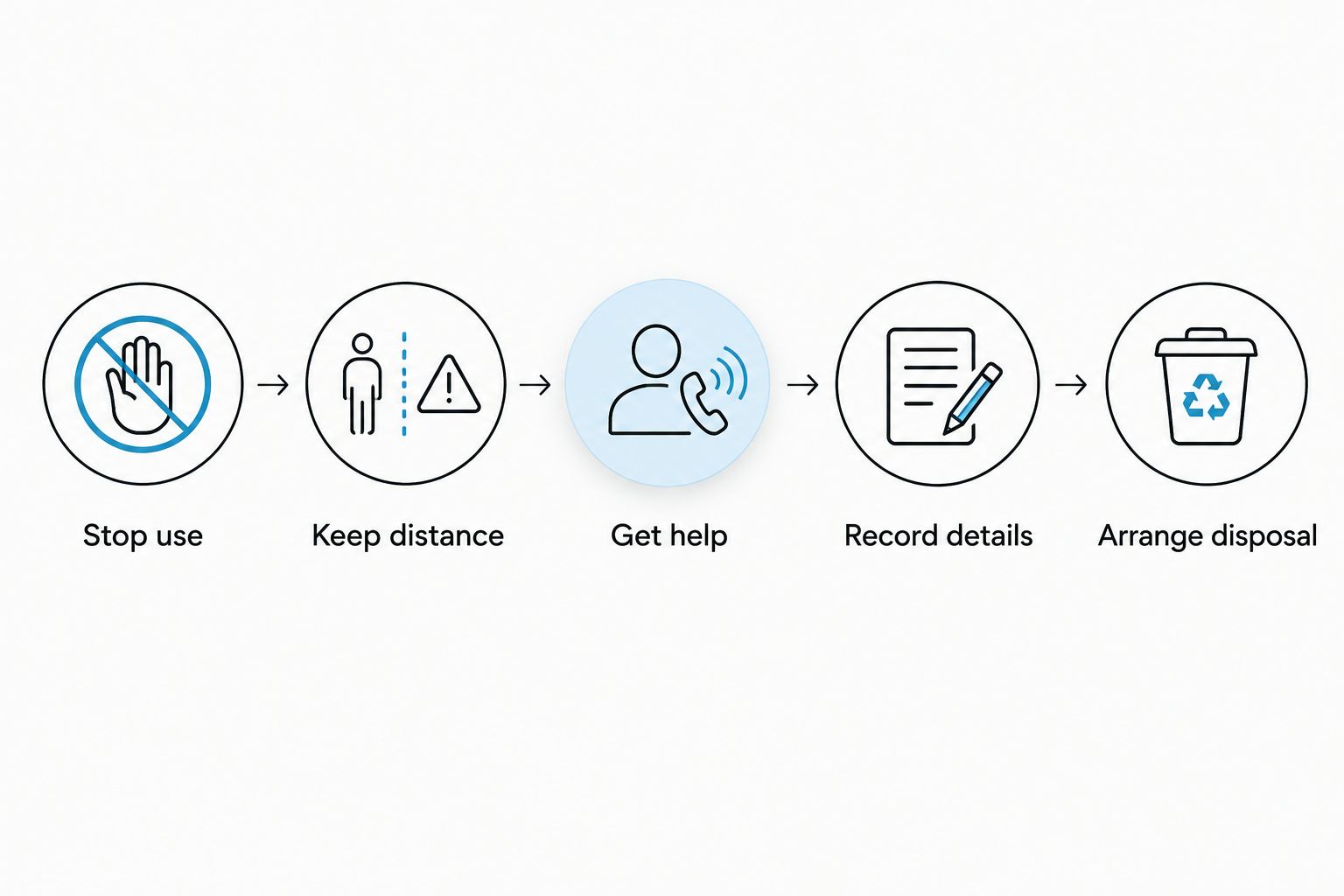
- Stop use. Do not inhale from, activate, or recharge the device. Do not attempt to finish its contents.
- Keep distance. If it is smoking, sparking, hissing, swelling, or becoming rapidly hotter, move away and keep others away. Do not carry it through your home.
- Get help. Call 911 for fire, immediate danger, severe breathing difficulty, collapse, or another medical emergency. Disconnect electricity at the wall only if you can do so safely without approaching the failing device.
- Record details. Once there is no immediate danger, keep the packaging and note the product name, lot number, incident, and symptoms. Photograph damage only when doing so is safe.
- Arrange disposal. Contact your local household hazardous waste program and explain that the item contains a potentially damaged lithium-ion battery and cannabis residue.
Do not open the casing, puncture the battery, transfer the liquid, or try to repair the heating components. Those actions introduce additional exposure and injury risks without establishing safety.
A stopped device is not necessarily a stable device. Continue to keep people away if heat, smoke, swelling, or unusual noises persist, and follow emergency responders’ instructions.
Why the risk varies between damaged devices
There is no reliable home inspection that assigns a damaged cannabis vape a safe number of remaining uses. The significance of damage depends on what failed and whether there has been an exposure.
- Battery damage: Crushing, puncture, swelling, and water intrusion raise concerns about internal electrical damage.
- Broken containment: A cracked reservoir or failed seal creates an exposure route that an intact container does not have.
- Abnormal operation: Unexpected activation or unusual heat indicates a problem beyond appearance alone.
- Unknown contents: A label or visual inspection cannot identify every substance in escaped liquid or aerosol.
- Exposure route: Eye contact, swallowing, skin contact, and inhalation require different medical advice.
- Individual vulnerability: Children and pets need particular protection from access to cannabis contents and damaged components.
A small exterior scratch is not the same finding as a swollen casing. However, if you cannot distinguish surface wear from a crack, do not resolve that uncertainty by using or charging the device.
Can you keep using a vape if it only leaks a little?
Stop using a leaking cannabis vape, even if the amount looks small. Appearance does not establish what escaped, whether the container remains intact, or whether liquid reached electrical components.
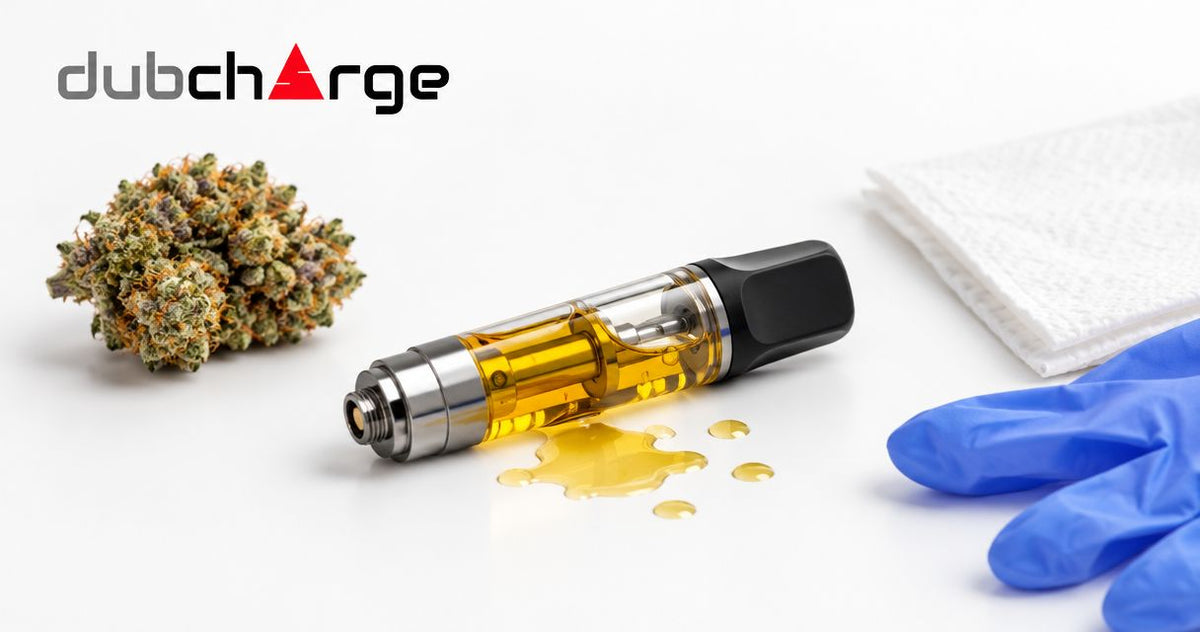
Do not taste the liquid or deliberately smell it at close range. Avoid touching it with bare hands, and keep contaminated items away from children and pets. Do not transfer escaped liquid into another device or container for later consumption.
If liquid contacts your skin, remove contaminated clothing and wash the affected skin with running water and soap. For eye exposure, Poison Control’s general first-aid guidance calls for immediate irrigation with room-temperature running water for 15–20 minutes; remove contact lenses if possible and seek exposure-specific advice.
The U.S. Poison Control number is 1-800-222-1222. Have the packaging available if safe, but do not delay getting help while searching for product information.
Is a damaged vape safe if it still works?
A damaged vape is not proven safe because it still activates or produces aerosol. Functioning hardware can still have a cracked reservoir, compromised insulation, or internal damage that you cannot see.
Do not use repeated activation as a diagnostic test. Likewise, cooling down after an overheating incident does not establish that the underlying fault has disappeared.
Contact the manufacturer for safety and disposal guidance using independently verified contact information. An explanation of expected behavior is not a substitute for medical advice after an exposure or emergency assistance during a battery failure.
Which symptoms need medical attention?
Call 911 for severe trouble breathing, collapse, a seizure, or someone who cannot be awakened. Chest pain, significant burns, or rapidly worsening symptoms also require urgent medical assessment.
Stop exposure and seek prompt medical advice for persistent cough, shortness of breath, chest discomfort, vomiting, dizziness, or irritation after using a damaged cannabis vape. These symptoms do not identify a single cause. Tell the clinician what you used, when symptoms started, and whether the device leaked, overheated, or broke.
For suspected swallowing or contact with leaked contents, call U.S. Poison Control at 1-800-222-1222. Do not induce vomiting unless a medical professional specifically directs you to do so.
For a pet exposure, contact a veterinarian or emergency veterinary service immediately. Keep the product packaging available without bringing an unstable device into a clinic or vehicle.
Does a passing cannabis lab report make damaged hardware safe?
No. A certificate of analysis describes testing of a sample, not the safety of a damaged device after purchase. Its usefulness depends on the sample identity, batch match, methods, reporting limits, and substances actually tested.
A report cannot establish that a later crack introduced no fragments, that a battery remained undamaged after an impact, or that leaking contents stayed uncontaminated. “Pass” also refers to the report’s specified criteria; it is not a universal declaration of safety.
When reviewing cannabis testing information in 2026, separate three questions:
- Does the report correspond to the product and lot you have?
- What did the laboratory actually test and report?
- What happened to the device after that sample was collected?
The first two questions help interpret the document. They do not answer the third. Do not use a lab report to overrule visible damage, abnormal heat, or symptoms.
How should you check a recall or report an incident?
Start with the product name, manufacturer, lot or batch identifier, and any other identifiers printed on the packaging. Compare those details with official notices rather than relying on a matching photograph alone.
For U.S. recall checks in 2026, consult the relevant state cannabis regulator and the manufacturer’s official safety notices. Federal agencies also publish recalls within their authority; no single list should be treated as a complete clearance of every cannabis product or device.
If a notice applies, stop use and follow its instructions. Do not mail a damaged battery or return it in person without confirming safe handling requirements with the recipient.
Report medical problems to your clinician and the relevant regulator. FDA MedWatch accepts reports involving problems with cannabis and cannabis-derived products; submitting a report does not establish the cause of an injury. Describe what happened without guessing which component or ingredient was responsible.
How should you store and dispose of a damaged cannabis vape?
An actively failing device needs emergency handling, not ordinary storage. Do not put a hot, smoking, or swollen device into a drawer, pocket, bag, or sealed improvised container.
For a damaged device that is cool and not showing active failure, seek instructions from your local household hazardous waste program. Explain both the battery damage and the cannabis residue before transporting it. Do not dismantle an integrated device to separate those materials yourself.
EPA guidance for U.S. lithium-ion battery disposal says these batteries and devices containing them do not belong in household trash or municipal recycling bins. Damaged batteries need special handling; a routine retail battery collection box is not automatically an appropriate destination.
Disposal acceptance rules remain local in 2026. Ask the receiving program how to package and transport the item, and do not assume that an ordinary shipping service accepts it. While awaiting instructions, prevent access by children and pets without handling an unstable device.
FAQ
When should I stop using a damaged cannabis vape?
Stop immediately for cracks, leaks, swelling, unusual heat, smoke, sparks, or unexpected activation. Stop charging too, and do not take another inhalation to test it.
Can I use a cannabis vape after dropping it?
Do not use or charge it if the drop caused damage, leaking, abnormal operation, or uncertainty about its condition. A visual check cannot rule out internal battery damage after a substantial impact.
Is it safe to use a cracked cartridge if it does not leak?
Do not use a cracked cartridge, even without a visible leak. The container is damaged, and the absence of visible leakage does not establish safety.
Does a burnt taste prove my cannabis vape is contaminated?
No, taste cannot identify contamination or establish its cause. Stop using a device with an unexpected burnt taste rather than repeatedly inhaling to investigate.
What should I do if cannabis vape liquid gets in my eye?
Immediately rinse the eye with room-temperature running water for 15–20 minutes and contact Poison Control for individual advice. Remove contact lenses if possible; seek urgent care for serious or persistent symptoms.
Can I throw a damaged disposable cannabis vape in the trash?
Do not put a lithium-ion battery-containing vape in household trash or municipal recycling. Contact your local household hazardous waste program and disclose the damage and cannabis residue.
Does an intact label or passing lab report mean a damaged vape is safe?
No, neither establishes the safety of damaged hardware. Laboratory testing concerns the tested sample and cannot rule out damage or contamination occurring afterward.
One last thing
A photograph of the packaging can be more useful than keeping the damaged device nearby. When safe, record the lot identifier and incident details before arranging disposal. Never delay medical care or approach a failing battery to collect evidence.


Leave a comment
This site is protected by hCaptcha and the hCaptcha Privacy Policy and Terms of Service apply.