


















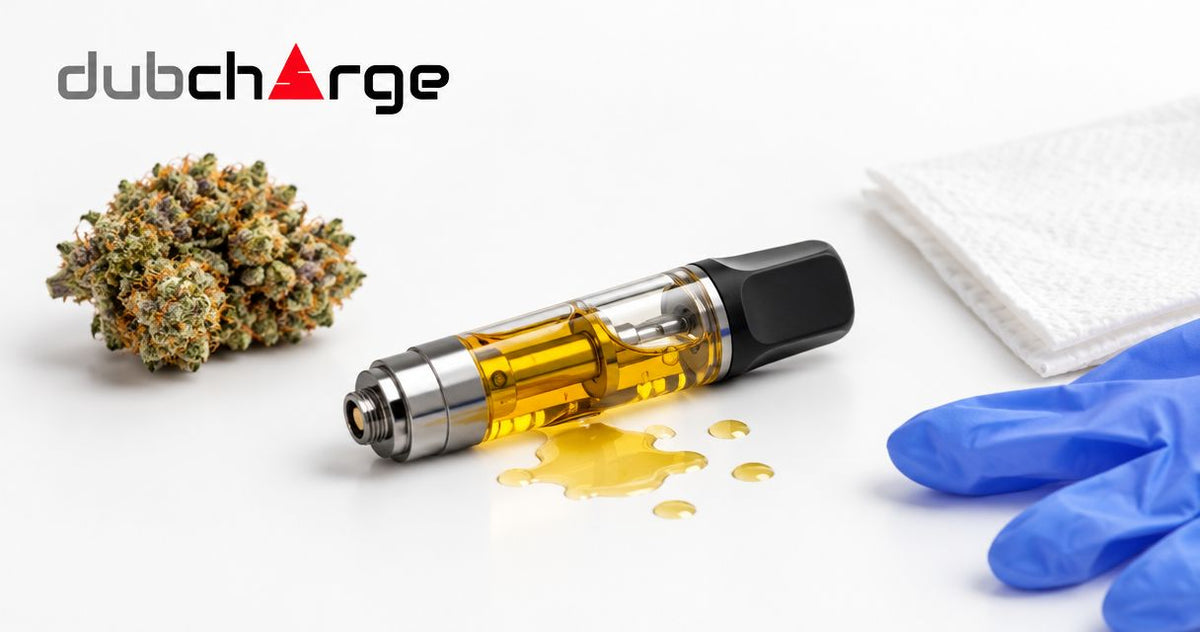
Stop using a leaking cannabis vape, avoid contact with the liquid, and keep children and pets away. Rinse exposed skin or eyes promptly, contact Poison Control for a suspected exposure, and call 911 if someone collapses, has a seizure, struggles to breathe, or cannot be awakened. Do not recharge, test, or repair the leaking device; a hot, swollen, hissing, or smoking battery requires a separate emergency response.
- Leaking cannabis vape exposure safety starts with stopping use, preventing contact, and checking for urgent symptoms.
- U.S. Poison Control provides exposure guidance at 1-800-222-1222; call 911 for life-threatening symptoms.
- Rinse exposed eyes immediately for 15–20 minutes; do not delay irrigation while looking for product information.
- Dubcharge’s cannabis education explains health risks; a passing lab report does not establish that a leaking device is safe.
How should you handle a leaking cannabis vape safely?
Treat leaked liquid as a potential exposure, not a device-maintenance problem. Protect the person first, then address the spill and damaged device. Do not take another puff to check whether the leak has stopped.
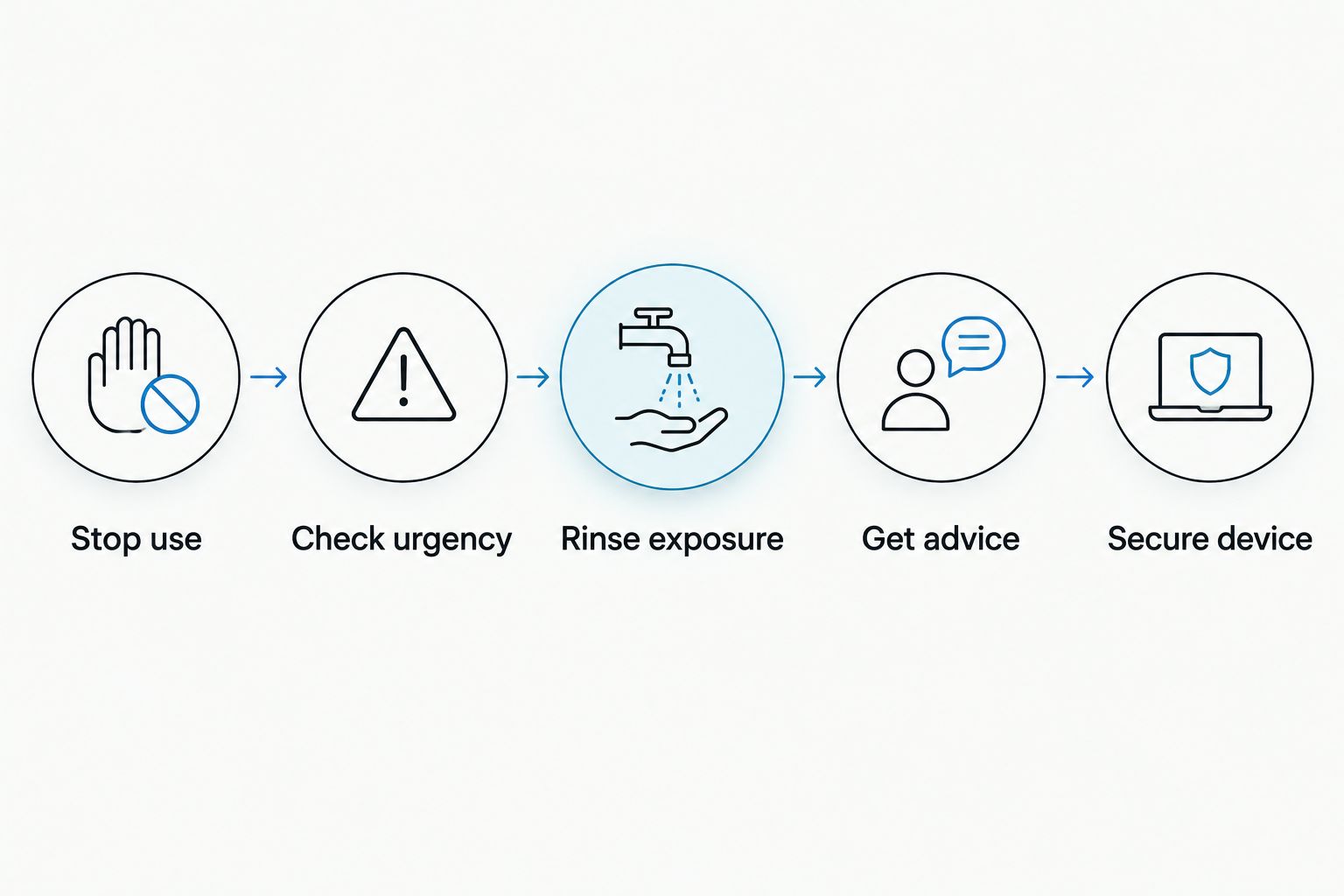
- Stop use. Stop using and charging the device. Do not open the housing, transfer the liquid, or attempt to clear the leak with heat.
- Check urgency. Look for breathing difficulty, collapse, seizure, or inability to wake. Call 911 for these symptoms rather than waiting for advice online.
- Rinse exposure. Begin appropriate skin or eye rinsing immediately. Avoid spreading liquid from your hands to your face, phone, or other surfaces.
- Get advice. In the United States, call Poison Control at 1-800-222-1222 for individualized exposure guidance. Help is available 24 hours a day.
- Secure device. If the device is cool and stable, prevent access while arranging disposal guidance. If it is hot, swelling, hissing, or smoking, move away and contact emergency services.
Dubcharge’s guide to health risks of cannabis vaping provides broader context. For an active exposure, a poison specialist or emergency clinician takes priority over an article.
Why this matters
A leak creates several distinct problems: contact with the contents, accidental swallowing, contamination of nearby surfaces, and possible damage to a battery-powered device. A label cannot tell you how much liquid reached someone’s eyes or mouth. The response depends on the exposure route and symptoms, not just the product name.
For U.S. readers in 2026, Poison Control is the appropriate starting point for a suspected poisoning without life-threatening symptoms. Do not wait for symptoms after a child swallows or mouths leaked liquid. Cannabis poisoning can cause serious effects in children, including severe sleepiness and breathing problems.
What should you do for each type of exposure?
The following first-aid measures follow general U.S. Poison Control guidance for swallowed, inhaled, skin, and eye exposures. They are not evidence that every cannabis formulation behaves identically. Start first aid promptly, then obtain advice specific to the person and product.
| Exposure or warning sign | Immediate response | Important limit |
|---|---|---|
| Liquid on skin | Remove contaminated clothing and rinse skin with running water for at least 15 minutes; mild soap can help remove material | Do not use solvents or harsh cleaners on skin |
| Liquid in an eye | Irrigate immediately with room-temperature running water for 15–20 minutes; remove contact lenses if possible | Do not delay rinsing to identify ingredients |
| Liquid swallowed | Contact Poison Control promptly; do not induce vomiting | Do not assume a small-looking amount is harmless |
| Symptoms after inhalation | Stop exposure and move to fresh air if safe | Breathing difficulty requires urgent medical attention |
| Collapse, seizure, or inability to wake | Call 911 immediately | Do not give anything by mouth to an unconscious person |
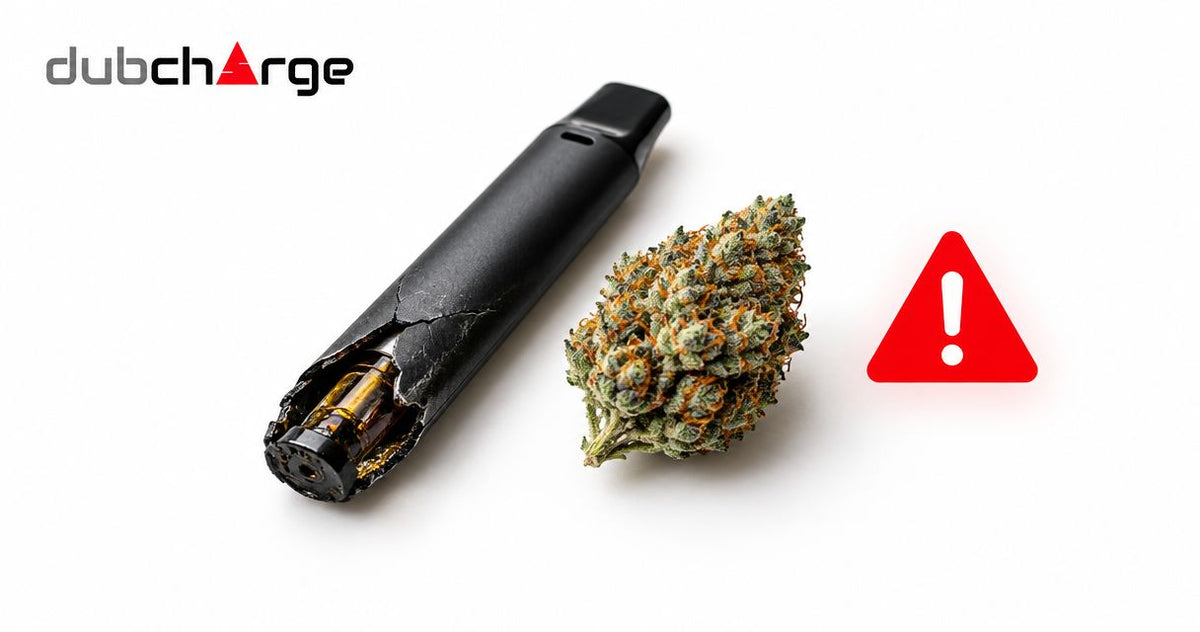
| Hot, swollen, hissing, or smoking device | Move away and contact emergency services | Do not handle, charge, or carry it through the building |
What if cannabis vape liquid gets on your skin?
Rinse exposed skin with running water for at least 15 minutes. Remove contaminated clothing without spreading liquid to unaffected skin. Mild soap can help remove sticky material; do not scrub aggressively or use alcohol, acetone, or other solvents.
A brief skin contact is not the same exposure as swallowing the contents, but that distinction does not establish safety. Contact Poison Control if symptoms develop, irritation persists, the exposed area is extensive, or you are uncertain what the liquid contains. Prevent hand-to-mouth transfer while cleaning up.
What if cannabis vape liquid gets in your eye?
Rinse the eye immediately for 15–20 minutes with room-temperature running water. Encourage blinking and use a gentle flow rather than a forceful stream. Remove contact lenses if possible, but do not postpone irrigation while struggling with them.
Do not add soap, cleaning products, or substances intended to neutralize the liquid. After rinsing, contact Poison Control for the next step. Severe pain, vision changes, or persistent symptoms require urgent medical assessment.
What if someone swallows leaked liquid?
Call Poison Control promptly and do not induce vomiting. Do not give food, drink, or home remedies to someone who is drowsy, seizing, or unable to swallow normally. Follow the specialist’s directions rather than trying to calculate a safe amount from the package.
Tell the specialist whether the person swallowed liquid, mouthed the device, or had an uncertain exposure. In children, do not use the absence of immediate symptoms as a reason to wait. If the person becomes difficult to wake or has trouble breathing, call 911.
Why the response varies
There is no single home checklist that establishes whether an exposed person is safe. These factors change the assessment:
- Exposure route: Skin contact, eye contact, inhalation, and swallowing require different first-aid measures.
- Person exposed: Age, body size, medical conditions, and other substances taken affect clinical assessment.
- Contents: A product name or flavor does not establish the full formulation or identify every possible contaminant.
- Amount and timing: Specialists need the estimated amount, when contact occurred, and whether exposure continued.
- Symptoms: Increasing sleepiness, vomiting, confusion, breathing changes, or eye pain change the urgency.
- Device condition: A stable leak and an overheating battery require different handling precautions.
For a 2026 exposure assessment, describe what happened rather than converting a label claim into an estimated absorbed dose. An uncertain amount is useful information; a guessed amount presented as fact is not.
How should you contain a small spill?
Only approach a small spill if the device is cool and stable and nobody needs immediate care. Keep children and animals out of the area. Wear disposable gloves to avoid direct contact, and avoid touching your face or other objects during cleanup.
Use disposable absorbent material to collect accessible liquid without opening or squeezing the device. Keep contaminated materials away from food, dishes, toys, and pet supplies. Clean the affected hard surface according to its care instructions, and never mix cleaning chemicals.
Do not vacuum broken glass or handle sharp fragments with bare hands. If the spill is extensive, involves an unknown substance, or cannot be contained without handling a damaged battery, stop and seek local hazardous-waste or emergency guidance. Wash your hands after removing gloves.
Containment limits further contact; it does not make the device safe to use again. Do not place a hot or reacting device in a bag or sealed container. Leave battery-fire management to emergency responders.
What should you tell Poison Control or a clinician?
Have the person’s age, approximate weight, symptoms, exposure time, and contact route ready. Read the package wording exactly, including listed cannabinoids and other ingredients. Say clearly when the amount or contents are unknown.
Keep the packaging or take photographs if that is safe. Record the brand, product name, lot or batch identifier, and any available laboratory report reference. Do not delay first aid to collect these details, and do not bring an actively overheating device into a vehicle or healthcare facility.
For a pet exposure, contact a veterinarian or an animal poison service promptly. Human Poison Control guidance does not replace veterinary assessment. Do not induce vomiting in an animal unless a veterinary professional directs you to do so.
Can a laboratory report prove the leaked liquid is safe?
No. A passing laboratory report does not prove that a leaking cannabis vape is safe. A certificate of analysis describes results for the sample and tests identified on that report. It does not measure the amount that reached a particular person or verify the condition of a damaged device.
Check whether the product’s batch identifier matches the report, which substances were tested, and what limits the report uses. “Not detected” is a laboratory result within a method’s detection capability, not proof that a substance is absent under every possible measurement.
In 2026, cannabis testing requirements remain jurisdiction-specific. Do not treat one state’s required panel as a national safety standard. A report also cannot explain every leak or exclude all risks from damaged hardware, storage conditions, or substances outside the testing panel.
How should you store and dispose of the leaking device?
If the device is cool and stable, keep it inaccessible to children and pets while obtaining disposal instructions. Maintain identification separately if needed for a complaint or recall check. Do not store leaking equipment near food or in an ordinary pocket or bag where others can touch it.
The U.S. Environmental Protection Agency advises that lithium-ion batteries and devices containing them do not belong in household trash or curbside recycling because they can cause fires. A cannabis-containing device also raises local waste-handling questions. Do not pour leaked liquid into a sink, toilet, or storm drain.
For disposal in 2026, contact your local household hazardous-waste program and describe both the battery and cannabis residue. Ask specifically whether the program accepts the intact device, contaminated absorbent materials, and damaged batteries. Acceptance rules differ; an ordinary electronics drop-off is not automatically appropriate.
Do not dismantle an integrated device to separate the battery. Do not mail a leaking device back without explicit instructions addressing hazardous contents and battery condition. If the device shows heat, swelling, smoke, or other signs of failure, seek emergency guidance instead of transporting it.
How do recalls and reports fit into the response?
Check the relevant state cannabis regulator for regulated cannabis recalls and safety notices. For products outside that system, reporting routes depend on the product and jurisdiction. Match the exact product and batch rather than assuming that similar packaging identifies a recalled item.
A recall search in 2026 is a follow-up step, not first aid. No matching notice does not establish safety. Preserve safe-to-keep documentation, report the leak accurately, and follow the regulator’s or manufacturer’s handling instructions without attempting repairs.
FAQ
What should I do first if my cannabis vape is leaking?
Stop using and charging it, prevent contact with the liquid, and check whether anyone was exposed. Begin skin or eye rinsing immediately when needed; call 911 for collapse, seizure, breathing difficulty, or inability to wake.
How long should I rinse my eye after cannabis vape liquid gets in it?
Rinse immediately with room-temperature running water for 15–20 minutes, following general Poison Control eye-exposure guidance. Remove contact lenses if possible without delaying irrigation, then obtain exposure-specific advice.
Who should I call in the United States after swallowing leaked cannabis liquid?
Call Poison Control at 1-800-222-1222 for individualized advice, available 24 hours a day. Do not induce vomiting; call 911 for life-threatening symptoms.
Is a small cannabis vape leak safe to keep using?
A small visible leak does not establish that the device is safe to use. Stop use and do not recharge, heat, open, or repair it to test whether the problem has cleared.
Does a passing cannabis lab report make a leaking vape safe?
No, a passing laboratory report does not establish the safety of a leaking device or an individual exposure. It reports findings for the identified sample and listed tests, not every possible hazard.
Can I put a leaking cannabis vape in household recycling?
Do not put a device containing a lithium-ion battery in household trash or curbside recycling. Contact your local household hazardous-waste program and disclose the cannabis residue and battery condition before bringing it in.
What should I do if a child or pet touches the leaked liquid?
Prevent further contact and obtain professional advice promptly. Contact Poison Control for a child and a veterinarian or animal poison service for a pet; call 911 if a person has life-threatening symptoms.
One last thing
Photograph the batch information, not just the front of the package. A recognizable product name helps identify the item, but batch details are more useful when checking a recall or connecting a report to the correct laboratory document. Take the photograph only after urgent exposure care and only when approaching the item is safe.
The guidance here uses U.S. Poison Control first-aid principles and EPA lithium-ion battery disposal guidance for general context in 2026. Neither source can establish the contents or condition of a particular leaking device without an individual assessment.


Leave a comment
This site is protected by hCaptcha and the hCaptcha Privacy Policy and Terms of Service apply.