




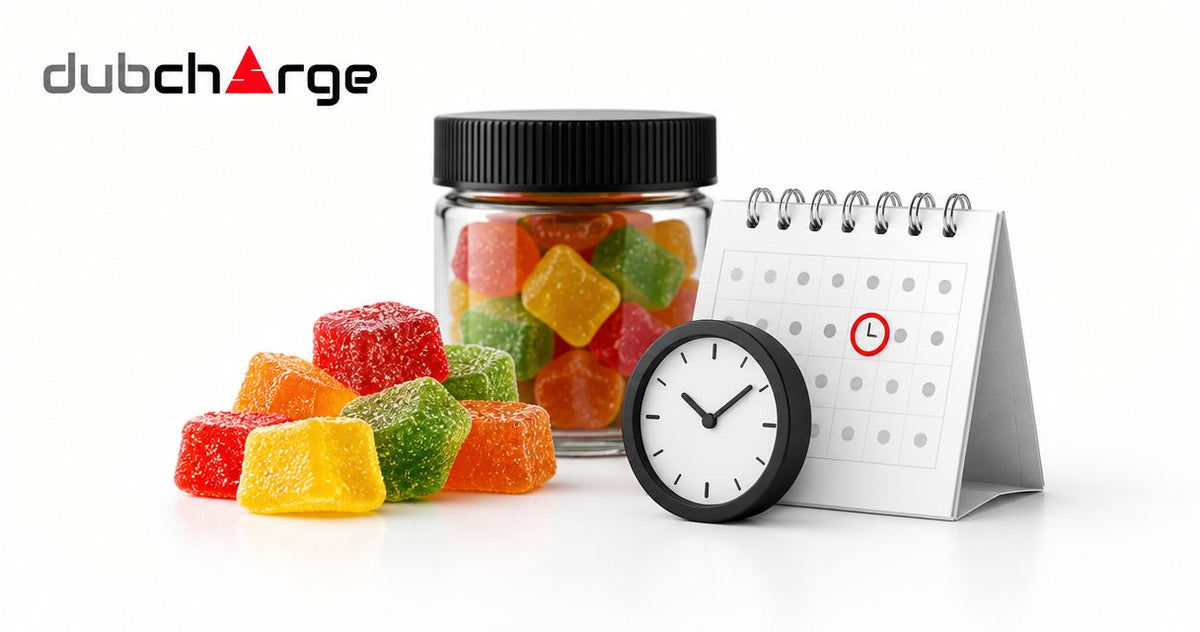
No. Cannabis edible expiration dates do not establish safety, and a future date does not rule out contamination, a recall, incorrect labeling, or unsafe storage. A date also does not establish that an edible is appropriate for a particular person or that its THC effects are predictable. In 2026, treat the date as one piece of product information—not permission to ignore other warning signs.
- Cannabis edible expiration safety depends on more than the printed date; recalls and storage conditions also matter.
- USDA distinguishes food quality dates from safety guarantees; cannabis labeling requirements vary by jurisdiction.
- A cannabis certificate of analysis describes tested samples, not every package or its later storage history.
- Do not taste a suspect edible to check safety; secure it away from children and pets.
Why this matters
An edible presents separate questions: whether the food has been handled safely, what the cannabinoid label establishes, and whether consuming it creates health risks. A printed date cannot answer all of them. Neither can a laboratory result viewed without its batch information and testing scope.
Dubcharge’s guide to reading a cannabis lab report is a relevant companion for adults checking what a certificate of analysis actually reports. A passing report is not a safety guarantee, and a recent report does not document what happened to a package afterward.
Do cannabis edible expiration dates establish safety?
No. The meaning of a date depends on its wording, the manufacturer’s instructions, the food formulation, and applicable labeling rules. USDA’s Food Product Dating guidance explains that common food date labels generally concern quality rather than establishing a universal safety cutoff; its guidance is not a cannabis-specific shelf-life standard.
| Package information | What it helps you assess | What it does not establish |
|---|---|---|
| Best-by or best-before date | The manufacturer’s stated quality window | Freedom from contamination or intoxication risk |
| Use-by or expiration date | The manufacturer’s stated endpoint and associated instructions | Safety despite a recall, damaged seal, or improper storage |
| Manufacture or package date | When a stated production or packaging event occurred | A validated shelf life by itself |
| Lot or batch identifier | Whether the package matches a report or recall | That every unit is identical to the tested sample |
| Storage instructions | Conditions the manufacturer directs you to maintain | That those conditions were maintained before you received it |
Do not substitute one field for another. A packaging date is not an expiration date, and a laboratory testing date is not a fresh shelf-life clock.
For a package you are assessing in 2026, read the actual wording rather than assuming that every date means the same thing. If the instructions are unclear, keep the edible unused while you request clarification from the manufacturer or relevant regulator.
What should you check besides the expiration date?
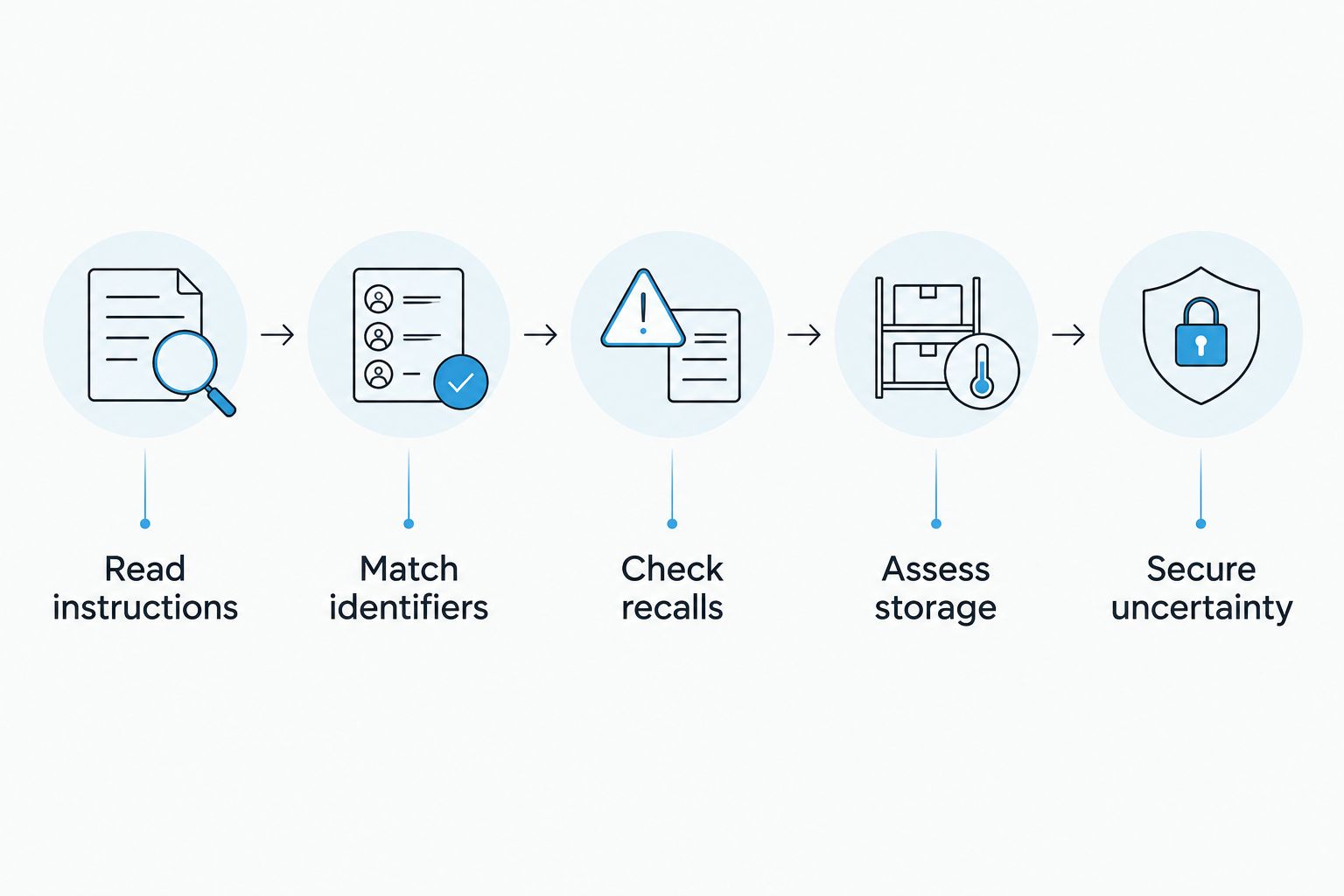
Use the following sequence before treating a package as suitable for use. These checks identify reasons to stop; completing them does not prove that an edible is risk-free.
- Read instructions. Identify the date wording, storage directions, ingredient list, allergen information, and any directions that apply after opening. An unopened shelf-life statement does not automatically describe an opened package.
- Match identifiers. Compare the product name and lot or batch identifier with any laboratory report or official notice. A report for a different batch does not establish results for your package.
- Check recalls. Look for notices from the relevant state cannabis regulator, state health department, or FDA, as applicable. Match the affected identifiers rather than relying on a similar product name or photograph.
- Assess storage. Consider whether the package required refrigeration, whether it spent time in heat, and whether its seal remained intact. Unknown storage history is not evidence of proper handling.
- Secure uncertainty. Keep recalled, damaged, or questionable products away from children, pets, and other adults who might mistake them for ordinary food. Follow official instructions before returning or disposing of them.
Keep the original packaging while checking a suspected problem. The lot code and manufacturer information can help a regulator or poison specialist identify the product; a loose edible without its label is harder to assess.
Why cannabis edible shelf life varies
There is no defensible expiration period that applies to every cannabis edible. The food itself and its handling matter alongside the cannabinoid ingredients.
- Food formulation: Moisture, acidity, and other formulation characteristics influence microbial growth. A date cannot be transferred between unrelated foods simply because both contain THC.
- Storage temperature: Refrigeration requirements remain relevant even when cannabis is an ingredient. An unexpired label does not cancel unsafe temperature exposure.
- Package integrity: Broken seals, punctures, leaks, or other damage undermine assumptions about protected storage. They require attention independently of the date.
- Opening and handling: Opening introduces handling conditions that differ from those of a sealed package. Follow any separate after-opening instructions.
- Testing scope: A potency result does not stand in for microbial, pesticide, or other contaminant testing. Each result answers a different question.
- Product-specific evidence: A shelf-life statement applies to the formulation, packaging, and conditions it describes. It is not evidence for another manufacturer’s product or a homemade edible.
Do not invent a shelf life when the label does not provide one. A familiar appearance or resemblance to an ordinary candy is not a substitute for product-specific information.
Does a passing laboratory report make an edible safe until expiration?
No. A certificate of analysis reports findings for the submitted sample under the methods and reporting limits shown. It does not continuously monitor the package in your possession.
Check whether the report matches the batch, identifies the laboratory, lists the test dates, and shows which analyses were performed. A cannabinoid panel alone does not answer whether the sample was tested for relevant contaminants. A result reported as not detected also does not mean that an analyte is absent at every possible concentration.
Even a matching report cannot establish the package’s later temperature history, handling, or seal integrity. It also cannot establish that THC exposure is safe for a particular adult, medication combination, or medical condition.
In 2026, verify the requirements of the jurisdiction overseeing the product rather than assuming that a hemp label and a state-regulated cannabis label carry identical testing obligations. FDA’s cannabis guidance distinguishes federal food-law concerns from state cannabis programs; a state authorization is not FDA approval.
Can you tell whether an edible is unsafe by looking or smelling?
No. Visible mold, unexpected leakage, or a damaged container are reasons not to consume an edible, but the absence of those signs does not establish safety. Disease-causing microorganisms do not always produce a detectable change in smell, taste, or appearance.
Do not take a small bite as a contamination test. Tasting exposes you to the product without resolving the underlying uncertainty, and it cannot verify the cannabinoid label either.
Changes in texture or color can involve quality deterioration rather than a specific identifiable hazard. You cannot reliably distinguish harmless aging from all food-safety problems at home, so do not use an appearance check to override a recall or storage warning.
Do refrigeration rules apply to cannabis edibles?
Yes, when the edible is a perishable food or its label requires refrigeration. Adding cannabis does not remove ordinary food-safety requirements.
USDA’s general household guidance calls for refrigerator temperatures of 40°F or below. For perishable foods, it advises against leaving them unrefrigerated for more than 2 hours, shortened to 1 hour when temperatures exceed 90°F. These are general food-handling rules—not a validated shelf life for every cannabis edible or a rule that all candies require refrigeration.
For household handling in 2026, apply those limits only to the foods and conditions they address, alongside product-specific instructions. Do not use a best-by date to excuse a refrigeration failure, and do not assume that freezing or reheating repairs a suspect product.
What should you do with a recalled or questionable edible?
Stop using it and prevent anyone else from eating it. Keep the package and identifying information available while checking the official notice or seeking advice.
For a recall, follow the regulator’s or manufacturer’s stated return and disposal instructions. Do not give the edible away, mix it into shared food, or leave it where a child or animal can reach it. Local disposal requirements differ, so avoid treating a generic disposal suggestion as a rule for every jurisdiction.
Store cannabis products separately from ordinary snacks, in their original child-resistant packaging where provided, and locked out of children’s reach and sight. Child-resistant packaging is not childproof. A package awaiting disposal still needs secure storage.
If someone develops symptoms after eating a questionable product, seek medical advice rather than trying to identify the cause from the expiration date. Foodborne illness and cannabis exposure require assessment based on the person and symptoms, not just the label.
When should you get urgent help?
Call 911 if someone collapses, has a seizure, has trouble breathing, or cannot be awakened. Do not wait to determine whether the edible was expired.
In the United States, call Poison Control at 1-800-222-1222 for suspected poisoning or unexpected cannabis exposure. Contact Poison Control promptly if a child eats a cannabis edible, even when the package is within its printed date. For a pet exposure, contact a veterinarian or emergency veterinary service.
Keep the packaging nearby if you can do so safely. Tell the responder what was consumed, when it happened, the symptoms, and any label information you have; do not induce vomiting unless a medical professional directs you to.
FAQ
Is an unexpired cannabis gummy guaranteed safe?
No. An unexpired cannabis gummy can still be affected by contamination, a recall, damaged packaging, incorrect labeling, or improper storage. Its date also does not eliminate THC-related health risks.
Can I eat a cannabis edible after its best-by date?
A best-by date alone cannot establish whether a particular cannabis edible is safe to eat afterward. Follow the product instructions and do not consume it if it is recalled, damaged, improperly stored, or otherwise questionable.
Does an expired edible stop containing THC?
No. An expiration date does not establish that THC has disappeared or that the edible can no longer cause intoxication. Do not treat an old edible as inactive.
Does a certificate of analysis extend an edible’s expiration date?
No. A certificate of analysis does not extend an edible’s stated expiration date. It reports results for a tested sample and does not establish the later storage history of your package.
Can I refrigerate an edible after leaving it in a hot car?
Refrigerating an edible afterward does not establish that earlier heat exposure was safe. For perishable foods, USDA advises a 1-hour unrefrigerated limit when temperatures exceed 90°F; follow product-specific instructions as well.
What should I do if my child eats an unexpired cannabis edible?
In the United States, call Poison Control at 1-800-222-1222 promptly after a child eats a cannabis edible. Call 911 for trouble breathing, seizures, collapse, or inability to awaken; the expiration date does not change that response.
Authoritative guidance behind these checks
For this 2026 safety checklist, the relevant authorities address different parts of the question:
- USDA Food Safety and Inspection Service: Food Product Dating and household food-handling guidance explain quality-date limitations, refrigeration, and time outside temperature control. They do not assign shelf lives to cannabis products.
- FDA: Cannabis and cannabis-derived-compound guidance addresses federal regulatory limitations. FDA recall notices identify affected products when a notice falls within its scope.
- CDC: Cannabis health guidance explains poisoning risks and the importance of preventing accidental ingestion by children.
- Poison Control: Poisoning-response guidance supports prompt assessment after an exposure. It is not a product-testing service or shelf-life certification.
Use the relevant state regulator for current cannabis-specific recall notices and local requirements. Do not read any one source as a blanket approval of a product.
One last thing
Keep the lot code, not just the expiration date. A recall can target particular batches while other packages carry similar dates. Before discarding a suspect package, preserve its identifying information and follow any instructions from the responding authority.


Leave a comment
This site is protected by hCaptcha and the hCaptcha Privacy Policy and Terms of Service apply.