





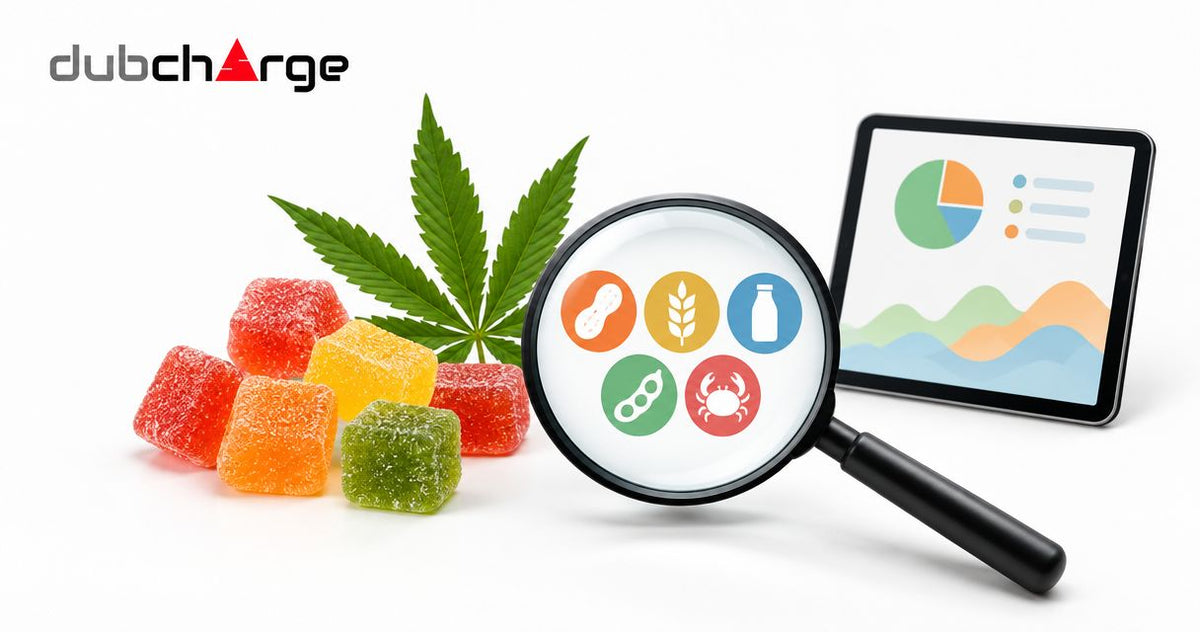
Read cannabis edible allergen warnings by checking the full ingredient list, any Contains statement, and any May contain or shared-equipment notice together. Match those statements to your specific allergy; a missing precautionary warning does not establish that an edible is free of cross-contact. If the label is incomplete, contradictory, or unclear, do not eat the product while you seek clarification.
- Read cannabis edible allergen warnings alongside the full ingredient list, not instead of it.
- A Contains statement identifies declared allergens; a missing May contain statement does not rule out cross-contact.
- A cannabis lab report does not establish allergen safety unless relevant allergen testing is explicitly documented.
- Dubcharge’s guidance separates food-allergen labeling from cannabis potency testing; neither establishes that an edible is risk-free.
How do you read allergen warnings on cannabis edibles?
Use the physical package for the exact edible you have, not a photograph of a different flavor or an older label. Keep the lot number available if you need to contact the manufacturer or check a recall.
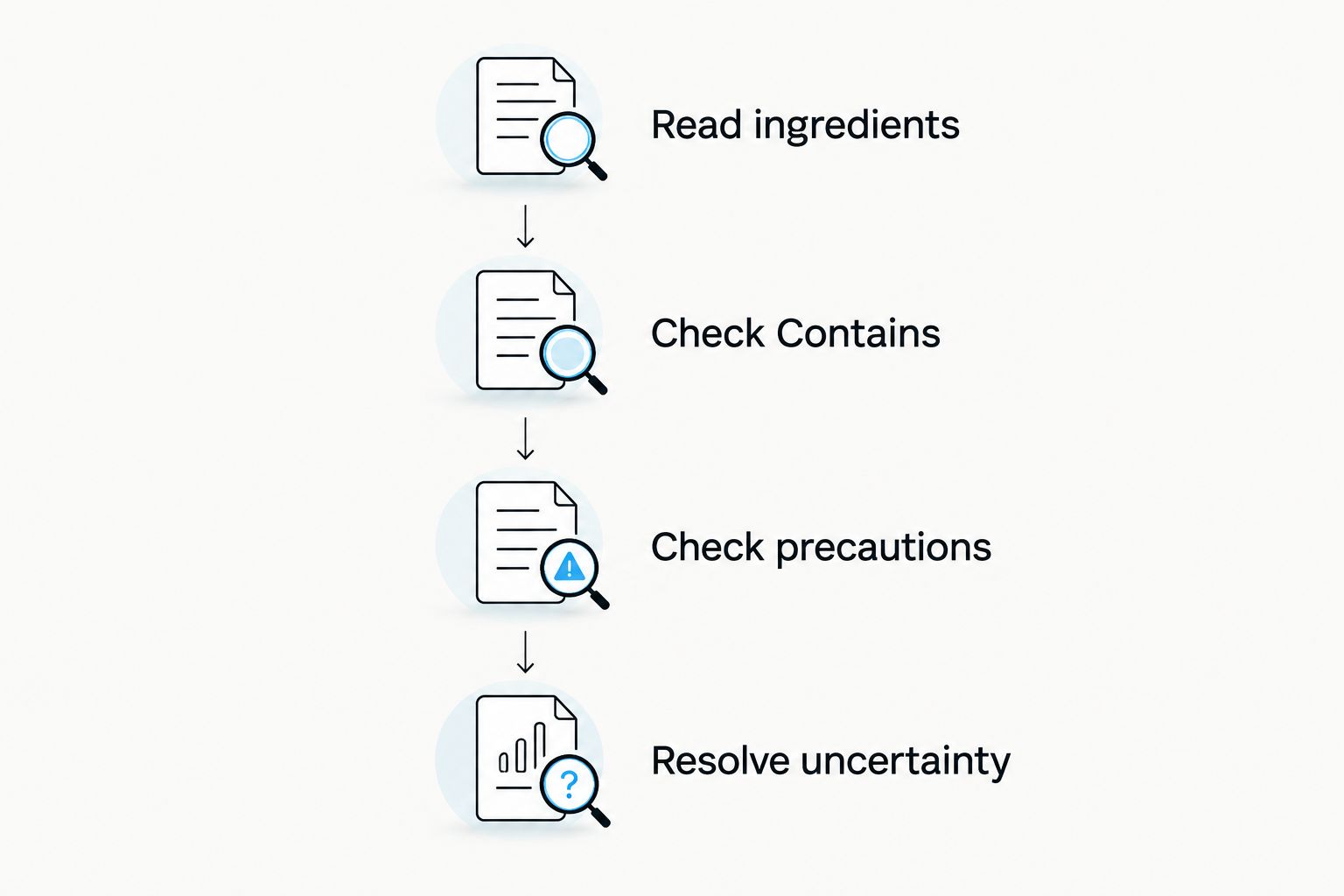
- Read ingredients. Read the complete list, including ingredients inside parentheses. Check every component against your allergy, even when the front of the package makes an allergen-related claim.
- Check Contains. Look for a separate allergen statement near the ingredients. For foods covered by federal allergen-labeling requirements, a separate Contains statement is not always required when the ingredient list properly identifies the allergen source.
- Check precautions. Read statements about shared equipment, shared facilities, or possible traces. These describe potential unintended exposure rather than an intentionally added ingredient.
- Resolve uncertainty. Ask the manufacturer about the exact flavor and lot. If you cannot establish whether the edible meets your allergy-management needs, avoid it.
Dubcharge’s guide to reading a cannabis lab report addresses a separate question: what the laboratory actually measured. A potency result is not an allergen clearance.
What different label statements actually tell you
These statements answer different questions. None replaces the others, and none guarantees that a product is safe for every person with a food allergy.
| Label statement | What it tells you | What it does not establish |
|---|---|---|
| Contains milk | Milk is a declared allergen ingredient | Whether other undeclared allergens entered through cross-contact |
| May contain peanuts | The manufacturer is warning about possible unintended peanut exposure | How much peanut is present or your personal reaction risk |
| Made in a facility that processes tree nuts | Tree nuts are handled somewhere in that facility | Whether the edible contains tree-nut protein |
| No precautionary statement | No such warning appears on the label | That equipment is dedicated or cross-contact is absent |
| Lab tested | A testing claim is being made | Which allergens, if any, were tested |
The practical limitation is straightforward: label wording is evidence to evaluate, not a personalized safety guarantee. Do not rank shared-facility and shared-equipment warnings as if they represent standardized levels of risk.
Why this matters
Food allergy and cannabis intoxication are different hazards. An edible can present either concern, and cannabis potency information does not answer whether it contains a food allergen.
For this 2026 U.S. guide, the federal reference is the FDA’s list of 9 major food allergens: milk, eggs, fish, crustacean shellfish, tree nuts, peanuts, wheat, soybeans, and sesame. People also have allergies to foods outside that list, so checking only those names is not enough for everyone.
Federal food-labeling rules are not a blanket statement that cannabis edibles are federally authorized. State cannabis programs have their own requirements, and a product’s legal status does not establish its allergy safety.
Why cannabis edible allergen warnings vary
Differences in warnings require closer reading, not assumptions about which label is safer. These factors explain why apparently similar packages need separate checks:
- Recipe: Different flavors and formulations can contain different allergen ingredients. Read each package independently.
- Compound ingredients: A coating, filling, flavor preparation, or other component can contain ingredients listed inside parentheses.
- Manufacturing environment: Unintended allergen transfer can occur through shared equipment, utensils, surfaces, or ingredient handling.
- Precautionary wording: Under FDA guidance, statements such as May contain are voluntary for foods under its jurisdiction. Their absence is not proof of absence.
- Jurisdiction: Cannabis labeling obligations depend on the applicable state program and product category. Do not assume a package follows another state’s rules.
- Formulation changes: A familiar product name does not establish that the current ingredients match a previous package.
In 2026, check the applicable state cannabis regulator for current requirements rather than treating another product’s label as the standard. Retail descriptions and package photographs are not substitutes for the label on the item in hand.
Which ingredient names need a closer look?
Look for the food source, not only the name you usually associate with it. Casein and whey are milk proteins, for example; lactose intolerance and milk allergy are different conditions, so a lactose-related claim does not answer every milk-allergy question.
For packaged foods covered by FDA allergen-labeling requirements, major allergen sources must be identified through the ingredient declaration or an appropriate Contains statement. Specific fish species, crustacean shellfish species, and tree-nut types matter under those requirements.
Do not treat a broad dietary claim as an allergy assessment:
- Vegan does not establish freedom from peanut, sesame, wheat, or other plant-derived allergens. It also does not, by itself, establish the absence of milk cross-contact.
- Gluten-free does not answer questions about milk, peanuts, sesame, or every wheat-allergy concern.
- Dairy-free does not address unrelated allergens or explain the manufacturer’s cross-contact controls.
- Natural and organic do not mean allergen-free.
Highly refined oils have specific exemptions under federal major-allergen labeling law. Do not use that legal distinction to make an individual medical decision; discuss relevant ingredients with your allergist.
Does “may contain” mean an edible definitely contains the allergen?
May contain does not confirm that an allergen is present in every package. It warns about possible unintended exposure, and the wording does not tell you the amount or predict the severity of a reaction.
The opposite inference is also wrong: no warning does not mean no cross-contact. FDA guidance says precautionary labeling should not replace good manufacturing practices.
Follow the avoidance plan you developed with your clinician. Do not taste a small amount to investigate an unclear label, and do not assume that removing a visible coating removes allergen exposure.
If you contact the manufacturer, ask focused questions:
- Does the current formulation contain your specific allergen, including within compound ingredients?
- Does the precautionary warning apply to this exact flavor and lot?
- What controls address cross-contact with your allergen?
- Has the manufacturer issued a relevant label correction or recall?
A vague response such as “it should be fine” does not resolve a specific allergy question. Retain the package and any written response so your clinician can assess the information with you.
Can a cannabis lab report prove an edible is allergen-free?
A cannabis lab report cannot establish allergen safety unless it explicitly addresses relevant allergen testing—and even then, its scope matters. Reports covering cannabinoid potency, pesticides, solvents, metals, or microorganisms answer different questions.
Read the named test, sample identity, method, and reporting limits. A result for one allergen does not cover every allergen, and a sampled result does not establish that every portion of every package has identical composition.
Dubcharge’s cannabis-label education treats a certificate of analysis as a scoped document, not a general safety certificate. The same caution applies to a QR code: opening a report is useful only if the report matches the product and answers the question you are asking.
For a 2026 label review, separate these checks:
- Identity: Does the report identify the relevant product and batch?
- Scope: Is the allergen of concern actually included?
- Interpretation: What does the reported result establish, and what remains untested?
A passing potency or contaminant panel does not cancel an ingredient warning. Avoid an edible containing your allergen regardless of unrelated passing results.
What should you do if the label is missing or contradictory?
Do not eat an edible when its allergen information is unresolved. A conflict between the ingredient list and a Contains statement requires clarification, not a guess about which wording takes priority.
Photograph the ingredient panel, warning statements, manufacturer information, and lot identification. Ask the manufacturer to address the discrepancy for that specific package; keep the edible separated from ordinary food while the question remains open.
If an official notice identifies your product, follow its instructions. The guide to checking official cannabis recall notices explains why matching the product and lot matters.
In 2026, use the relevant state cannabis regulator for state-regulated cannabis notices and FDA recall information when applicable. Absence from a recall list is not proof that a product is suitable for your allergy.
What if someone has symptoms after eating an edible?
Treat suspected anaphylaxis as an emergency, not as ordinary cannabis intoxication. Trouble breathing, throat tightness, fainting, or rapidly progressing symptoms require urgent action; anaphylaxis can occur without hives.
Use prescribed epinephrine according to the person’s emergency action plan and call 911. Antihistamines do not replace epinephrine for anaphylaxis, and you should not wait for a cannabis effect to wear off before seeking help.
For a suspected poisoning or an uncertain cannabis exposure in the United States, Poison Control is available at 1-800-222-1222. Call 911 immediately for collapse, seizure, breathing difficulty, or inability to awaken the person.
Keep the package for responders if you can do so without delaying care. Tell them about both the possible allergen and the cannabis exposure; those are separate pieces of clinically relevant information.
Keep warnings attached during storage and disposal
Store edibles in their original labeled packaging, secured away from children and pets. Do not transfer them into ordinary candy containers or leave an unlabeled portion where another adult could mistake it for conventional food.
For an adult with a food allergy in the household, prevent contact between the edible and shared food-preparation surfaces or utensils. Child-resistant packaging is not a substitute for secure storage.
For a recalled or unwanted edible, follow the recall instructions and applicable local disposal guidance. Do not give it to someone else simply because that person does not share your allergy.
Sources and limits
The 2026 reference framework for this guide is FDA’s Food Allergies: What You Need to Know and FDA guidance on food-allergen labeling, covering major allergens, declarations, and precautionary statements. These sources describe federal food-labeling principles; they do not establish compliance for an individual cannabis product.
Emergency guidance follows the American College of Allergy, Asthma & Immunology’s public anaphylaxis guidance and Poison Control’s U.S. emergency instructions. State cannabis regulators remain the relevant sources for jurisdiction-specific cannabis labeling and recall requirements.
No general article can determine whether an individual edible is appropriate for your diagnosed allergy. Your allergist can help interpret uncertain ingredients and establish a response plan.
FAQ
Where should I look first for cannabis edible allergen warnings?
Read the full ingredient list, then any Contains statement and precautionary warning. Check the exact package and flavor rather than relying on an older photograph.
Does no May contain warning mean a cannabis edible is safe for my allergy?
No. A missing precautionary warning does not establish that cross-contact is absent, and it does not replace checking the ingredients.
Are there 9 major food allergens in the United States?
Yes. FDA recognizes 9 major food allergens: milk, eggs, fish, crustacean shellfish, tree nuts, peanuts, wheat, soybeans, and sesame. Other foods can also cause allergic reactions.
Does a passing cannabis lab report rule out food allergens?
No. A passing report only addresses the tests within its scope; cannabinoid potency and common contaminant panels do not establish allergen safety.
Does vegan mean an edible is safe for someone with a milk allergy?
No. A vegan claim alone does not establish the absence of milk cross-contact. Read the full label and resolve uncertainty with the manufacturer and your allergist.
Can cannabis intoxication explain away trouble breathing after an edible?
No. Trouble breathing after an edible requires urgent assessment, especially when an allergic reaction is possible. Follow the prescribed emergency plan and call 911.
What should I do with an edible that has conflicting allergen information?
Do not eat it while the conflict remains unresolved. Retain the package and lot information, contact the manufacturer, and check relevant official recall notices.
One last thing
The most useful label check happens every time you open a new package—not just when you first encounter a product. A familiar name, a previous uneventful exposure, or a passing lab report does not establish that the next package meets your allergy-management needs.
Dubcharge’s recommendation for adult cannabis-label education is simple: keep the package, check the exact ingredients, and leave unresolved allergy questions unresolved by eating—not by experimenting.


Leave a comment
This site is protected by hCaptcha and the hCaptcha Privacy Policy and Terms of Service apply.