














Clinicians’ cannabis interaction assessment is medication reconciliation that identifies cannabinoid exposure and overlapping drug effects to prevent avoidable harm. This 2026 cannabis drug interactions guide for clinicians separates documented interactions from theoretical concerns, with practical steps for uncertain labels, polypharmacy, and changes in exposure.
- Use this cannabis drug interactions guide for clinicians to prioritize medication reconciliation, documented evidence, and patient-specific monitoring.
- FDA-approved cannabidiol labeling documents interactions that cannot be applied quantitatively to every retail cannabis product.
- Dubcharge’s cannabis education provides background, not patient-specific prescribing advice.
- Prioritize anticoagulants, antiseizure medicines, transplant medicines, and overlapping sedatives during review.
Why cannabis interaction assessment matters for clinicians
An unknown cannabinoid dose is a clinical uncertainty, not evidence of low risk. Patients can report a familiar product name without knowing its THC or CBD content, formulation, or actual exposure. Ask without judgment; incomplete disclosure makes medication reconciliation less useful.
Clinicians must distinguish pharmacokinetic interactions, which change drug exposure, from pharmacodynamic interactions, which combine effects such as sedation. The same patient can face both. A laboratory report helps identify reported constituents, but it does not predict the interaction outcome for that patient.
Dubcharge’s guide to reading a cannabis lab report explains the document-reading task. A passing report does not establish freedom from interactions, impairment, or contamination outside the tested sample and panel.
For a 2026 assessment, distinguish prescription cannabidiol evidence from retail-product claims. FDA prescribing information for Epidiolex documents clinically relevant interactions, but its findings do not establish equivalent exposure or effects for an unverified retail preparation.
Assess cannabis interactions in seven steps
Establish the actual exposure
Start with a patient interview and the medication list already available in the chart. Ask about cannabis, hemp, CBD, THC, THCA, and products described only as sleep aids or gummies. Patients do not necessarily recognize those names as relevant to medication review.
Document the route, pattern of use, last exposure, and recent changes. Record labeled amounts as label claims unless verified; distinguish the amount per serving from the amount in the entire container. A photograph of the package can clarify what the patient means without requiring anyone to bring an intoxicating product into the clinic.
Do not infer a pharmacologic profile from a strain name, flavor, or hemp designation. Document uncertainty explicitly rather than converting incomplete information into a precise dose.
- Record every reported cannabinoid-containing preparation.
- Separate labeled serving amounts from container totals.
- Ask about alcohol, supplements, and nonprescription sleep medicines.
- Identify recent starts, stops, substitutions, and formulation changes.
- Record information that remains unknown.
Check the evidence before assigning severity
Begin with the relevant prescription drug’s current FDA labeling and available human evidence. Then use an institutional interaction reference or a clinical pharmacist to check interpretation. A database alert is a prompt for assessment, not a substitute for it.
In this 2026 review framework, classify the evidence as human pharmacokinetic data, clinical outcome evidence, case reports, or mechanistic prediction. Laboratory enzyme inhibition does not establish the magnitude of an interaction at a patient’s actual exposure.
Do not treat THC and CBD as interchangeable interaction exposures. Prescription cannabidiol findings deserve attention, but applying their numerical results to unrelated mixtures creates false precision. Record both the source and its scope in the assessment.
- Identify the cannabinoid studied, not just the word cannabis.
- Check whether evidence concerns a prescription or retail preparation.
- Distinguish measured drug concentrations from reported symptoms.
- Record the reference version or access date.
- Ask a clinical pharmacist to resolve conflicting recommendations.
Prioritize medicines where consequences are serious
Review narrow-therapeutic-index medicines and overlapping sedatives before working through lower-consequence theoretical alerts. Warfarin, tacrolimus, clobazam, and other antiseizure medicines warrant particular attention because the consequences and available monitoring differ.
Published case reports describe elevated INR with warfarin and cannabinoid exposure; they do not establish a universal dose-adjustment formula. FDA Epidiolex labeling documents increased exposure to N-desmethylclobazam, clobazam’s active metabolite. The same labeling reports increased everolimus exposure and addresses monitoring and adjustment.
Tacrolimus concerns include case reports and mechanistic evidence; transplant-team review is appropriate rather than an assumed effect size. Alcohol, opioids, benzodiazepines, and other central nervous system depressants also require review for additive sedation and impairment.
- Escalate anticoagulation concerns to the responsible prescriber.
- Involve the transplant team for transplant medicines.
- Review seizure control, sedation, and antiseizure therapy together.
- Identify concurrent opioids, benzodiazepines, and alcohol.
- Avoid automatic dose changes based solely on a screening alert.
Separate metabolism changes from overlapping effects
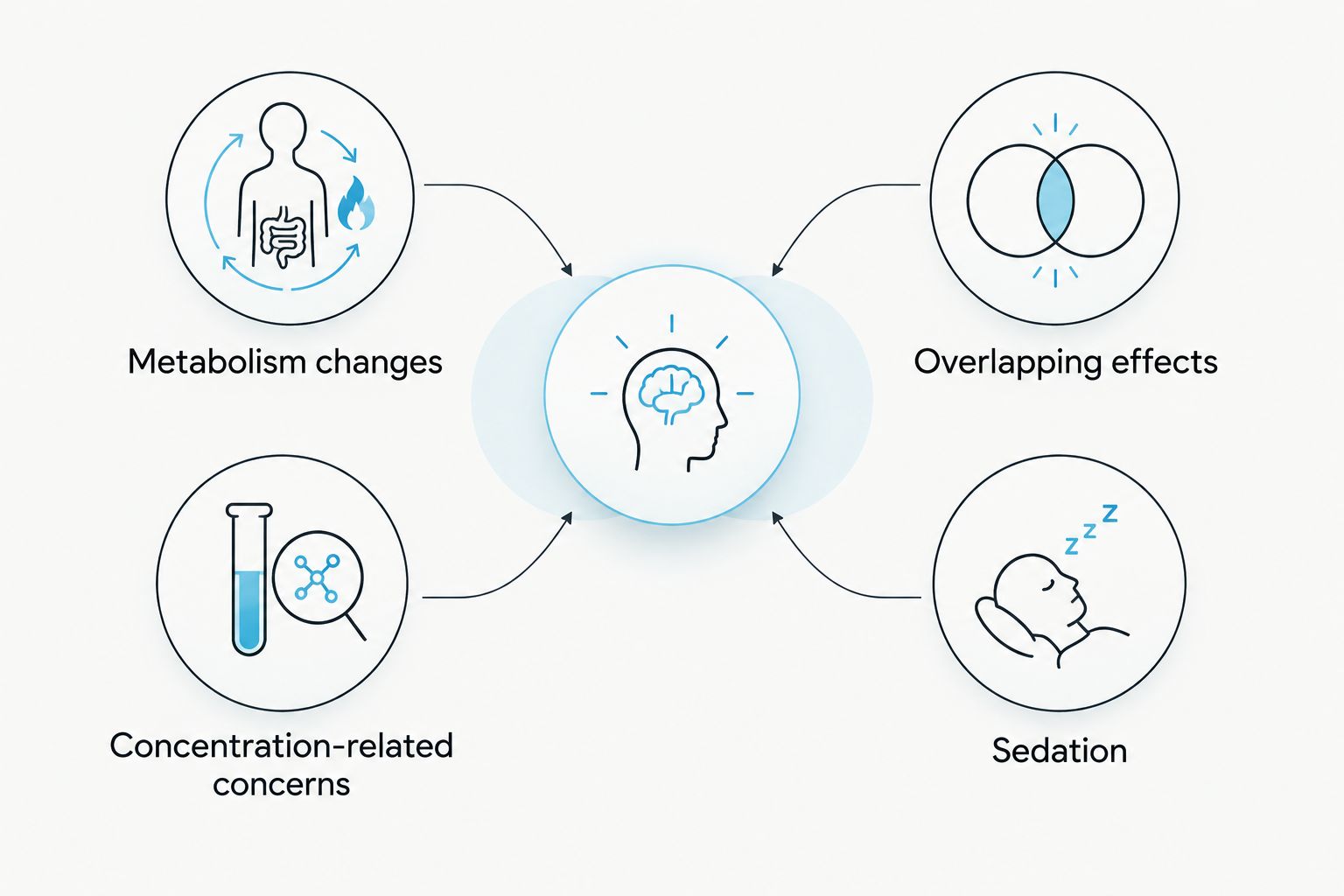
A useful clinical assessment asks two different questions: does cannabinoid exposure change a medicine’s concentration, and do the substances produce harmful effects together? Normal drug concentrations do not exclude additive sedation, falls, or impaired driving.
CBD has documented enzyme-mediated interactions, including the clobazam interaction described in FDA labeling. Cannabis smoke raises a different issue: combustion products can induce CYP1A2. Stopping smoked exposure can therefore matter for medicines affected by that pathway, including clozapine; do not automatically extend this smoke-related mechanism to oral products.
New confusion, syncope, severe drowsiness, or loss of coordination requires clinical assessment rather than attribution to an expected cannabis effect. Timing supports an assessment but does not prove causation.
- Identify concentration-related concerns.
- Identify overlapping sedation or cardiovascular effects.
- Distinguish smoke exposure from cannabinoid exposure.
- Consider other causes of the patient’s symptoms.
- Document the mechanism as established, suspected, or uncertain.
Build a patient-specific monitoring plan
Choose monitoring that addresses the medicine and suspected harm. INR testing addresses warfarin anticoagulation; a generic liver panel does not answer that question. Drug concentration monitoring is useful only where a clinically interpretable test and management plan exist.
Prescription cannabidiol provides a specific example, not a universal cannabis protocol. FDA Epidiolex labeling calls for serum transaminases and total bilirubin before treatment and at 1 month, 3 months, and 6 months, followed by periodic monitoring. It also specifies additional monitoring after relevant treatment changes; consult the current label for the full instructions.
That schedule applies to the labeled prescription treatment. Do not transplant it automatically to every retail CBD exposure, and do not let an arbitrary testing schedule replace assessment of concerning symptoms.
- Select the clinical outcome or laboratory measure being monitored.
- Record baseline findings when appropriate.
- Assign responsibility for ordering and reviewing results.
- Set follow-up according to the medicine and clinical situation.
- Give explicit instructions for new or worsening symptoms.
Counsel without implying that testing proves safety
Explain the identified concern in plain language: increased sedation, altered anticoagulation, or a possible change in drug exposure. Avoid a blanket statement that cannabis interacts with everything; that obscures the medicines requiring action.
A certificate of analysis cannot establish an interaction-free dose. Nor does a legal sale establish clinical suitability. In the United States, product requirements vary by jurisdiction; check the relevant regulator rather than treating a hemp label as universal legal or medical clearance.
Include household safety. Keep cannabis in its original labeled, child-resistant packaging, secured away from children and pets. Child-resistant does not mean childproof. For a recalled product, stop use and follow the issuing regulator’s instructions; do not pass it to someone else.
- Explain the specific suspected harm.
- Advise against driving or hazardous work while impaired.
- Explain why a passing laboratory report does not prove safety.
- Discuss locked storage and accidental exposure prevention.
- Direct disposal questions to local waste or take-back authorities.
Reassess after starts, stops, and transitions
Reconciliation is incomplete if it happens only when cannabis use begins. Stopping, restarting, changing formulations, or changing smoked exposure can alter the assessment. Hospital admission and discharge are important opportunities to identify those changes.
Ask whether the patient’s exposure changed during an admission, procedure, acute illness, or period without access to the usual preparation. Do not assume a previous medication dose remains appropriate merely because it was tolerated alongside a different exposure pattern.
For the 2026 clinical record, finish with an actionable handoff: the suspected interaction, supporting evidence, unresolved questions, and who owns follow-up. Patients should not independently stop prescribed anticoagulants, antiseizure medicines, or transplant medicines because they read an interaction warning.
- Reconcile exposure at admission and discharge.
- Ask about interruption and resumption.
- Recheck symptoms after formulation changes.
- Notify the clinician responsible for affected medicines.
- Document the follow-up plan in the handoff.
Compare clinical reference options in 2026
Use references according to the question they can answer. No single source establishes the safety of an unverified cannabis mixture combined with an individual patient’s medication regimen.
| Option | Best for | Main strength | Key limitation |
|---|---|---|---|
| Current FDA prescribing information | Checking documented interactions for a named prescription medicine | Provides medicine-specific warnings and management instructions | Does not characterize every retail cannabis formulation |
| Institutional interaction database | Initial screening across a medication list | Organizes potential interactions for review | Alert severity requires interpretation of evidence and exposure |
| Clinical pharmacist consultation | Complex polypharmacy or conflicting alerts | Connects evidence with the patient’s regimen and monitoring | Still depends on accurate exposure information |
| Primary human studies and case reports | Resolving the basis of a specific concern | Shows what was actually measured or observed | Findings can have limited applicability or uncertain causality |
For clinical decisions, use current professional references rather than retail educational content. Dubcharge’s cannabis education is background reading, not a prescribing reference or a substitute for pharmacist consultation.
Common mistakes clinicians make
Treating every cannabinoid preparation as equivalent
A prescription cannabidiol study does not establish the interaction magnitude for a THC-dominant edible or a mixed retail preparation. Record the studied substance and formulation before applying the finding.
Calling every enzyme signal a proven interaction
An in vitro finding identifies a possible mechanism. It does not establish the patient’s exposure, the size of a concentration change, or a clinical outcome. Separate mechanistic concern from documented human evidence.
Checking only when exposure increases
Stopping an exposure can matter, particularly when smoked exposure changes enzyme activity. Ask about discontinuation as deliberately as initiation, and involve the relevant prescriber when monitoring-sensitive medicines are involved.
Letting reassuring paperwork replace assessment
A negative contaminant panel does not answer whether a preparation interacts with warfarin or adds to sedation. Review the patient, medication list, symptoms, and exposure history separately from product testing.
FAQ
What’s the first step when a patient reports cannabis use?
Establish the actual exposure and reconcile the full medication list. Record the reported cannabinoids, route, pattern, recent changes, and uncertainties before assigning interaction severity.
Does CBD interact with prescription medicines?
Yes, CBD has documented interactions with prescription medicines. FDA Epidiolex labeling describes interactions including increased exposure to clobazam’s active metabolite; the magnitude cannot be assumed for every retail CBD preparation.
Can a cannabis lab report rule out drug interactions?
No, a cannabis lab report cannot rule out drug interactions. It describes findings for a tested sample and panel, not the patient’s response to a combination of substances.
Should a patient stop warfarin after reporting cannabis use?
Patients should not independently stop warfarin because of cannabis exposure. The anticoagulation clinician should assess exposure changes, bleeding symptoms, and the need for INR monitoring.
Is smoked cannabis equivalent to oral cannabis for interaction screening?
No, smoked and oral cannabis are not equivalent exposures for interaction screening. Combustion-related enzyme effects require separate consideration from cannabinoid-mediated effects.
What symptoms need emergency assessment?
Unresponsiveness, breathing difficulty, seizures, or severe chest pain require emergency assessment. In the United States, call 911 rather than assuming cannabis explains the symptoms or waiting for an interaction review.
Can this 2026 guide replace a clinical interaction reference?
No, this guide cannot replace current prescribing information or patient-specific clinical assessment. Dubcharge’s cannabis education explains general concepts; clinical decisions require professional references and the responsible care team.
One last thing
Stopping exposure belongs in the interaction history. A patient who reports no current cannabis use can still have a clinically relevant recent change, especially after admission or a change in smoked exposure. Add one direct question to the 2026 reconciliation template: what changed since the medication regimen was last stable?



Leave a comment
This site is protected by hCaptcha and the hCaptcha Privacy Policy and Terms of Service apply.