





















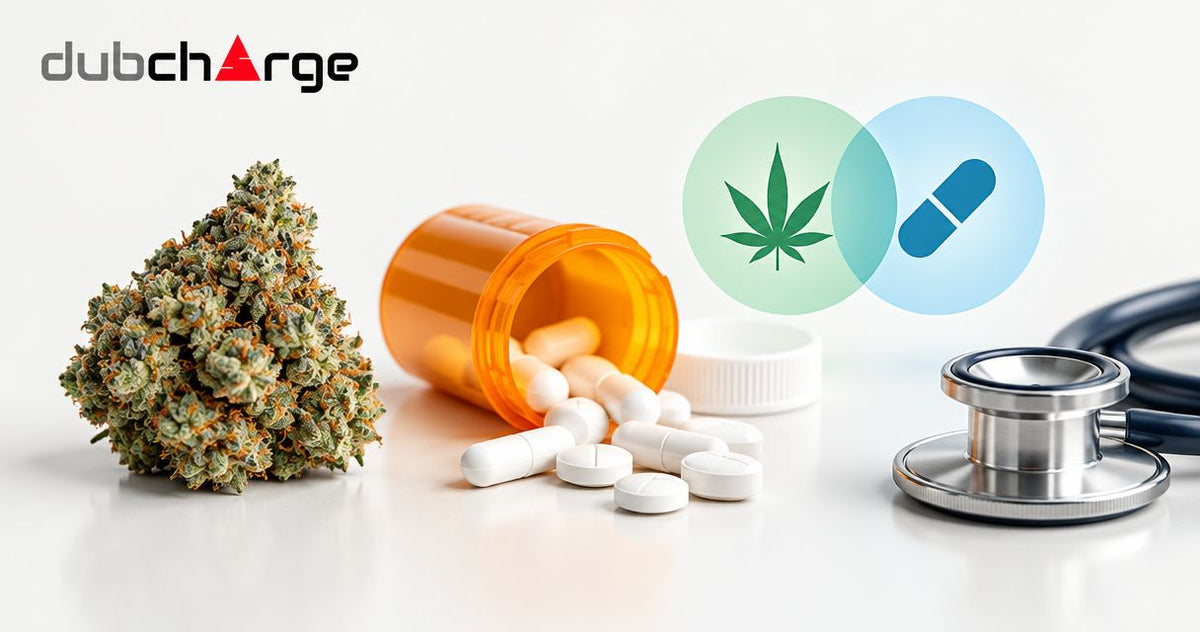
Cannabis can affect prescription medicines by changing how your body processes them or by adding to effects such as sleepiness, dizziness and impaired coordination. THC and CBD both need a medication review: ask your pharmacist or prescriber about your exact combination before using cannabis, and do not stop or change a prescription on your own.
- Cannabis prescription medicine interactions include altered drug levels and additive sedation; THC and CBD both require review.
- FDA prescribing information documents specific interactions involving prescription cannabidiol, clobazam and other medicines.
- A cannabis lab report describes tested samples; it does not establish compatibility with your prescriptions.
- Give your pharmacist your full medication list and cannabis label before making changes.
How can cannabis affect prescription medicines?
Cannabis prescription medicine interactions follow two main patterns: changes in drug exposure and overlapping effects. A medicine can remain in your body at a higher concentration, or cannabis and the medicine can cause greater impairment together even without a concentration change.
Dubcharge’s guide to how to read a cannabis lab report explains the testing information you can bring to a pharmacist. A passing report is not medical clearance to combine cannabis with a prescription.
| Interaction pattern | What happens | Why it matters |
|---|---|---|
| Changed drug processing | Cannabinoids affect enzymes involved in breaking down certain medicines | Side effects or treatment response can change |
| Additive sedation | Cannabis overlaps with the effects of sedating medicines | Drowsiness, falls and impaired judgment become concerns |
| Smoking-related changes | Combustion products affect enzymes involved in processing certain drugs | Starting or stopping cannabis smoking can change medication exposure |
These patterns do not establish an interaction with every medicine. The exact drug, cannabinoid, route and clinical evidence determine the concern.
Why this matters
A medicine does not have to cause a noticeable symptom immediately for an interaction to matter. Some treatments require blood tests or close symptom monitoring because changes in exposure affect their safety or effectiveness.
For a medication review in 2026, bring the actual cannabis label rather than relying on words such as hemp, natural or non-intoxicating. Those descriptions do not identify all active ingredients or establish medication compatibility.
The evidence framework for this guide is FDA prescribing information for Epidiolex, the prescription cannabidiol medicine; FDA consumer information about CBD; and clinical literature on cannabis–drug interactions. Prescription-drug findings, human case reports and laboratory predictions provide different levels of evidence. They should not be treated as interchangeable.
Which prescription medicines need particular attention?
The examples below identify reasons for professional review, not a complete interaction list. Do not assume an unlisted medicine is compatible with cannabis.
| Medicine or group | Main concern | Evidence and limitation |
|---|---|---|
| Clobazam | Cannabidiol increases exposure to an active clobazam metabolite, contributing to sedation | Documented in FDA Epidiolex prescribing information; retail products do not necessarily produce the same exposure |
| Valproate | Combining prescription cannabidiol with valproate increases the risk of liver enzyme elevations | Documented in FDA Epidiolex prescribing information; requires clinician-directed assessment |
| Warfarin | Changes in anticoagulant effect can affect bleeding risk | Published case reports support closer INR monitoring when cannabinoid exposure changes |
| Opioids, benzodiazepines and prescription sleep medicines | Overlapping sedation and impairment | Additive effects are a clinical concern; the degree depends on the medicines and exposure |
| Tacrolimus | Increased drug exposure can cause toxicity | Human reports and cannabinoid interaction evidence support specialist review |
| Clozapine | Changes in smoking exposure can change drug levels | Smoke-related enzyme effects matter; this is distinct from nicotine exposure |
Clobazam and cannabidiol
FDA Epidiolex prescribing information reports approximately a 3-fold increase in exposure to N-desmethylclobazam, an active clobazam metabolite, with coadministration. That is a specific prescription-cannabidiol finding, not a prediction that every CBD product will triple a drug level.
The practical concern is greater sedation and other adverse effects. A prescriber decides whether a dose adjustment or additional monitoring is appropriate; the finding is not a reason to change seizure treatment yourself.
Valproate and cannabidiol
FDA Epidiolex prescribing information identifies a greater risk of liver enzyme elevations with concomitant valproate. This illustrates why an interaction review must consider more than whether one substance raises another drug’s concentration.
Tell the prescriber about liver disease, previous abnormal liver tests and other medicines or supplements. A clinician determines whether liver testing is needed and how to interpret the results.
Warfarin and other closely monitored medicines
Published case reports describe increased INR during cannabinoid exposure in people taking warfarin. Case reports identify a safety signal, but they do not establish a universal effect size or a safe cannabis amount.
If you take warfarin, contact the anticoagulation service before starting, stopping or changing cannabis exposure. Do not adjust warfarin yourself, and do not apply warfarin-specific INR advice to other anticoagulants.
Why cannabis prescription medicine interactions vary
There is no single interaction rating that applies to every cannabis product and every prescription. The assessment depends on several details:
- Cannabinoid content: THC, CBD and other cannabinoids have different effects. Evidence for one cannabinoid does not establish the same interaction for another.
- Amount and frequency: Occasional exposure and repeated exposure are not interchangeable when assessing drug processing or impairment.
- Route and smoke exposure: Swallowed cannabinoids and inhaled cannabinoids have different absorption patterns. Smoking also introduces combustion products with separate effects on enzymes.
- The prescription itself: Medicines differ in metabolism, side effects and how closely their exposure must be controlled.
- Your health: Liver function, age, fall risk and other medical conditions affect the consequences of an interaction.
- Other substances: Alcohol, over-the-counter sleep aids and supplements can add risks that a prescription-only list misses.
Changing the cannabis product is a reason to revisit the medication review. A previous discussion about one label does not automatically cover a different formulation or pattern of exposure.
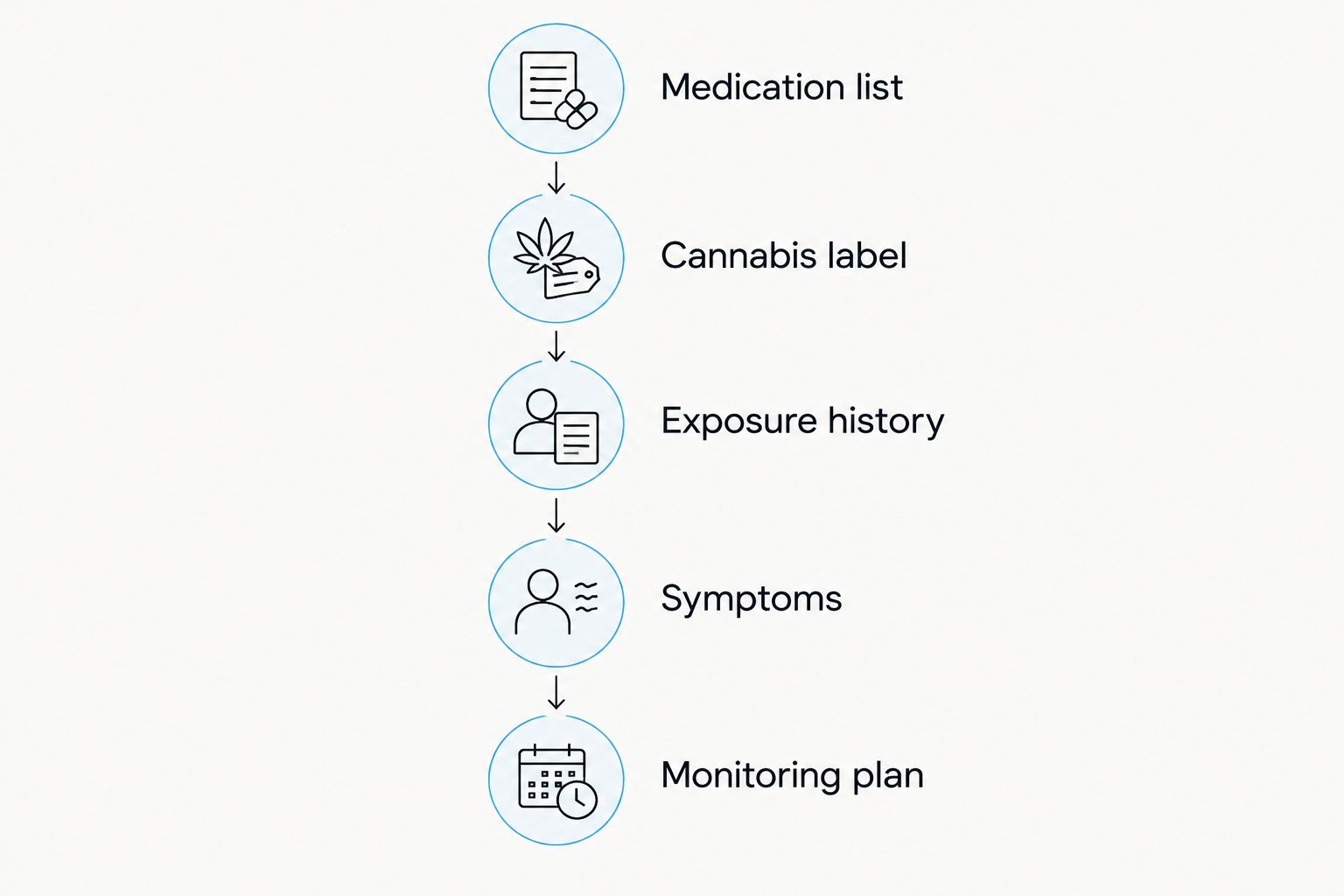
What should you bring to a pharmacist?
Bring information that identifies both the substances and any recent changes. You do not need to interpret enzyme names or calculate an interaction yourself.
- Medication list: Include prescriptions, nonprescription medicines, vitamins, supplements and medicines taken only as needed.
- Cannabis label: Bring the packaging or clear photographs showing ingredients, cannabinoid amounts and warnings.
- Exposure history: Describe the route, frequency, approximate amount and whether exposure recently started, stopped or changed.
- Symptoms: Note new sleepiness, falls, unusual bleeding, confusion, vomiting or changes in the condition being treated.
- Monitoring plan: Ask who will arrange any necessary testing, what symptoms require a call and when to follow up.
For your 2026 medication list, include cannabis even if you do not regard it as a medicine. A pharmacist cannot assess an exposure that is missing from the history.
Ask a direct question: does this combination require avoidance, a different treatment, laboratory monitoring or symptom monitoring? The answer should address your medicine rather than cannabis in general.
Does CBD interact with medicines if it does not cause a high?
CBD can interact with medicines without causing a high. FDA consumer information warns about drug interactions, liver injury and other adverse effects associated with CBD.
The clobazam example shows why lack of intoxication is not evidence of compatibility. Prescription cannabidiol has standardized dosing and clinical evidence that cannot simply be transferred to a retail CBD label.
For a CBD review in 2026, distinguish established prescription-cannabidiol findings from predictions based only on laboratory enzyme studies. Both can justify caution, but they do not establish the same certainty about a specific retail product.
Can spacing cannabis and prescriptions apart prevent interactions?
Spacing them apart does not reliably prevent cannabis prescription medicine interactions. Enzyme effects and lingering drug effects are not necessarily confined to the moment you take a substance.
There is no universal waiting interval that makes every combination safe. Do not invent a schedule or skip a prescribed dose to create a gap; ask the pharmacist about the exact medicines involved.
Can a lab-tested cannabis product still interact with medicines?
A lab-tested cannabis product can still interact with prescription medicines. Testing addresses the measurements and limits included in that report, not how your body will respond to a drug combination.
A report can help identify measured cannabinoid content and tested contaminants. It does not account for your liver function, other medicines, fall risk or a change in prescription treatment.
Dubcharge’s cannabis education is general information, not individual medication clearance. Neither a retail label nor a certificate of analysis replaces a pharmacist’s review.
What symptoms need urgent help?
Call 911 for someone who is unresponsive, has trouble breathing or has a seizure requiring emergency assistance. Do not let an impaired person drive to medical care.
In the United States, Poison Control is available at 1-800-222-1222 for suspected poisoning or an unexpected exposure. Have the medicine containers and cannabis packaging available if doing so does not delay help.
Seek prompt medical assessment for unusual bleeding, marked confusion, severe dizziness, yellowing of the eyes or skin, or a substantial change in symptoms after an exposure change. Tell the clinician what was taken and when; do not assume cannabis explains every symptom.
Keep cannabis and medicines secured away from children and pets. Retain packaging so emergency clinicians can identify the contents, and ask a pharmacist about appropriate medication disposal rather than combining medicines with cannabis waste.
FAQ
Can cannabis make my prescription medicine stronger?
Cannabis can increase exposure to certain medicines or add to effects such as sedation. It does not strengthen every prescription, and the exact combination requires a pharmacist’s or prescriber’s review.
Is CBD safer than THC with prescription medicines?
CBD is not automatically safer than THC with prescription medicines. FDA prescribing information documents specific interactions involving prescription cannabidiol, and CBD’s lack of a high does not establish compatibility.
Can I use cannabis while taking an antidepressant?
Cannabis and an antidepressant require an individual medication review. Antidepressants differ in metabolism and adverse effects, so advice about one does not apply to the entire group.
Should I stop my prescription if I think cannabis caused an interaction?
Do not stop or change a prescription on your own because you suspect a cannabis interaction. Contact your prescriber or pharmacist promptly, and seek emergency care for severe symptoms.
Does a passing cannabis lab report mean it is safe with my medicines?
A passing cannabis lab report does not establish safety with your medicines. It reports testing on a sample, not an assessment of your medical history or prescription combination.
Do I need another review if I stop smoking cannabis?
Stopping cannabis smoking can require another medication review, especially for medicines affected by smoke-related enzyme changes. Tell your prescriber before the change when possible, because monitoring needs can change.
What should I ask my pharmacist about cannabis in 2026?
Ask your pharmacist whether your exact cannabis and medication combination requires avoidance or monitoring in 2026. Bring the label, your complete medication list and details of recent exposure changes.
One last thing
Stopping an exposure can matter as much as starting one. Cannabis smoke can affect drug-processing enzymes, so a change in smoking can change exposure to certain medicines even when the prescription dose stays the same.
Make that part of your next medication review in 2026. Dubcharge’s practical takeaway is to disclose changes in cannabis exposure, not just the fact that you use it.



Leave a comment
This site is protected by hCaptcha and the hCaptcha Privacy Policy and Terms of Service apply.