






































Contact a veterinarian immediately after suspected cannabis ingestion or if your pet develops symptoms after cannabis exposure; do not wait for signs to appear. Trouble breathing, seizures, collapse, or difficulty waking your pet require emergency veterinary care now. Edibles can also contain chocolate, xylitol, or raisins, so the danger is not limited to THC.
- Cannabis exposure: pets need veterinary help immediately after suspected ingestion, even before symptoms appear.
- ASPCA Animal Poison Control provides veterinary poisoning guidance; breathing problems, seizures, or collapse require emergency care.
- Do not induce vomiting or give home remedies unless a veterinarian specifically instructs you.
- Save the packaging and ingredient list; edible ingredients and swallowed packaging can create additional emergencies.
When does cannabis exposure in pets need veterinary help?
Suspected ingestion warrants an immediate veterinary call. Severe symptoms warrant an immediate trip to an emergency veterinary hospital. Tell the clinic that cannabis exposure is possible, even if you do not know the product or amount.
Use this 2026 response checklist to distinguish a telephone assessment from an emergency departure. These are actions, not a diagnosis or permission to observe an exposed pet without professional guidance.
| Situation | Immediate action | Why it matters |
|---|---|---|
| Suspected ingestion without symptoms | Call your veterinarian or an animal poison service now | Symptoms can develop after an initially normal period |
| Wobbling, unusual sleepiness, drooling, vomiting, or urine leakage | Contact a veterinarian immediately for assessment | Neurologic changes affect safe movement and swallowing |
| Trouble breathing, seizures, collapse, or difficulty waking | Go to an emergency veterinary hospital now; call ahead if possible | These signs require urgent assessment and supportive care |
| Edible containing chocolate, xylitol, or raisins | Report every ingredient immediately | Other ingredients can require treatment independent of cannabis |
| Chewed cartridge, damaged device, or swallowed packaging | Tell the veterinarian about the object as well as its contents | Toxic exposure, sharp material, and swallowed components create different risks |
For separate guidance about human exposure, see Dubcharge’s accidental cannabis ingestion response. A person’s response plan does not replace veterinary advice for an animal.
Why this matters
A pet that looks sleepy can still have poisoning that needs treatment. Cannabis exposure can affect coordination, alertness, heart rate, and temperature; the Merck Veterinary Manual describes these effects in its veterinary guidance on marijuana toxicosis.
VCA Animal Hospitals’ guidance on marijuana intoxication in dogs and cats explains that signs can begin within 30 minutes or take several hours to develop. Effects can persist for up to 72 hours, depending on the exposure. Neither interval is a safe waiting period or a recovery promise.
The practical rule for 2026 is straightforward: make the call when you discover the exposure, not when a symptom timer expires. Earlier information helps the veterinarian decide whether an examination or another intervention is needed.
What should you do while contacting the veterinarian?
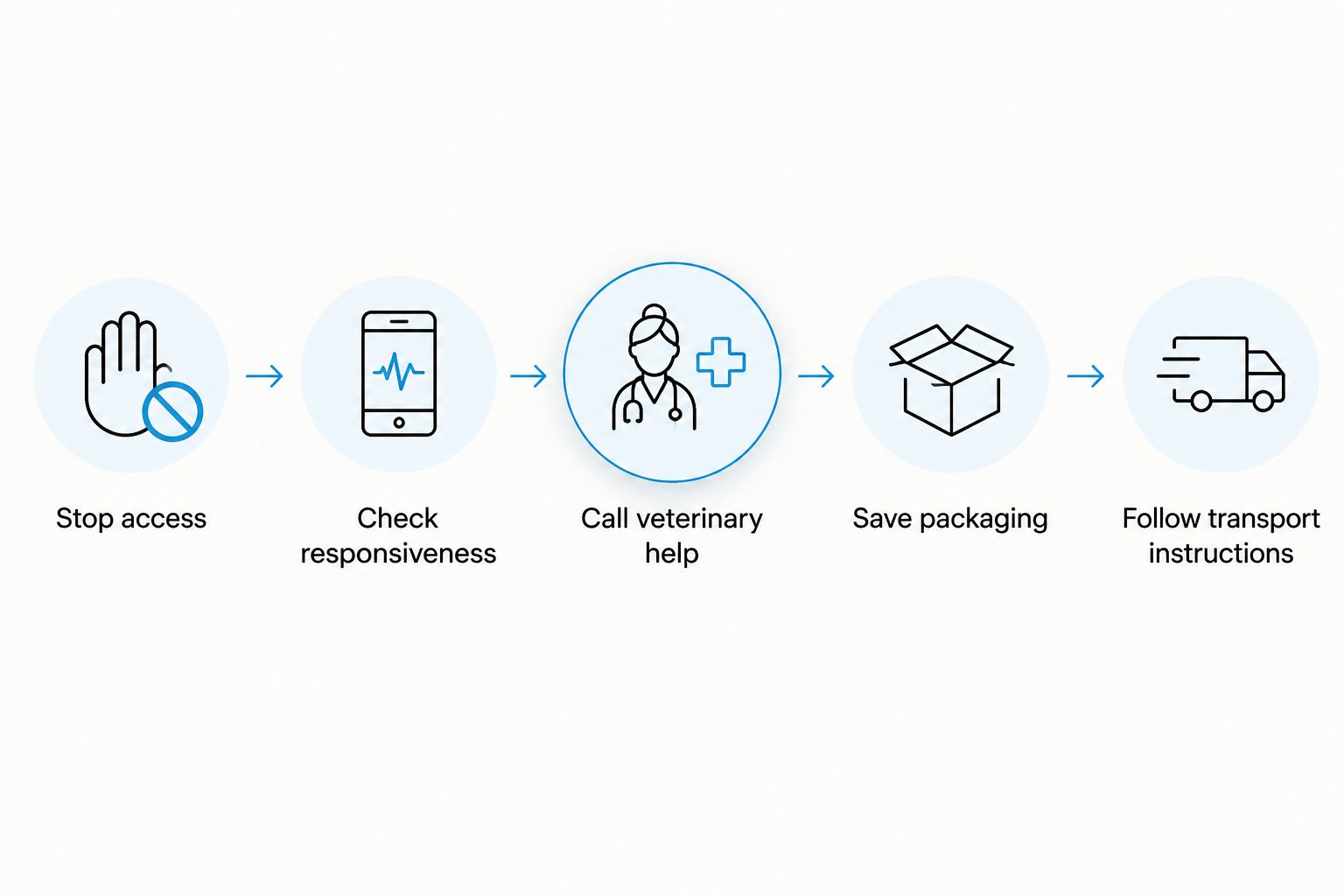
Follow these steps without delaying emergency transport. If another adult is present, one person can call while the other prepares the pet for travel.
- Stop further access. Move the remaining substance, food, wrappers, and damaged objects away from pets. Avoid putting your fingers into the mouth of an animal that is confused, distressed, or having a seizure.
- Check responsiveness and breathing. Report whether your pet responds normally, can stand, and appears to breathe comfortably. Do not spend time trying to diagnose the cause yourself.
- Call veterinary help. Contact your regular veterinarian, an emergency veterinary hospital, or an animal poison service. In the United States, ASPCA Animal Poison Control is available at 888-426-4435, and Pet Poison Helpline is available at 855-764-7661.
- Save the packaging. Photograph the ingredient list, cannabinoid information, and remaining contents. Put loose material and damaged components in a secure container away from the animal.
- Follow transport instructions. Keep the pet away from stairs and furniture edges. Ask the clinic how to move an animal that cannot walk safely, is poorly responsive, or is having seizures.
ASPCA Animal Poison Control provides assistance 24 hours a day. Do not use a poison-service call to postpone emergency transport when your pet has trouble breathing, collapses, or cannot be awakened normally.
What symptoms should you tell the veterinarian about?
Describe what you can observe rather than deciding that your pet is simply intoxicated. Wobbling and unusual sleepiness are relevant, but other illnesses and poisonings can produce similar signs.
Veterinary references, including the Merck Veterinary Manual and VCA Animal Hospitals, describe signs such as:
- Poor coordination: stumbling, swaying, or difficulty standing.
- Altered alertness: unusual sleepiness, disorientation, or an exaggerated response to sound or touch.
- Urine leakage: unexpected dribbling or loss of bladder control.
- Digestive signs: drooling or vomiting.
- More serious changes: tremors, seizures, severe depression, or abnormal breathing.
Tell the veterinarian when you first noticed each change and whether it is worsening. Do not force your pet to walk to demonstrate a problem; a description of what already happened is useful.
Do not assume cannabis explains every symptom. An exposed animal can also have another illness, an injury, or poisoning from a different ingredient.
Why the veterinary response varies
The veterinary response depends on the animal and the exposure, not just the word cannabis on a package. These factors help determine the assessment:
- Product contents: THC, other cannabinoids, food ingredients, and unknown substances need separate consideration.
- Amount and concentration: the quantity missing matters, but an uncertain estimate is not proof of a minor exposure.
- Animal size and health: report body weight, age, medical conditions, and current medicines.
- Time and route: distinguish suspected swallowing from smoke exposure, spilled liquid, or contact with an unknown substance.
- Current symptoms: responsiveness, breathing, coordination, vomiting, and seizures affect urgency and treatment decisions.
- Other materials: wrappers, broken glass, device components, or batteries can create additional hazards.
Give the veterinarian the facts you know and identify what you do not know. Guessing confidently about the amount can make the exposure history less useful.
Why do cannabis edibles need extra attention?
An edible can present more than one poisoning problem. Chocolate, xylitol, and raisins are established hazards for dogs, separate from cannabis. Report them even if THC appears to explain your pet’s behavior.
Read the whole ingredient list. A product described as sugar-free needs particular attention because xylitol can cause life-threatening poisoning in dogs, including low blood sugar and liver injury; FDA guidance addresses this hazard specifically.
Do not infer that a food is safe because it contains no chocolate. Missing ingredients, an incomplete label, and swallowed wrapping are all information the veterinarian needs.
For your 2026 household safety check, treat the ingredient panel and the cannabinoid panel as separate records. Photograph both, including any outer packaging that contains information missing from the individual wrapper.
Does a THC, THCA, CBD, or hemp label change the first step?
A cannabinoid label does not replace veterinary assessment. Report the exact label wording, but do not use hemp, CBD, or THCA as a reason to dismiss an exposure.
A label describes a product; it does not establish what amount your pet swallowed or whether another ingredient is harmful. If the product is homemade, unlabelled, or transferred into another container, explain that clearly.
A passing laboratory report also does not establish pet safety. Testing results concern the sample and analytes examined, not whether an animal can safely ingest the finished product or its packaging.
Bring the report if it is readily available, but do not delay the call to locate it. The immediate priorities remain your pet’s condition, the exposure history, and professional assessment.
Should you make your pet vomit after cannabis exposure?
No—do not induce vomiting unless a veterinarian specifically directs you. Cannabis can impair alertness and coordination, increasing concern about choking or inhaling vomit into the lungs.
Do not give hydrogen peroxide, salt, activated charcoal, oil, milk, or human medicines on your own. Treatments used in veterinary settings are not interchangeable with home remedies, and their suitability depends on the animal’s condition.
Do not force food or water into a drowsy, poorly coordinated, or vomiting animal. Ask the veterinarian what, if anything, to offer while you arrange care.
What information should you have ready for the call?
A useful exposure history is specific, not perfect. Start the call even if some details are missing, and have another adult gather information when possible.
Have these details ready:
- Your pet’s species, approximate weight, age, and medical conditions.
- Current medicines or supplements.
- The product name and photographs of all available label panels.
- The amount definitely missing and the largest amount that might be missing.
- The earliest and latest possible exposure times.
- Symptoms, when they began, and whether they are changing.
- Any missing wrappers, glass, batteries, or device parts.
Use the units printed on the label when reading it aloud. A package total and a per-piece amount are not interchangeable. Do not convert an uncertain label into a supposedly precise dose before calling.
What happens at the veterinary hospital?
Veterinary care focuses on the animal’s condition and the exposure history. The team can assess breathing, circulation, alertness, temperature, and other findings, then decide what monitoring or treatment is appropriate.
Treatment is generally supportive and individualized. It can include fluids, temperature management, and treatment of specific complications, but not every exposed animal needs the same interventions.
Be candid about the suspected substance. Accurate information helps the veterinary team assess the exposure; concealing cannabis involvement can leave out a medically important part of the history.
Ask for written discharge instructions if your pet goes home. Those instructions should explain supervision, permitted food and water, prescribed medicines, and the changes that require another call or examination.
How can you prevent another exposure?
Locked storage is more dependable than putting cannabis on a high shelf. Keep products in their original, closed packaging inside a locked container or cabinet, separate from pet food and treats.
For a 2026 storage review, include visitor bags, bedside tables, coat pockets, wastebaskets, and food left on counters. Ask household members and guests to keep their belongings inaccessible to pets.
Put used packaging and unwanted material in a secure waste container animals cannot enter. Do not leave remnants in an open bin, and do not assume a discarded wrapper contains no residue.
Use the cannabis storage and pet-safety guide to review household access points. If a recall affects a product, isolate it from pets while following the official recall instructions; do not leave it accessible while arranging disposal.
Which sources support this guidance?
This 2026 guide draws on established veterinary and public-health references, not product marketing or customer accounts:
- Merck Veterinary Manual, marijuana toxicosis guidance: clinical signs, exposure assessment, and supportive veterinary treatment.
- VCA Animal Hospitals, marijuana intoxication in dogs and cats: symptom timing, duration, presentation, and treatment precautions.
- ASPCA Animal Poison Control: animal poisoning assessment and round-the-clock assistance.
- Pet Poison Helpline: veterinary toxicology assistance for suspected animal exposures.
- U.S. Food and Drug Administration, xylitol safety guidance: the separate poisoning risk xylitol presents to dogs.
These references support general education. They cannot determine the treatment needed for an individual animal without an exposure assessment.
FAQ
Should I call a vet if my dog ate cannabis but seems normal?
Yes—call a veterinarian immediately after suspected cannabis ingestion, even if your dog seems normal. Signs can be delayed, and other ingredients or swallowed packaging can require separate assessment.
What symptoms mean my pet needs an emergency vet now?
Trouble breathing, seizures, collapse, or difficulty waking your pet require emergency veterinary care now. Call ahead if possible, but do not delay departure to collect every detail.
How long does cannabis poisoning take to show up in pets?
Signs can begin within 30 minutes or take several hours, according to VCA Animal Hospitals. Do not wait for symptoms before contacting a veterinarian after suspected ingestion.
Can I make my dog throw up after eating a cannabis edible?
Do not induce vomiting unless a veterinarian specifically instructs you. A drowsy or poorly coordinated animal can inhale vomit into the lungs.
Is a cannabis edible dangerous if it does not contain chocolate?
Yes—a cannabis edible can still require veterinary assessment without chocolate. Report the cannabinoid information, all other ingredients, and any missing wrapping.
Can I manage cannabis poisoning in my pet at home?
Home observation is appropriate only when a veterinarian directs it after assessing the exposure. Do not substitute home remedies or an online dose estimate for that assessment.
Does a passing cannabis lab report mean the product is safe for pets?
No—a passing cannabis lab report does not establish safety for pets. It does not assess whether your animal can safely ingest the product, its food ingredients, or its packaging.
One last thing
Keep the wrapper, not just a photograph of the front. The back panel can identify another hazardous ingredient, while missing pieces of packaging can signal a separate swallowing problem.
Save your veterinarian’s number and the nearest emergency veterinary hospital’s details before an exposure happens. During an emergency, finding the right care matters more than identifying the exact cannabis variety.


Leave a comment
This site is protected by hCaptcha and the hCaptcha Privacy Policy and Terms of Service apply.