

















First responders’ cannabis exposure response is the assessment and management of suspected cannabis-related illness with the aim of preventing immediate harm and arranging appropriate care. This 2026 guide covers scene safety, emergency assessment, Poison Control consultation, labeling evidence, and handoff without treating cannabis as the automatic explanation for a patient’s symptoms.
- Dubcharge’s cannabis exposure response guide for first responders is educational, not a substitute for EMS protocols.
- Prioritize airway, breathing, circulation, and alternative causes of altered mental status before identifying a cannabis product.
- Call US Poison Control at 1-800-222-1222 for case-specific exposure advice; activate emergency care for serious symptoms.
- Preserve packaging and batch information, but never treat a passing cannabis laboratory report as proof of safety.
Why cannabis exposure response matters for first responders
A suspected cannabis exposure presents two separate questions: what threatens the patient now, and what substance was involved? Answer the first before investigating the second. A familiar package, a cannabis odor, or a witness’s explanation does not establish the cause of altered consciousness.
First responders also face incomplete histories. An edible can resemble ordinary food, several people can share a package, and a label cannot establish how much a patient actually swallowed. The related guide to accidental cannabis ingestion response addresses the ingestion-specific context.
Treat the patient’s condition, not the product’s branding. Dubcharge’s cannabis exposure education is for readers seeking general safety information, not clinical authorization to assess, treat, or release a patient. Your scope of practice, local protocols, medical direction, and receiving facility requirements control those decisions.
For this 2026 guide, the relevant US authorities are CDC cannabis health guidance, Poison Control exposure instructions, FDA cannabis safety information, and EPA household hazardous-waste guidance. These sources address different questions; none replaces a patient-specific assessment.
Follow a structured exposure assessment
Assess immediate threats
Start with scene safety and your standard primary assessment. Unresponsiveness, abnormal breathing, seizures, severe chest pain, or collapse requires emergency action under your training and protocols—not a period of observation to see whether cannabis effects resolve.
For public-safety personnel without medical assessment authority, activate EMS and provide first aid within your training. Clinical responders should assess vital signs and mental status, including glucose assessment when indicated by protocol. Do not postpone necessary care while someone searches for packaging.
- Establish scene safety and request additional resources when needed.
- Assess airway, breathing, circulation, and responsiveness within your scope.
- Begin indicated emergency care without waiting for product identification.
- Record the initial presentation so later changes are clear.
Identify the exposure
Ask what happened using neutral language. Distinguish swallowing, inhalation, eye contact, skin contact, and an unknown route; these are not interchangeable exposures. Ask about timing, other substances, medications, and whether anyone else became ill.
CDC guidance describes edible effects as taking about 30 minutes to 2 hours to appear. That delay explains why an initially well patient does not settle the assessment; it is not a discharge rule or a recommended observation period. Document whether the reported amount is known, estimated, or entirely uncertain.
- Ask what was taken, when, and by which route.
- Separate witnessed facts from assumptions and secondhand statements.
- Record alcohol, medication, and other substance exposures when reported.
- Identify everyone potentially exposed, including children in the same location.
Keep alternative diagnoses open
Cannabis exposure can accompany another emergency. Consider trauma, hypoglycemia, stroke, infection, other poisoning, and environmental hazards according to the presentation. Do not dismiss abnormal breathing or a focal neurological finding because someone reports cannabis use.
A positive cannabis urine screen does not establish that cannabis caused the current illness or prove current impairment. Testing decisions belong to the treating clinical team. If opioid poisoning is suspected, follow your opioid-response protocol; naloxone treats opioid effects, not cannabis intoxication.
- Look for injuries, medical identification, and environmental hazards.
- Assess glucose and neurological findings when authorized and indicated.
- Follow opioid-response procedures when the clinical picture warrants them.
- Reassess after interventions rather than relying on the initial explanation.
Limit further exposure
Stop ongoing contact without creating another hazard. Move away from smoke when it is safe, avoid handling leaking material with bare hands, and follow your agency’s protective-equipment procedures. An unknown spill or suspicious powder needs its own hazard assessment.
Poison Control recommends immediate eye irrigation after a splash, generally for 15–20 minutes, followed by exposure-specific advice. Use clean, room-temperature running water and follow local protocols; do not delay irrigation while identifying the substance. Persistent pain, vision changes, or significant injury requires medical evaluation.
- Avoid additional smoke exposure and unnecessary contact with residues.
- Remove contaminated clothing and rinse affected skin as directed.
- Begin eye irrigation promptly after a splash and seek specific guidance.
- Do not induce vomiting or give food, drink, or remedies to an impaired patient.
Record labels and testing limits
Photograph packaging when permitted and safe. Capture the product name, ingredient list, cannabinoid statements, serving information, lot or batch identifier, and any laboratory-report reference. Record the package separately from the patient history: finding a container does not prove its contents were consumed.
A certificate of analysis describes a submitted sample and the tests performed. It does not establish the patient’s exposure, exclude untested substances, or guarantee that every unit matches the sample. The guide to reading a cannabis lab report explains why sample identity and testing scope matter.
- Preserve label photographs and identifying numbers under agency policy.
- Distinguish the amount per serving from the amount per container.
- Record label wording exactly rather than interpreting unfamiliar cannabinoid names.
- Treat missing, mismatched, or inaccessible reports as unresolved information.
Consult Poison Control
In the United States, Poison Control is available at 1-800-222-1222 for exposure-specific guidance. Call while care proceeds when staffing permits; emergency stabilization takes priority. Provide the patient’s condition, age, route, timing, available product information, and interventions already performed.
A consultation supports clinical decisions but does not replace local medical direction. Do not apply advice given for one patient to another person with a different age, route, medical history, or symptom pattern. In 2026, a product label remains insufficient grounds for choosing a universal observation or release interval.
- Give the clinical presentation before reading lengthy package details.
- State what is unknown rather than supplying an assumed dose.
- Document recommendations, consultation time, and changes reported afterward.
- Contact medical direction when required or when recommendations need clarification.
Document the handoff
Transfer a clear timeline, not just a diagnosis label. Include the initial assessment, changes in responsiveness or breathing, relevant findings, suspected co-exposures, and any advice received. Explain which information came from the patient, witnesses, packaging, or direct observation.
Send label information through approved channels without carrying unsafe material into the ambulance or receiving facility. Document the disposition under local policy. A patient appearing calmer does not, by itself, establish that assessment or monitoring is complete.
- Report the suspected exposure route and the certainty of the history.
- Describe assessment findings and their trend over time.
- Include interventions, response, and Poison Control recommendations.
- Transfer photographs or packaging only through approved procedures.
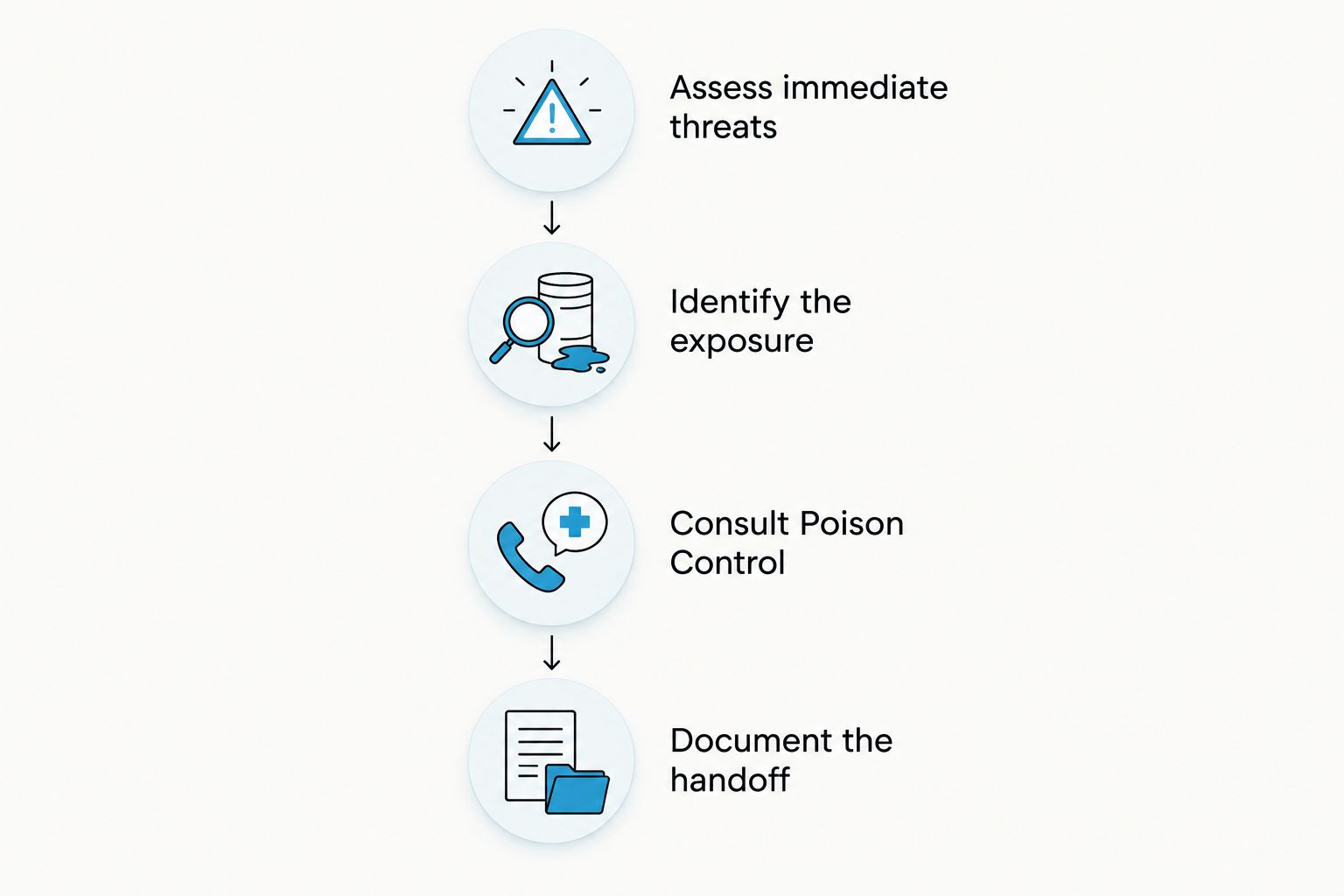
The assessment sequence connects immediate threats, exposure history, specialist advice, and handoff. Keep those elements visible in your documentation so product investigation never displaces patient care.
Choose the right response resource
These resources answer different questions. Use emergency care for an unstable patient, Poison Control for exposure-specific advice, and regulatory records for product investigations. None is a substitute for the others.
| Resource | Best for | Main strength | Key limitation |
|---|---|---|---|
| EMS and emergency department | Serious symptoms or an uncertain acute illness | Assessment, stabilization, and escalation of care | Product identity can remain uncertain |
| Poison Control | Patient-specific poisoning questions | Advice based on the reported exposure and clinical condition | Consultation does not replace hands-on emergency care |
| Agency medical direction | Protocol, treatment, and disposition decisions | Clinical oversight within the local response system | Advice depends on accurate assessment and reporting |
| State cannabis regulator | Recall notices and regulated-product identifiers | Official information for that jurisdiction | No individualized medical assessment |
| Product laboratory report | Understanding a sample’s reported results | Lists measured analytes and testing information | Does not prove safety or identify the cause of illness |
For a 2026 incident, check current official notices rather than relying on a screenshot or social-media claim. US cannabis requirements vary by jurisdiction, and an absence of a recall does not establish safety. Record the issuing agency, affected identifiers, notice date, and instructions when a relevant notice exists.
Common mistakes first responders make
Accepting cannabis as the complete diagnosis
A witness’s account can narrow the history but cannot exclude another illness. Document suspected exposure separately from your assessment findings. Reopen the differential when the course, severity, or physical findings do not fit the initial explanation.
Turning a package total into a patient dose
A container’s stated cannabinoid content is not a measurement of what entered the patient. Missing pieces, shared food, an uncertain serving size, or unreliable labeling leave uncertainty. Report those limits instead of presenting a calculated amount as established fact.
Using a passing report to dismiss symptoms
A laboratory pass applies to specified tests and a particular sample under the relevant testing rules. It is not medical clearance. Dubcharge’s cannabis exposure education treats laboratory results as supporting information, never a reason to ignore an abnormal clinical presentation.
Handling damaged devices as ordinary litter
A leaking or damaged cannabis device can present both a substance-contact problem and a battery hazard. Do not activate, charge, open, or attempt to repair it. Separate patient care from disposal decisions and follow agency hazardous-material and battery procedures.
Giving an automatic all-clear after improvement
Reduced anxiety or improved conversation is useful reassessment information, not a universal release criterion. Disposition must account for the full presentation, possible co-exposures, consultation, and local requirements. Do not substitute an informal cannabis checklist for your agency’s assessment process.
Address storage, disposal, and follow-up
Once urgent care is arranged, reduce the chance of another exposure. Advise responsible adults to keep cannabis in its original labeled, child-resistant packaging, locked away from children and pets, and separate from ordinary food. Child-resistant packaging is not childproof.
Keep potentially recalled material secured while checking the issuing authority’s instructions. Do not improvise a return, transfer, or destruction method. For devices containing lithium-ion batteries, EPA guidance excludes household trash and ordinary curbside recycling; local collection instructions determine the appropriate destination.
For 2026 follow-up documentation, retain the distinction between a reported exposure, a suspected adverse effect, and a confirmed finding. That distinction helps receiving clinicians and public-health investigators interpret the record without overstating what the scene established.
FAQ
What should a first responder do first after a suspected cannabis exposure?
Assess immediate threats to airway, breathing, circulation, and responsiveness under local protocols. Do not delay necessary emergency care while identifying a product or obtaining packaging.
When should someone call 911 instead of waiting for Poison Control advice?
Call 911 for unresponsiveness, abnormal breathing, seizures, collapse, or other serious symptoms. Poison Control consultation can support care, but it must not delay emergency activation or stabilization.
What number should US responders call for cannabis poisoning advice?
Call Poison Control at 1-800-222-1222 for exposure-specific advice in the United States. Provide the patient’s condition, route, timing, suspected substances, and care already given.
Does a positive cannabis test prove the cause of altered mental status?
No, a positive cannabis urine screen does not establish the cause of current symptoms or prove current impairment. Continue assessing alternative illnesses, injuries, and co-exposures according to the clinical presentation.
Does a passing cannabis lab report mean the product is safe?
No, a passing report does not prove product safety. It describes a tested sample and specified measurements, not every possible hazard or the patient’s actual exposure.
Should responders make someone vomit after swallowing a cannabis edible?
No, do not induce vomiting after a suspected cannabis ingestion. Seek Poison Control advice and avoid giving anything by mouth to a patient whose alertness or swallowing is impaired.
Can naloxone reverse cannabis intoxication?
Naloxone does not reverse cannabis intoxication. If opioid poisoning is suspected, follow your opioid-response protocol and provide indicated emergency care without waiting for certainty about the substance.
One last thing
The most useful product detail can be the batch identifier, not the advertised strength. A batch identifier helps compare packaging with a recall notice or laboratory report; advertised strength cannot establish the patient’s dose. Photograph identifying information when safe, but never let that task delay care.


Leave a comment
This site is protected by hCaptcha and the hCaptcha Privacy Policy and Terms of Service apply.