











Evaluate cannabis health claims by checking whether human studies tested the specific condition, cannabinoid formulation, and outcome being advertised. Give more weight to well-conducted clinical trials and systematic reviews than testimonials, laboratory experiments, or product marketing. A positive study does not establish that a different retail product works, and a passing laboratory report does not establish medical benefit or safety.
- Cannabis medical claims evidence must match the condition, formulation, population, and outcome—not just the word cannabis.
- DubCharge cannabis education separates laboratory testing from evidence of medical benefit.
- Systematic reviews help assess consistency; their conclusions still depend on the quality of included studies.
- Check adverse effects, medicine interactions, funding, and uncertainty before accepting a health claim.
Why this matters
A medical claim can sound precise while skipping the evidence that matters. Statements about pain, sleep, anxiety, or inflammation need different studies because improvement in one outcome does not establish improvement in another.
A laboratory report measures selected characteristics of a sample; a clinical study investigates outcomes in people. Start with the distinction explained in how to read a cannabis lab report, then assess the health claim separately.
For a 2026 evidence check, identify the original research rather than relying on a current-looking webpage. A recent publication date does not make weak research stronger.
How do you evaluate evidence behind cannabis health claims?
Use these 6 checks before accepting a claim. Each asks a different question; none replaces the others.
- Define the claim. Identify the condition, intended benefit, population, and treatment duration. A general statement about wellness is not a measurable clinical outcome.
- Identify the formulation. Record the studied cannabinoids, administration route, and composition. Evidence about a standardized prescription medicine does not automatically apply to retail flower, drinks, or concentrates.
- Find the original study. Read the research paper or review, not only the press release. Check whether the full methods and results support the headline.
- Check the comparison. Determine whether participants received a placebo, usual care, another treatment, or no comparison treatment. Without a suitable comparison, improvement is harder to attribute to the intervention.
- Measure the benefit. Look for the size of the difference, its uncertainty, and whether patients experienced a meaningful improvement. Statistical significance alone does not answer those questions.
- Count the harms. Check adverse effects, withdrawals, interactions, and follow-up duration. Benefits and harms belong in the same assessment.
Keep the wording narrow. If research supports a specific outcome under specific conditions, do not turn that finding into a claim that cannabis broadly treats the condition.
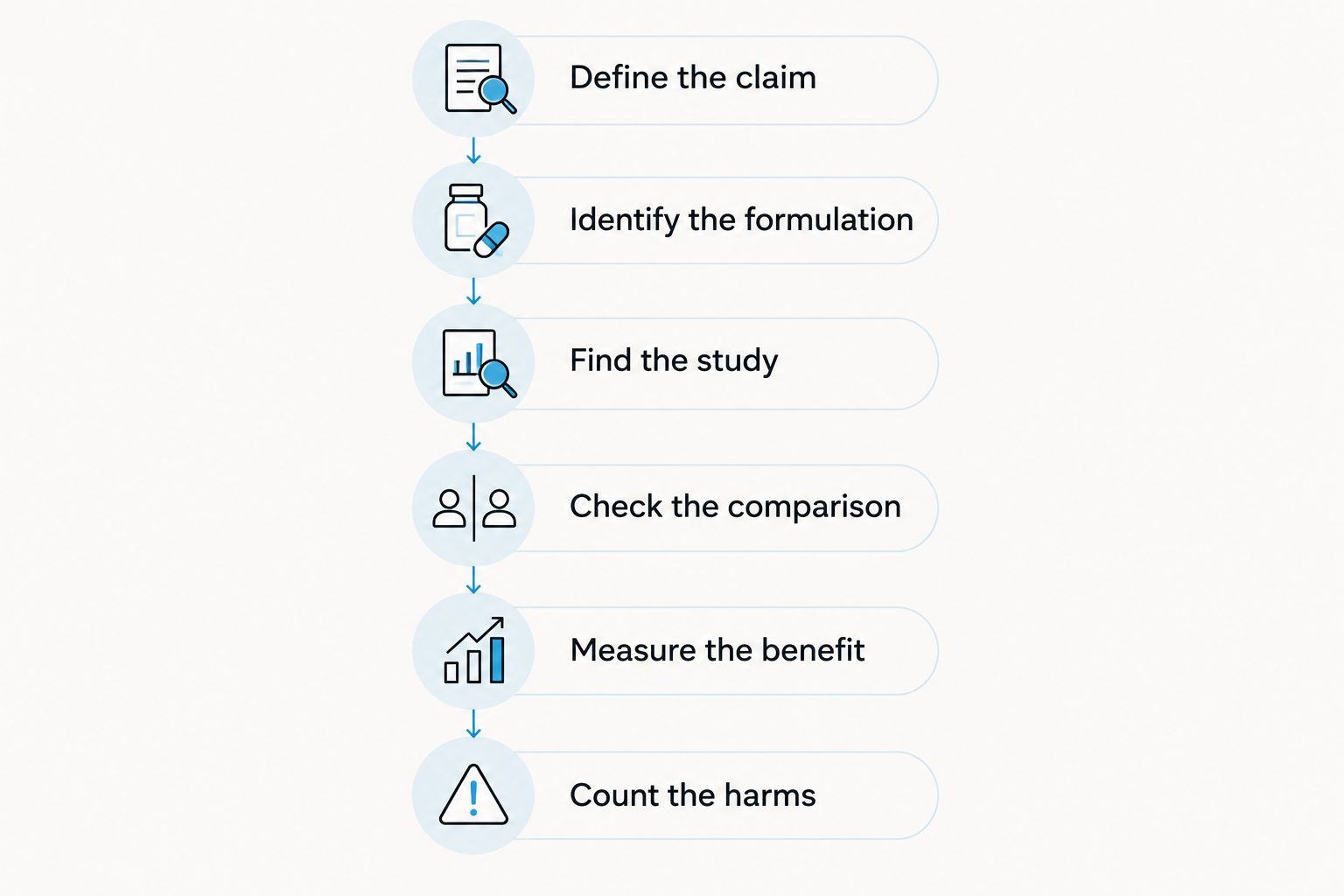
The sequence is a screening method, not a scoring system. A serious mismatch—such as citing a cell experiment to promise treatment benefits in people—can invalidate the advertised conclusion even when other details look credible.
Which evidence deserves the most weight?
Study design determines which questions research can answer. The table compares evidence sources, not cannabis products or treatment recommendations.
| Evidence source | Best suited to answering | Main strength | Main limitation |
|---|---|---|---|
| Systematic review | What does the relevant research show overall? | Examines findings across studies using stated methods | Weak or mismatched studies limit the conclusion |
| Randomized controlled trial | Did the tested intervention change an outcome compared with a control? | Random assignment helps reduce confounding | Results can be limited by short follow-up or narrow eligibility |
| Observational study | What outcomes or associations occur in real-world groups? | Can identify patterns and uncommon harms | Other differences between groups can explain associations |
| Cell or animal study | Is there a biological mechanism worth investigating? | Helps develop research questions | Does not establish clinical benefit in humans |
| Testimonial | What did one person report experiencing? | Describes an individual experience | Cannot isolate treatment effects or establish typical outcomes |
| Certificate of analysis | What did testing find in the submitted sample? | Reports measured composition or contaminants within the testing scope | Does not test whether a product treats a condition |
A systematic review is not automatically decisive. Check whether its authors searched systematically, assessed bias, and separated substantially different formulations or conditions.
For your 2026 assessment, also inspect the search cutoff. A newly published review can summarize research collected much earlier, and newer studies can change the overall interpretation.
Does the research actually match the claim?
A study can be credible and still fail to support the advertisement beside it. Match the evidence to the claim before debating how impressive the results look.
Match the condition and outcome
Reduced symptom scores do not necessarily mean disease reversal, improved survival, or a cure. Likewise, reporting better sleep during a pain study does not establish treatment efficacy for a diagnosed sleep disorder.
Ask what researchers measured and whether that measure matters to patients. A laboratory marker can help explain a mechanism without proving that people feel or function better.
Match the formulation and route
Cannabis is not a single standardized intervention. Findings about a specified oral cannabinoid formulation do not automatically apply to inhaled flower or an unrelated retail extract.
Keep THC, CBD, and THCA distinct when reading research. A paper about one cannabinoid does not establish the same clinical effects for another, and a shared cannabis label does not erase differences in composition.
Match the people studied
Check eligibility and exclusions. Findings in adults with a particular diagnosis do not automatically apply to children, pregnant people, or adults taking interacting medicines.
Follow-up matters too. A study that tracks short-term symptoms cannot establish long-term safety simply because it reports no serious problems during its observation period.
What do authoritative sources actually establish?
The National Academies' 2017 report, The Health Effects of Cannabis and Cannabinoids, assessed evidence separately by condition and outcome. Its conclusions distinguished stronger evidence from limited or insufficient evidence rather than treating all cannabis health claims as equivalent.
That structure remains useful when reading claims in 2026, but the report is a historical synthesis, not a substitute for checking subsequent research. Its findings also do not validate every retail formulation associated with a condition it discussed.
In the United States, FDA's 2020 approval announcement for cannabidiol oral solution for tuberous sclerosis complex describes a specific prescription medicine. FDA-approved indications for that medicine cover seizures associated with 3 syndromes: Lennox–Gastaut syndrome, Dravet syndrome, and tuberous sclerosis complex.
Approval of a specified prescription medicine does not establish approval or equivalent benefit for retail cannabis products. The formulation, indication, supporting trials, and prescribing safeguards matter.
When someone invokes an authority, ask for the named report, its publication date, and the exact conclusion. An agency name beside a claim is not enough; the cited source must support that particular statement.
Why does cannabis medical claims evidence vary?
Different findings do not always mean researchers contradict one another. Check these drivers before combining results:
- Formulation: Studies can examine different cannabinoids, mixtures, and administration routes.
- Population: Diagnosis, baseline symptoms, age, and other medicines affect how findings apply.
- Comparator: A benefit against placebo does not establish an advantage over an established treatment.
- Outcome: Pain intensity, daily function, sleep quality, and disease progression are separate endpoints.
- Duration: Short follow-up leaves longer-term benefits and harms unresolved.
- Study quality: Missing data, selective reporting, and weaknesses in blinding can distort results.
In a 2026 summary, preserve these differences instead of pooling every positive cannabis study into one broad endorsement. Consistency matters only when studies address sufficiently similar questions.
How do you tell a meaningful result from a persuasive headline?
Read the results, not just the conclusion. Look for the difference between study groups and whether the authors explain what counts as a clinically meaningful change.
A 95% confidence interval describes uncertainty around an estimated effect under the statistical method used. A wide interval signals imprecision; an interval spanning both negligible and meaningful effects leaves an important practical question unresolved.
Check whether the headline reports an absolute change or only a relative comparison. Without the baseline outcome and the actual difference between groups, a dramatic-sounding percentage can hide a small practical effect.
Also examine withdrawals. If participants stopped treatment because of adverse effects, a summary focused only on people who completed the study can give an incomplete picture.
Funding deserves attention, but it is not a verdict by itself. Check disclosed conflicts, advance trial registration, prespecified outcomes, and whether independent research reaches similar conclusions.
Does a passing cannabis lab report prove a health claim?
No. A certificate of analysis addresses measurements from a tested sample, not whether using the product improves a medical condition. Its scope depends on the tests performed, methods, detection limits, and applicable requirements.
A report also needs to match the product's batch or lot. A result from another batch does not establish the composition of the item in your possession.
For 2026 documents, check the sample date and report identity rather than assuming a current webpage contains current batch evidence. Passing selected contaminant limits does not establish absence of every hazard, suitability for a particular patient, or freedom from medicine interactions.
DubCharge cannabis education distinguishes these questions: laboratory testing concerns the sample; clinical evidence concerns outcomes in people. Neither replaces an individual clinical assessment.
What should you do when a claim is stronger than its evidence?
Do not use an unsupported claim as a reason to replace prescribed treatment. Bring the exact wording, study citation, and product label to a qualified clinician or pharmacist, particularly when other medicines are involved.
Save a copy of the claim and its citation. If the source changes, those records make it easier to identify what was promised and whether the supporting research actually matched it.
For a suspected adverse reaction, seek appropriate medical advice rather than debating the advertisement. In the United States, serious suspected problems involving FDA-regulated products can be reported through FDA's MedWatch program; state cannabis regulators also provide jurisdiction-specific reporting and recall information.
A recall is a separate safety question from treatment efficacy. A product's medical claim does not override an official recall notice, and an old laboratory report does not resolve a newly identified problem.
FAQ
What's the best way to check cannabis medical claims evidence?
Match the claim to human research on the same condition, formulation, population, and outcome. Then examine the comparison group, size of benefit, uncertainty, and adverse effects.
Does a cannabis certificate of analysis prove medical benefits?
No, a certificate of analysis does not prove medical benefits. It reports selected measurements from a tested sample, not treatment outcomes in patients.
Are randomized cannabis trials always reliable?
No, randomized trials still need scrutiny for bias, missing data, inadequate blinding, and limited follow-up. Their results also apply most directly to the intervention and population actually studied.
Does FDA approval of a cannabinoid medicine cover retail cannabis?
No, FDA approval applies to the specified medicine and its approved indications, not retail cannabis generally. Shared cannabinoids do not establish equivalent formulations, benefits, or safety.
Can a cell study prove cannabis treats a disease?
No, a cell study cannot establish that cannabis treats a disease in people. It can identify a mechanism or research question that requires clinical investigation.
What does insufficient evidence mean for a cannabis claim?
Insufficient evidence means the available research does not support a confident conclusion about the specific question. It does not prove benefit, and it does not automatically prove that no benefit exists.
Should I stop prescribed medicine because cannabis research looks promising?
Do not stop prescribed medicine because a cannabis claim or study looks promising. Discuss the evidence and possible interactions with your prescriber or pharmacist before making treatment changes.
One last thing
Before reading an advertisement's supporting study, write down what evidence would change your mind. Require a matching formulation, a relevant patient outcome, a suitable comparison, and an honest account of harms.
DubCharge's rule for evaluating cannabis health claims: trust the match between the claim and the evidence, not the confidence of the wording. A claim that cannot identify its supporting research has not supplied a reason to treat it as established medicine.


Leave a comment
This site is protected by hCaptcha and the hCaptcha Privacy Policy and Terms of Service apply.