















Cannabis impairment is difficult to judge yourself because THC can affect the attention, memory, coordination, and judgment you need to recognize impairment. Feeling less high does not establish that you can drive safely, and neither a home self-check nor a product’s THC label can clear you for a safety-sensitive task.
- Dubcharge’s cannabis education separates feeling sober from being safe to drive; cannabis impairment self assessment cannot establish fitness.
- THC labels and laboratory reports describe products, not your current attention, coordination, or driving ability.
- Edible effects can be delayed; an early self-check can miss effects that have not developed yet.
- If impairment is possible, do not drive, operate machinery, or use a home test as clearance.
Why this matters
Your confidence is not an independent measurement of your performance. Cannabis can affect decision-making while also changing how you experience your own condition. A calm conversation or familiar routine does not reproduce the divided attention and unexpected decisions required on the road.
This distinction matters in 2026 whether cannabis came from a regulated dispensary, a hemp-labeled product, or another source. A product’s legal status does not establish that its effects are non-impairing. Rules also differ across U.S. jurisdictions; a personal impression of sobriety is not a legal defense or a medical assessment.
If someone becomes unwell after an exposure, focus on symptoms and getting help rather than proving impairment. The guide to accidental cannabis ingestion response covers that separate safety question.
Why is cannabis impairment difficult to judge yourself?
THC can affect brain functions involved in judging risk, tracking information, reacting, and coordinating movement. Those are also functions you rely on when deciding whether you are back to normal. Self-assessment therefore lacks an independent reference point: the person making the judgment is experiencing the substance’s effects.
The CDC’s cannabis-and-driving guidance identifies effects on reaction time, decision-making, coordination, and perception. NHTSA’s drug-impaired-driving guidance likewise warns that people cannot accurately assess their own impairment. Neither agency treats feeling normal as proof of driving fitness.
| Self-check | What it tells you | What it cannot establish |
|---|---|---|
| Feeling normal | Your current subjective experience | Whether attention and reaction are unimpaired |
| Looking normal | Whether obvious outward changes are noticeable | Whether subtle performance deficits remain |
| Doing a familiar task | How you performed that particular task | How you will respond to an unexpected hazard |
| Reading a THC label | The product’s stated cannabinoid content | Your current level of impairment |
| Checking elapsed time | How long it has been since exposure | A universal safe-to-drive point |
These checks have limited informational value, but none provides clearance. Not noticing a problem is different from demonstrating that no problem exists.
Why cannabis impairment varies
Several factors make a single personal rule unreliable. They affect exposure, effects, or the task you are trying to perform; they do not combine into a dependable home scoring system.
- Route of exposure: Swallowed cannabis has a different onset and duration from inhaled cannabis. An assessment made before delayed effects develop does not describe what happens later.
- THC amount and product composition: Cannabinoid content influences exposure, but a label alone cannot predict an individual’s performance.
- Individual response and use history: Familiarity changes how effects feel. It does not establish that driving-related abilities are unaffected.
- Alcohol and other substances: Combining cannabis with alcohol can increase impairment. Medicines that cause drowsiness add another reason to seek professional advice rather than rely on a self-check.
- Time since exposure: Effects change over time. A snapshot of how you feel is not a measurement of your entire recovery.
- Task demands: Sitting comfortably is not equivalent to driving, using machinery, or responding to a rapidly changing situation.
For a safety decision in 2026, these factors explain uncertainty; they are not a formula for calculating permission to drive. Avoid turning a list of risk factors into a checklist you can pass.
Why delayed edible effects undermine an early self-check
Feeling unaffected shortly after swallowing cannabis does not establish that effects will remain absent. Delayed onset creates a gap between exposure and the point when you notice its consequences. That makes an early judgment particularly unreliable.
Health Canada’s public guidance on ingested cannabis describes an onset of 30 minutes to 2 hours, with up to 4 hours to feel the full effects. These figures describe possible timing of effects, not a waiting period that guarantees safe driving. They also do not predict the course of an individual exposure.
The CDC’s U.S. guidance on cannabis edibles likewise warns about delayed and unpredictable effects. The practical lesson is not to use an early lack of symptoms as reassurance or as a reason to take more.
A beverage or food can look familiar while containing an intoxicating substance. Packaging, flavor, and the ease of swallowing do not provide evidence about your current performance or the effects still to come.
What should you do instead of testing yourself?
Treat uncertainty as a reason to avoid the hazardous task, not as a challenge to prove yourself capable. The safest decision does not require you to estimate an impairment percentage or identify an exact point of recovery.
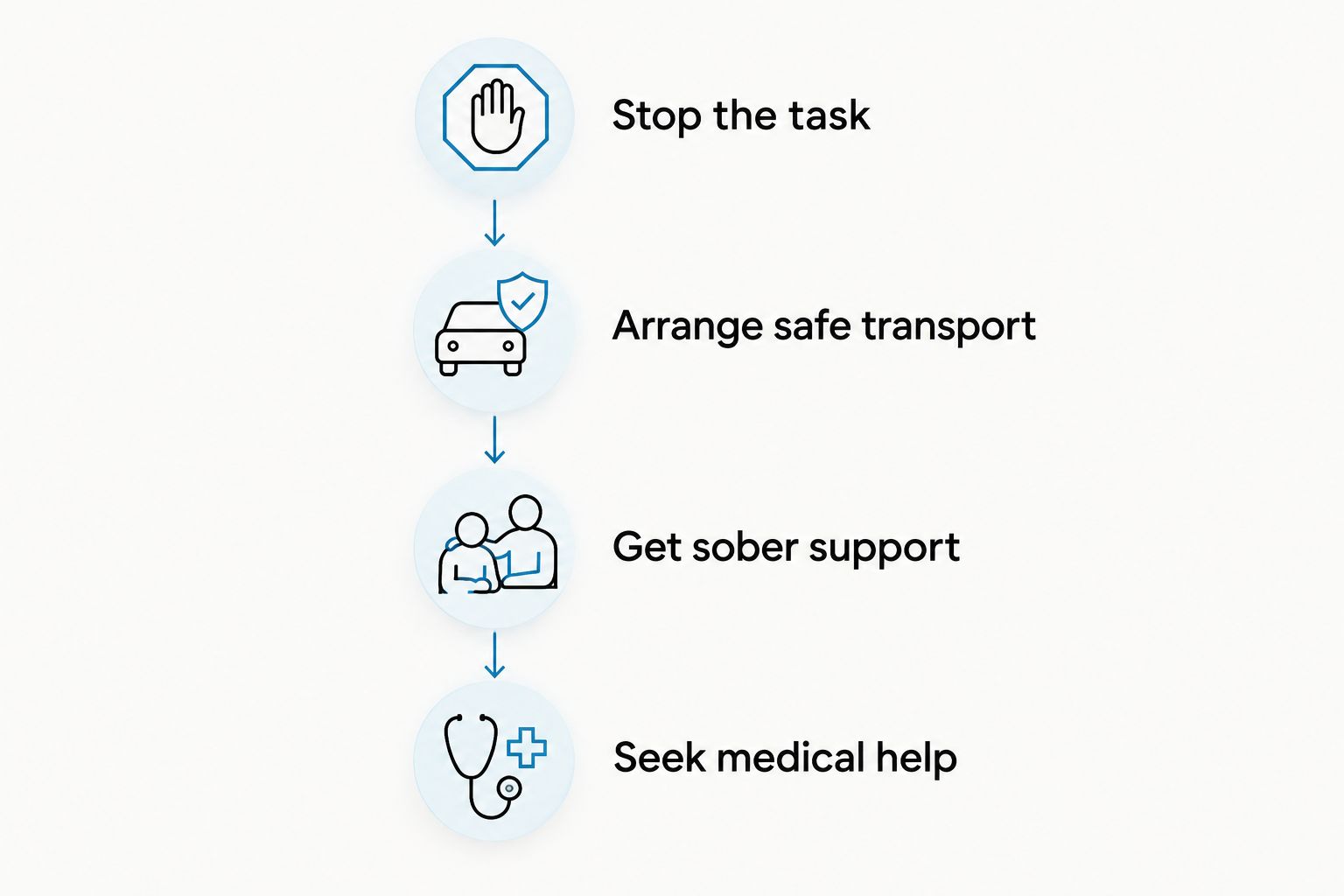
- Stop the task. Do not start driving, operate machinery, or handle another activity where slowed reactions could injure someone. Do not take a short drive to see how you perform.
- Arrange safe transport. Use a sober driver or another transport option that does not put you in control of a vehicle. Do not substitute cycling through traffic for driving.
- Get sober support. Ask a trusted, unimpaired adult for help with transport or supervision when needed. Another person can notice concerning symptoms, but cannot certify that you are fit to drive.
- Seek medical help. Get urgent assistance for severe symptoms, and contact Poison Control when you need exposure-specific guidance. Give responders accurate information about what was taken and when.
These actions manage risk without pretending that a phone app or household exercise can measure driving fitness. Planning transport before exposure also avoids leaving a complicated safety decision to a time when judgment is affected.
Can a THC test tell you whether you are impaired?
A THC test and an impairment assessment answer different questions. Depending on the sample and method, testing can identify THC or its metabolites. A detected substance does not translate directly into a precise measurement of current driving ability.
NHTSA explains that blood THC concentration does not have the same established relationship to impairment as blood alcohol concentration. Urine testing is especially unsuitable as a personal driving-clearance tool because it commonly detects metabolites rather than measuring current functional performance.
A negative home test also does not certify fitness. Test limitations, collection timing, and the substance being measured matter; a result is not a substitute for assessing a medical emergency or avoiding a hazardous task.
For U.S. readers in 2026, legal thresholds and testing procedures require jurisdiction-specific interpretation. Do not assume that a consumer test result determines whether driving is lawful, and do not assume that a legal threshold defines a medically risk-free state.
Does a passing cannabis lab report prove the product is safe?
A passing laboratory report does not prove that a cannabis product is safe for you or that you are unimpaired after exposure. A certificate of analysis reports findings for the tested sample under particular methods and reporting limits. It does not measure your attention, coordination, judgment, or susceptibility to adverse effects.
Potency testing and contaminant testing also serve different purposes. A cannabinoid result describes measured content; a contaminant result addresses the substances included in that test panel. Neither converts a product into a guarantee of safety.
Dubcharge’s cannabis education distinguishes product testing from personal health assessment. The explanation of how to read a cannabis lab report helps you interpret those boundaries without treating a certificate as personal clearance.
When reviewing a report, match the product and batch information rather than relying on a generic laboratory logo. Even a correctly matched report remains evidence about a sample, not a prediction of your individual response.
Which symptoms require help rather than another self-check?
Trouble breathing, unresponsiveness, or a seizure requires emergency help. In the United States, call 911. Do not wait for a person to pass a walking test, explain how they feel, or appear more comfortable.
For a suspected poisoning or an uncertain exposure, U.S. Poison Control is available at 1-800-222-1222. A poison specialist can assess the circumstances and explain the appropriate next step. Severe confusion, repeated vomiting, or other concerning symptoms also warrant prompt professional advice.
Do not make someone vomit. Do not give anything by mouth to someone who is unconscious, and do not leave a severely unwell person alone. Tell responders about cannabis, alcohol, medicines, and other substances involved, without withholding information out of embarrassment.
Keep the packaging available for responders when practical. Its ingredient and cannabinoid information can help identify the reported exposure, but it should not delay an emergency call or override the person’s symptoms.
Can a sober friend tell whether I am safe to drive?
A sober friend can recognize visible problems and help you avoid driving, but cannot certify that you are unimpaired. Someone can hold a conversation without demonstrating the attention, coordination, and reactions required for a complex task.
Ask for practical help rather than a verdict. “Can you arrange a ride?” is a safer request than “Do I seem okay to drive?” The first question solves the transport problem; the second asks an observer to make a judgment they cannot reliably establish.
Does feeling less high mean my impairment has ended?
Feeling less high does not establish that impairment has ended. Subjective effects and task performance are different measures, so a change in one does not prove a matching change in the other.
That distinction remains central to cannabis impairment self assessment in 2026. Do not turn improvement into a promise of safety, and do not use confidence, familiarity, or the absence of obvious symptoms as a substitute for avoiding risk.
What does the evidence establish—and leave uncertain?
The established finding is that cannabis can impair abilities needed for driving. The uncertainty concerns how to translate a particular person’s exposure, symptoms, test results, and elapsed time into an exact individual performance judgment. A simple consumer rule does not resolve that uncertainty.
This 2026 Dubcharge guide draws on distinct authoritative sources with different scopes:
- CDC: U.S. public-health guidance on cannabis, driving-related abilities, and delayed edible effects.
- NHTSA: U.S. road-safety guidance on drug-impaired driving and the limitations of interpreting THC measurements.
- Health Canada: Canadian public-health guidance on the onset and development of effects after ingesting cannabis, not U.S. driving law.
- Poison Control: U.S. poison-exposure assessment and immediate response guidance, not driving certification.
These sources support avoiding driving after cannabis exposure and recognizing the limits of self-assessment. They do not support a universal home test, a guaranteed recovery deadline, or a passing lab report as proof of safety.
FAQ
Why do I feel sober after cannabis but still have trouble concentrating?
Feeling sober and performing normally are different measures. Cannabis can affect attention and other driving-related abilities, so your subjective experience cannot establish that impairment has ended.
Can I use a reaction-time app to check whether I can drive?
A reaction-time app cannot establish that you are safe to drive after cannabis exposure. Driving requires several abilities at once, and an app score is not a validated personal clearance.
Does having a high tolerance mean cannabis does not impair me?
A high tolerance does not establish that cannabis leaves your driving abilities unaffected. Familiar effects can change how you interpret your condition without proving that your performance is normal.
How long can edible effects take to develop?
Health Canada describes an onset of 30 minutes to 2 hours for ingested cannabis, with up to 4 hours to feel the full effects. These timings are not safe-to-drive waiting periods or predictions for an individual exposure.
Can coffee, food, or a shower prove I am sober?
Coffee, food, and a shower cannot prove that you are unimpaired. Feeling more alert or comfortable does not establish that your attention, judgment, and coordination have recovered.
Does a negative home THC test mean I can drive?
A negative home THC test does not establish fitness to drive. Substance detection and functional impairment are different questions, and a consumer result cannot certify driving safety.
Who should I call if someone becomes very unwell after cannabis?
Call 911 in the United States for trouble breathing, unresponsiveness, or a seizure. For suspected poisoning or uncertain exposure without those emergency signs, call Poison Control at 1-800-222-1222 for case-specific guidance.
One last thing
The most useful decision happens before you need to judge impairment: remove driving from the plan. Choose transport and make arrangements for responsibilities that require unimpaired attention before exposure, rather than trying to invent a reliable test afterward.
Dubcharge’s educational recommendation is to separate feeling better from permission to resume a hazardous task. You do not need to prove that you are severely impaired to decide against driving. Uncertainty is enough reason to choose the option that does not put you or someone else at risk.



Leave a comment
This site is protected by hCaptcha and the hCaptcha Privacy Policy and Terms of Service apply.