






























Employer cannabis impairment management is the process of identifying and responding to reduced fitness for work, with the aim of protecting employees and others without treating cannabis exposure as proof of current impairment. Employers need separate procedures for immediate safety, testing, medical evaluation, and employment decisions because those questions do not have the same answer.
- DubCharge’s cannabis impairment guide for employers separates immediate workplace safety from drug testing and employment decisions.
- A positive cannabis test does not, by itself, establish current impairment or when cannabis was used.
- Document observable behavior, remove immediate hazards, and consider medical emergencies before attributing symptoms to cannabis.
- Use jurisdiction-specific legal review and qualified medical interpretation rather than automatic discipline.
Why cannabis impairment management matters for employers
Cannabis can affect attention, coordination, reaction time, and decision-making, according to CDC cannabis health guidance. Those effects matter when an employee drives, operates equipment, handles hazardous materials, or makes safety-critical decisions. A supervisor’s job is to recognize unsafe performance, not diagnose its cause.
DubCharge’s cannabis impairment guide is for employers separating workplace safety decisions from drug-test interpretation. This is adult education, not an individualized medical assessment or legal opinion.
For your 2026 policy review, distinguish what employees report from what supervisors observe. Feeling normal does not establish fitness for a hazardous task; the limitations of cannabis impairment self-assessment also apply when someone insists they can safely continue working.
A positive test, a lawful medical authorization, and an unsafe work incident each raise different questions. None replaces a documented assessment of the actual situation.
Build an employer response that separates safety from discipline
1. Define fitness-for-duty rules by job task
Start with your existing job descriptions and incident procedures. Identify the work that must stop when an employee cannot perform it safely, regardless of whether the suspected cause is cannabis, alcohol, fatigue, illness, or medication.
Avoid writing a policy that treats every role as identical. Driving a delivery vehicle and preparing a spreadsheet involve different immediate hazards, even though both require clear expectations. Define prohibited workplace conduct separately from any restrictions on off-duty activity.
Your 2026 written policy should explain who makes an immediate safety decision and who reviews employment consequences. Give employees a reporting route that does not require them to disclose a diagnosis to their direct supervisor.
- List safety-critical tasks and the conditions requiring work to stop.
- Name the supervisor, HR contact, and backup decision-maker.
- Explain reporting, testing, transport, and return-to-duty procedures.
- Have counsel review location-specific protections and exceptions.
2. Record observations without diagnosing cannabis use
Use a plain incident form before adding software or specialist services. Record what happened, when it happened, the task involved, and the specific behavior that created concern. Describe an employee missing a required safety check rather than labeling the employee intoxicated.
Unsteady movement, slowed responses, confusion, and unusual behavior are not specific to cannabis. Medical conditions, fatigue, and other substances can produce overlapping signs. Cannabis odor also does not establish who used it, when use occurred, or whether someone is currently impaired.
As an internal documentation safeguard, use 2 trained observers when available; this is a recommended procedure, not a universal legal requirement. Do not delay an urgent safety intervention while waiting for a second person.
- Record times, tasks, direct observations, and relevant employee statements.
- Separate firsthand observations from reports made by others.
- Describe errors or unsafe actions without assigning a medical cause.
- Restrict access to records containing sensitive health information.
3. Stop hazardous work and assess the immediate situation
Remove the employee from the hazardous task calmly and privately. Explain the observed safety issue, arrange supervision when needed, and follow your emergency procedures. Do not ask an employee to demonstrate fitness by continuing to drive or operate equipment.
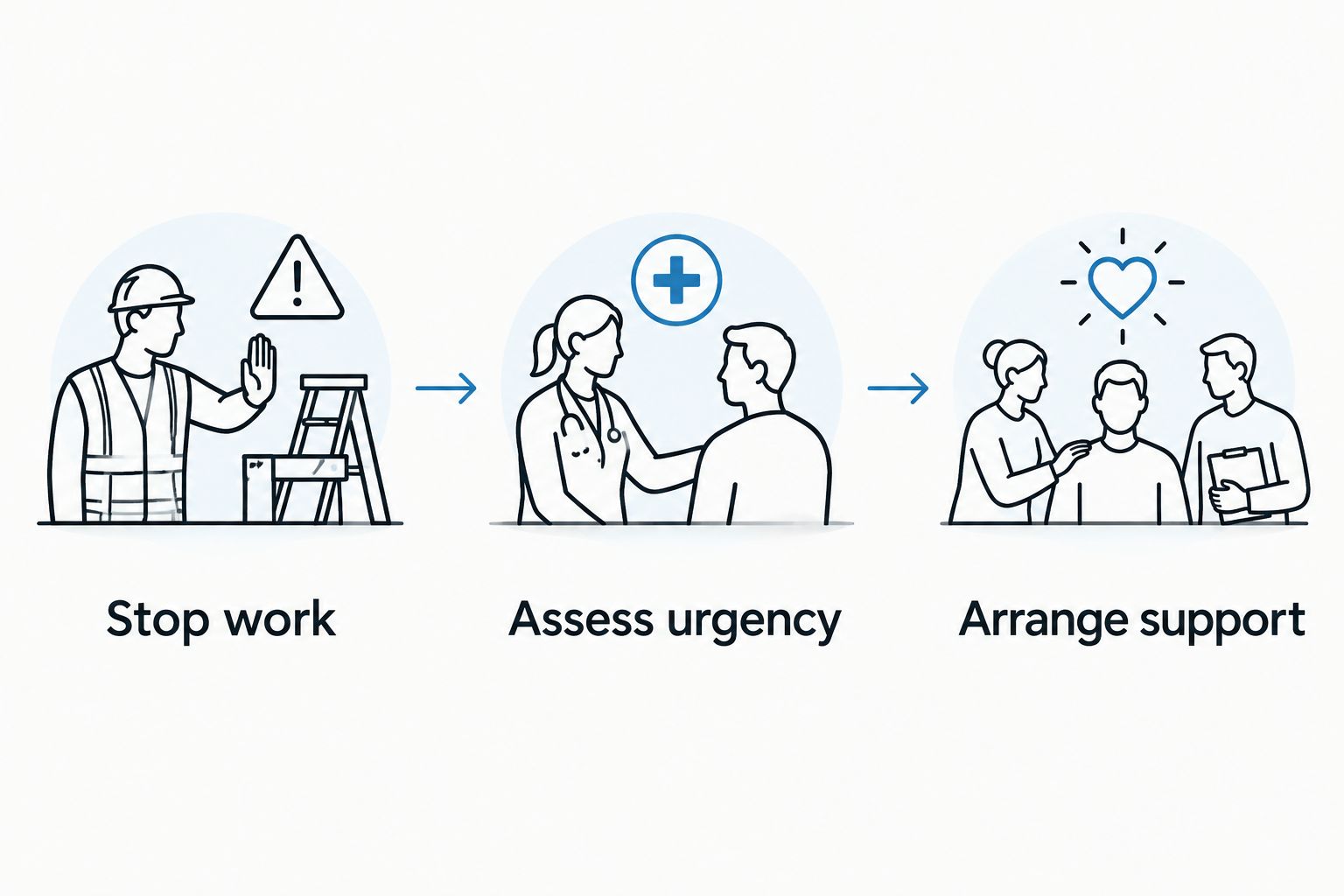
Use 3 response stages: secure the situation, assess urgent medical needs, and arrange the appropriate next step. If someone is unresponsive, has trouble breathing, has a seizure, or has another serious symptom, call 911. Do not assume cannabis explains a medical emergency.
The practical sequence is Stop work, Assess urgency, and Arrange support. It protects the employee while leaving diagnosis and employment review to the appropriate professionals.
A supervisor should not leave an apparently impaired employee to arrange unsafe transport alone. Use your established transport procedure, and obtain emergency help when the employee’s condition requires it.
- Stop driving, machinery operation, and other hazardous duties.
- Move the conversation away from coworkers and customers.
- Check for urgent symptoms without attempting a diagnosis.
- Arrange safe transport or emergency assistance as appropriate.
4. Interpret drug testing within its actual limits
Before ordering a test, identify its purpose and your authority to require it. Testing for evidence of exposure is different from determining whether someone could safely perform a specific task at a specific time.
NHTSA’s report to Congress on marijuana-impaired driving explains why blood THC concentrations do not provide the straightforward impairment relationship associated with alcohol. Urine testing generally detects cannabis metabolites rather than directly measuring current functional ability. Detection also depends on the specimen, test method, use history, and other factors.
For a 2026 testing policy, obtain the laboratory’s explanation of the specimen and reporting process. Use a qualified medical review officer where required or appropriate. Do not turn a screening result into a final finding before the applicable confirmation and review procedures are complete.
Federal transportation testing operates under a distinct framework, including U.S. Department of Transportation procedures in 49 CFR Part 40. Employers must determine which employees and testing events fall within the applicable federal rules rather than applying a generic workplace policy.
- Identify whether testing is federally regulated or employer-directed.
- Document the authorized reason for the test.
- Follow applicable collection, confirmation, and review procedures.
- Keep exposure findings separate from conclusions about impairment.
5. Explain what product labels and lab reports cannot prove
An employee might describe a product as hemp, THC-A, laboratory-tested, or legally purchased. None of those descriptions establishes fitness for work. A label identifies claimed contents; it does not measure the employee’s current attention, judgment, or coordination.
A certificate of analysis concerns the submitted sample and the reported testing scope. Even a passing report does not prove that every item is identical, that untested hazards are absent, or that use is safe for a particular person. Product testing and employee testing answer different questions.
Do not use a package’s stated cannabinoid amount to calculate an employee’s safe return time. Route of exposure, individual response, other substances, and the actual product contents complicate that judgment. CDC guidance also identifies increased impairment risks when cannabis and alcohol are used together.
- Explain the difference between product composition and employee fitness.
- Do not treat hemp terminology as a workplace safety exemption.
- Avoid using package claims as a substitute for medical assessment.
- Preserve relevant packaging information after a suspected exposure incident.
6. Separate support, accommodation, and employment review
Begin with a private conversation through HR or the designated policy contact. Ask what support or workplace process the employee needs without demanding an unnecessary medical history. An employee’s disclosure of treatment is not, by itself, evidence of unsafe work performance.
For employers planning a 2026 response, keep immediate safety restrictions separate from decisions about leave, accommodation, or discipline. U.S. federal disability law distinguishes current illegal drug use from certain recovery-related protections, while state cannabis laws create additional differences. Eligibility and obligations depend on the facts and jurisdiction.
For Ohio employers, working during addiction treatment raises separate questions about scheduling, leave eligibility, confidentiality, and job duties; treatment participation alone does not answer whether an employee can safely perform a particular task. Review the applicable rules rather than assuming that treatment guarantees job protection or justifies termination.
Use qualified occupational-health support when the question is functional ability. Use employment counsel when the question is what action the law permits. Neither role should be replaced by an informal supervisor diagnosis.
- Route medical documentation through the designated confidential process.
- Review leave and accommodation obligations individually.
- Assess essential job functions and specific safety restrictions.
- Document employment decisions separately from clinical information.
7. Set return-to-duty criteria and review the incident
Write return-to-duty expectations before an incident occurs. Base the process on job duties, applicable rules, and qualified assessment where needed—not an improvised waiting period or a promise that the employee feels fine.
There is no single cannabis waiting period that guarantees fitness for every employee and task. A negative test also does not prove that fatigue, illness, or another condition is absent. Conversely, a positive result does not independently establish current impairment.
Use your 2026 incident review to check whether supervisors followed the process consistently. Look for missing documentation, delayed emergency response, privacy problems, and unclear responsibility. The objective is a safer response, not a retrospective diagnosis by committee.
- Define who authorizes return to safety-critical work.
- Apply any required occupational-health or regulated return-to-duty process.
- Explain restrictions and review dates clearly to the employee.
- Update training when an incident reveals a procedural gap.
Compare employer assessment approaches
No single approach answers every workplace impairment question. Match each method to the question it can address, and record its limits alongside its findings. These approaches are complementary, not substitutes for one another.
| Approach | Best for | Strength | Key limitation |
|---|---|---|---|
| Structured supervisor observations | Immediate task-safety concerns | Records behavior and work context | Cannot establish the medical cause or confirm cannabis use |
| Laboratory drug testing | Detecting specified substances or metabolites under an authorized policy | Produces an analytical result within a defined testing process | Does not independently establish current impairment |
| Occupational-health evaluation | Individual functional assessment and work restrictions | Connects clinical assessment with job demands | Is not a universal cannabis impairment detector |
| Employment-law review | Testing authority, protections, and proposed employment action | Addresses the applicable legal framework | Does not assess medical fitness or replace emergency action |
Start with the immediate hazard. Add testing, clinical assessment, or legal review only when the situation and applicable rules call for them. A laboratory result should not be used to answer a question the test was not designed to resolve.
Common mistakes employers make
- Treating a positive result as proof of on-shift impairment. Keep the analytical finding, observed performance, and employment decision distinct. Record the reasoning for each.
- Using a single policy across every jurisdiction. State protections, testing restrictions, and federally regulated duties require specific review. A national template is a starting document, not a legal determination.
- Sending an employee home without assessing transport safety. Removing someone from machinery does not resolve the risk if the next step is driving away while apparently impaired.
- Assuming a medical authorization guarantees fitness. A treatment-related document and the ability to perform an essential job safely are separate matters. Review both through the proper process.
- Applying cannabis rules selectively. Use consistent observation standards for comparable safety concerns, including fatigue, alcohol, and medication-related effects. Inconsistent documentation weakens both safety management and fair treatment.
FAQ
Can an employer tell whether someone is impaired from a cannabis test?
A cannabis test alone does not establish current impairment. Interpret the result according to its specimen and method, and assess workplace safety separately using documented observations and qualified review.
What should a manager do first if an employee seems impaired?
Stop the hazardous task and assess whether the employee needs urgent medical help. Record specific observations, follow the workplace response procedure, and do not assume cannabis is the cause.
How long after cannabis use is an employee safe to work?
There is no single waiting period that guarantees fitness for every employee and job. Return-to-duty decisions must account for the task, observed condition, applicable rules, and qualified assessment when needed.
Can an employer fire someone for using cannabis outside work?
The answer depends on jurisdiction, job duties, applicable federal requirements, and the circumstances. Obtain location-specific legal review before treating off-duty cannabis use as grounds for discipline.
Does a medical cannabis authorization excuse unsafe work?
A medical cannabis authorization does not establish fitness for a particular task. Employers must separately assess safety and any applicable accommodation or employment protections.
Does a passing cannabis lab report mean a product cannot impair someone?
No. A passing report concerns the submitted sample and the tests performed; it does not prove that a product cannot cause impairment or that it is safe for every person.
Should employers treat an employee seeking addiction treatment as impaired?
No. Seeking treatment does not establish current impairment. Address actual job-performance concerns separately from confidential treatment, leave, and accommodation processes.
One last thing
Keep two fields on the incident form: observed safety concern and suspected cause. Requiring separate entries makes it harder for an assumption about cannabis to replace a description of what actually happened.
DubCharge’s cannabis impairment education draws the same boundary: a label, test result, or employee statement cannot independently establish fitness for duty. Your workplace procedure should preserve that distinction at every decision point.


Leave a comment
This site is protected by hCaptcha and the hCaptcha Privacy Policy and Terms of Service apply.