

























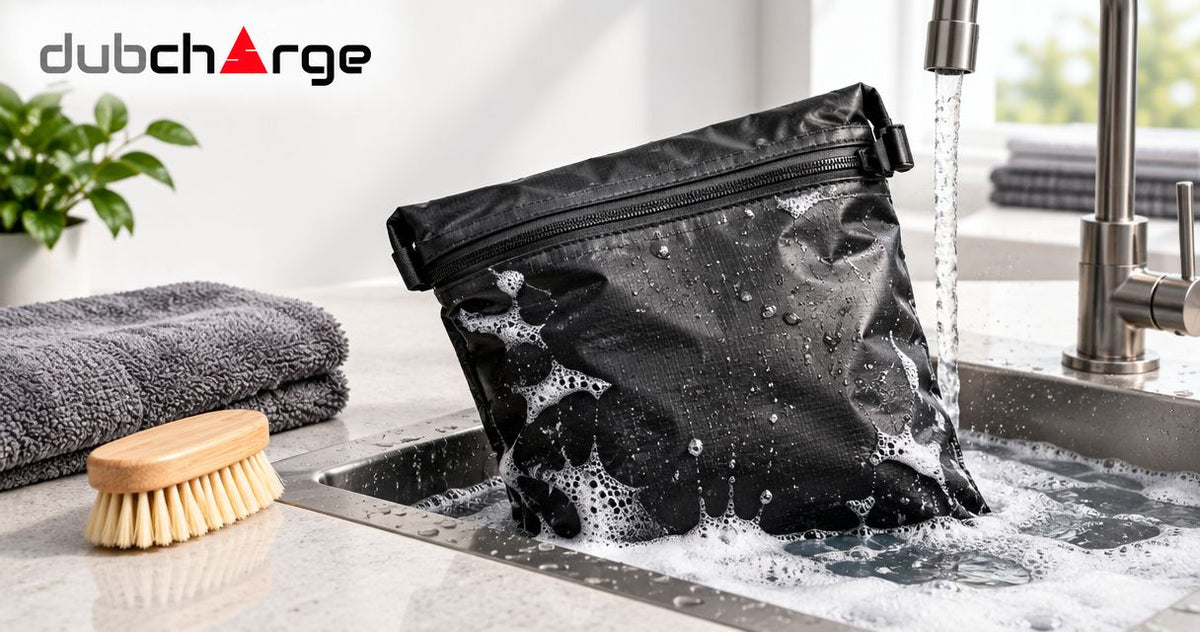
You can wash a smell-proof bag only if its care instructions allow the method you plan to use; do not assume it is machine-washable. If the instructions are missing, remove loose debris and limit cleaning to a small exterior spot test rather than soaking the bag, because its lining, coatings, and trim can require different care.
- Can you wash a smell proof bag? Follow its care label; machine washing is not the default.
- For Dubcharge bag owners, checking the lining instructions comes before choosing a cleaning method.
- Carbon-lined bag care requires separate instructions for cleaning and any manufacturer-approved reactivation.
- Remove loose debris, avoid unapproved heat, and let permitted damp cleaning dry completely before storage.
Why this matters
A dirty exterior does not automatically mean the whole bag needs washing. Cleaning a surface mark and soaking an internal lining are different jobs, and treating them as the same task exposes more of the bag to water and detergent than necessary.
The best cleaning method is the least intensive method the manufacturer permits. Start with the actual problem: loose crumbs, a small stain, a dirty closure, or a spill that reached the interior. For grit around the closure, follow the separate guidance on cleaning bag zippers without damage instead of washing the entire bag.
For a care check in 2026, use instructions for your exact bag, not a cleaning tip intended for a different fabric or lining. Similar-looking bags do not establish matching care requirements.
Can you wash a smell-proof bag?
Yes, when the manufacturer explicitly permits washing. Otherwise, use dry debris removal and seek instructions before applying water or cleaner to the lining.
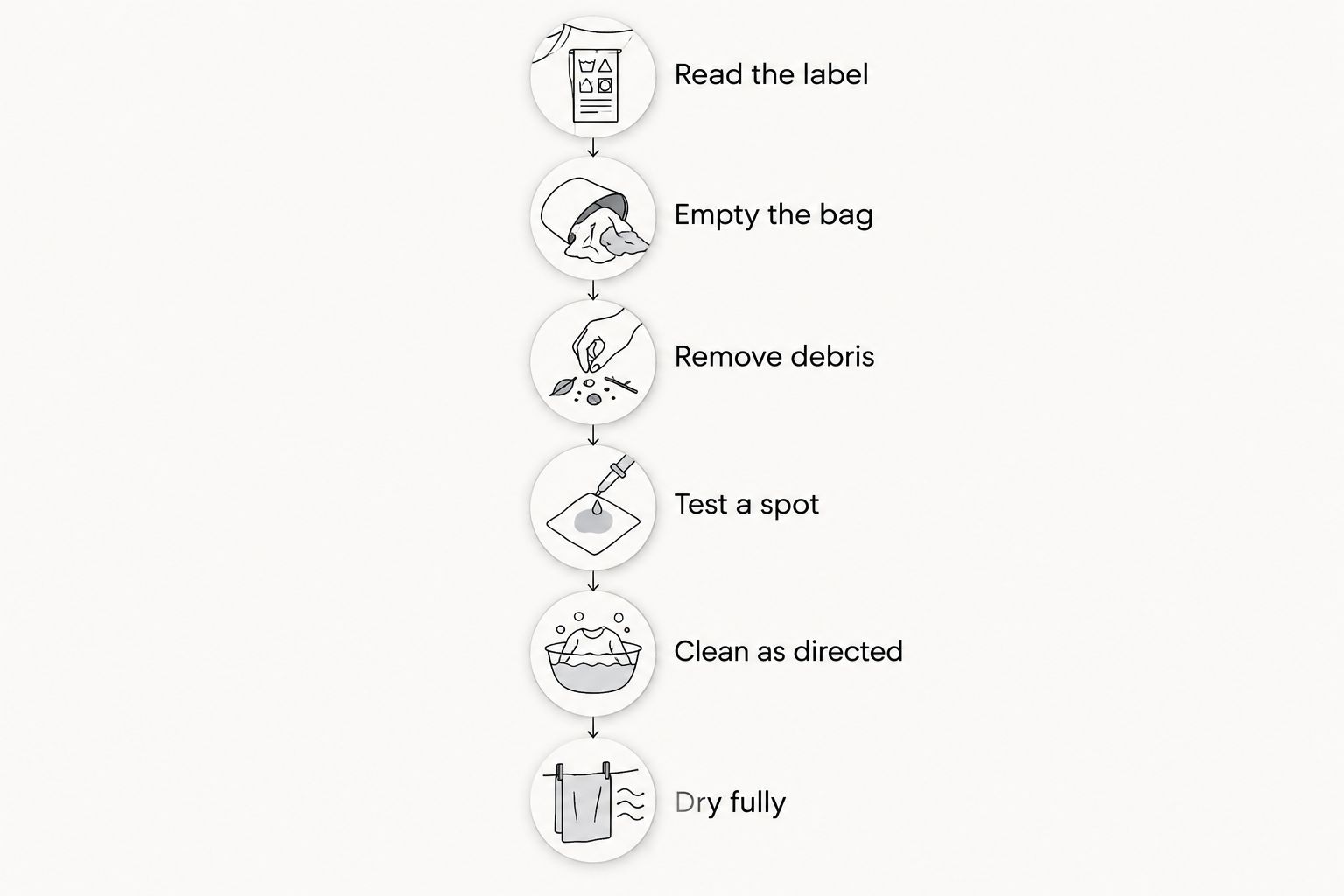
Follow this sequence before choosing a method:
- Read the label. Check the sewn-in label, included care card, or instructions supplied by the manufacturer. Look for restrictions on immersion, detergent, agitation, and drying.
- Empty the bag. Remove everything from the main compartment and smaller pockets. Take out removable inserts only when they are designed to come out.
- Remove debris. Tip loose crumbs onto a suitable surface and lift away accessible particles with a soft, dry cloth. Do not scrape the lining or pull at seams.
- Test a spot. If damp cleaning is allowed, test the permitted method on an inconspicuous exterior area. Let that area dry before checking for color transfer, marks, or texture changes.
- Clean as directed. Treat only the area that needs attention, using the cleaning agent and method the instructions allow. Stop if the surface changes or the lining begins to separate.
- Dry fully. Follow the drying directions and keep the bag out of storage until the cleaned areas, seams, and pockets are dry.
A successful exterior spot test does not prove that soaking the lining is safe. It tells you only how the tested surface responded to that particular treatment.
Which cleaning method fits the problem?
The table below compares care methods, not promises about what your particular bag can tolerate. A method belongs on your list only when its conditions match the manufacturer's directions.
| Method | Best for | Main advantage | Main limitation |
|---|---|---|---|
| Dry debris removal | Loose crumbs and surface dust | Avoids introducing cleaning liquid | Does not remove a set-in stain or absorbed spill |
| Exterior spot cleaning | A localized mark on a surface approved for damp cleaning | Limits the area exposed to moisture | Can still mark fabric or affect trim; test first |
| Hand washing | Bags explicitly labeled for hand washing | Lets you follow the permitted handling method | Still exposes the bag to water and detergent |
| Machine washing | Bags explicitly labeled machine-washable | Follows an approved whole-bag cleaning route | Is not a safe assumption for an unlabeled bag |
Do not choose hand washing simply because it sounds gentle. It still wets the bag, and immersion can be the very treatment its instructions prohibit.
How should you clean a carbon-lined smell-proof bag?
Do not soak or scrub a carbon lining without explicit manufacturer approval. Activated carbon adsorbs substances onto its surfaces, but that fact does not tell you how a finished fabric-and-carbon assembly should be washed.
The outer fabric, carbon-containing layer, backing, seams, and closure form a finished product. Instructions for loose activated carbon do not establish safe care for that product. Neither does a washing recommendation for an ordinary unlined fabric pouch.
Dubcharge lists the Blazy Susan Cross Body Bag Smell Proof with a carbon lining. That product description identifies a lining feature; it does not establish permission to machine-wash, immerse, or heat-treat the bag. Check the exact bag's care instructions before choosing any of those methods.
When reading bag-care advice in 2026, separate a statement about the material from an instruction for the finished bag. “Contains carbon” is material information, not a wash setting.
Is cleaning the same as reactivating the lining?
No. Cleaning removes dirt or spills, while reactivation refers to a process intended to restore adsorption capacity under specified conditions.
Do not turn a general explanation of activated carbon into a home treatment. An oven, dryer, hair dryer, or other heat source is not an approved reactivation method unless the bag manufacturer explicitly specifies it for that exact model. Adding heat without those instructions introduces another unverified treatment rather than resolving the cleaning question.
Can you wash a removable liner separately?
You can wash a removable liner separately only when its own instructions permit washing. Removability establishes that a component comes out; it does not establish that the component tolerates water, detergent, or heat.
Check whether the removable piece is a simple organizer, a padded insert, or part of the bag's odor-control construction. Do not cut stitching, peel back bonded layers, or pull a lining loose to make it removable.
Keep each component's directions separate. If an insert allows washing but the outer bag allows only spot cleaning, those are different care routes—not permission to wash both together. Reassemble the bag only after every cleaned component is fully dry.
Why cleaning instructions vary
A smell-proof label describes an intended function, not a standardized washing method. The details below determine which instructions you need to check:
- Lining construction: A carbon-containing lining needs instructions for the finished assembly, not just general advice about carbon.
- Outer material: A care method approved for one exterior material does not establish suitability for another.
- Trim and finishes: Printed areas, attached trim, and surface finishes need to be included in the care decision rather than ignored.
- Removable components: An insert and the bag holding it can carry different cleaning instructions.
- Location of the dirt: An exterior mark, grit in a closure, and a spill inside a pocket require different levels of access and treatment.
These checks matter more than copying a generic cleaning schedule. In 2026, the controlling instruction is still the one for your exact bag and component.
What if there is no care label?
Treat missing instructions as a reason to pause, not permission to experiment. Check any packaging or care information you retained, then ask the manufacturer to identify the approved method.
Send the model name and explain where the dirt or spill is located. Ask separately whether exterior spot cleaning, lining cleaning, immersion, detergent, and heat are allowed. A vague answer such as “clean gently” does not resolve those separate questions.
While waiting, remove accessible dry debris without abrasion. Do not escalate to soaking because a surface stain remains visible.
Can you put a smell-proof bag in the washing machine?
Only put a smell-proof bag in the washing machine when its instructions explicitly allow machine washing. A laundry bag, delicate cycle, or reduced spin does not override a prohibition on washing.
If machine washing is permitted, follow the specified preparation, cleaning agent, cycle, and drying directions. Do not substitute a familiar routine from clothing care or assume that all detachable parts belong in the same load.
Use the same standard when checking an online tutorial in 2026: it must match the exact product and agree with the manufacturer's instructions. A demonstration involving another bag is not evidence that yours tolerates the same treatment.
Can you use soap, alcohol, or household cleaners?
Use only a cleaner permitted by the bag's care instructions. “Mild,” “natural,” and “household” are not compatibility tests for a lining, coating, or printed finish.
Avoid improvised combinations of detergent, disinfectant, fragrance, and stain remover. Adding another chemical makes the treatment harder to assess and does not establish that the original dirt has been removed.
If the manufacturer permits spot cleaning, apply the approved method to the specified surface only. Do not let an instruction for the exterior become permission to saturate the lining. Stop if you see color transfer, surface distortion, or separation between layers.
How do you dry a smell-proof bag after cleaning?
Follow the manufacturer's drying instructions and wait until all cleaned areas are dry before closing or storing the bag. A dry exterior does not establish that a pocket fold or seam is dry too.
After permitted damp cleaning, inspect accessible folds and pocket corners rather than judging only the broad outer panels. Keep the bag open during air drying when that matches its care instructions, and place it on a clean surface away from splashes.
Do not invent a drying deadline. Material, construction, and the amount of moisture introduced affect the result, so a fixed waiting period is not a substitute for checking the bag. Do not add unapproved heat to meet a deadline.
FAQ
Can I wash a smell-proof bag if it has no washing instructions?
Do not assume an unlabeled smell-proof bag is washable. Remove accessible dry debris and ask the manufacturer for instructions before wetting the lining or immersing the bag.
Is hand washing safer than machine washing for a smell-proof bag?
Hand washing is not automatically suitable for a smell-proof bag. It still exposes the bag to water and detergent, so use it only when the care instructions permit it.
Can I clean only the outside of my smell-proof bag?
You can spot-clean the exterior when the care instructions allow it. Test an inconspicuous area first, let it dry, and keep the treatment away from components not approved for damp cleaning.
Can I put a carbon-lined bag in the dryer?
Do not put a carbon-lined bag in the dryer unless its manufacturer explicitly permits that drying method. A recommendation about another carbon product does not establish safe treatment for your bag.
Will washing make my bag smell-proof again?
Washing does not establish that a bag's odor-control performance has been restored. Cleaning and carbon reactivation are different processes, and any reactivation treatment needs instructions for the exact finished product.
Does Dubcharge's carbon-lined bag description mean the bag is washable?
No. Dubcharge's description identifies a carbon lining, but that feature alone does not establish washability. Check the exact product's care instructions before applying water, detergent, or heat.
What should I check before following a bag-cleaning video in 2026?
Check that the video covers your exact bag and agrees with its manufacturer's care instructions. Matching appearance or a shared carbon-lining claim does not establish matching washing and drying requirements.
One last thing
Treat a remaining stain and a damaged lining as different problems. Repeated scrubbing is not a sound response to peeling, flaking, torn seams, or layers coming apart.
Inspect the bag before attempting another cleaning round. If you find structural damage, stop cleaning and ask the manufacturer whether the bag should remain in service. A cleaner-looking exterior does not resolve damage inside the construction.

Leave a comment
This site is protected by hCaptcha and the hCaptcha Privacy Policy and Terms of Service apply.