













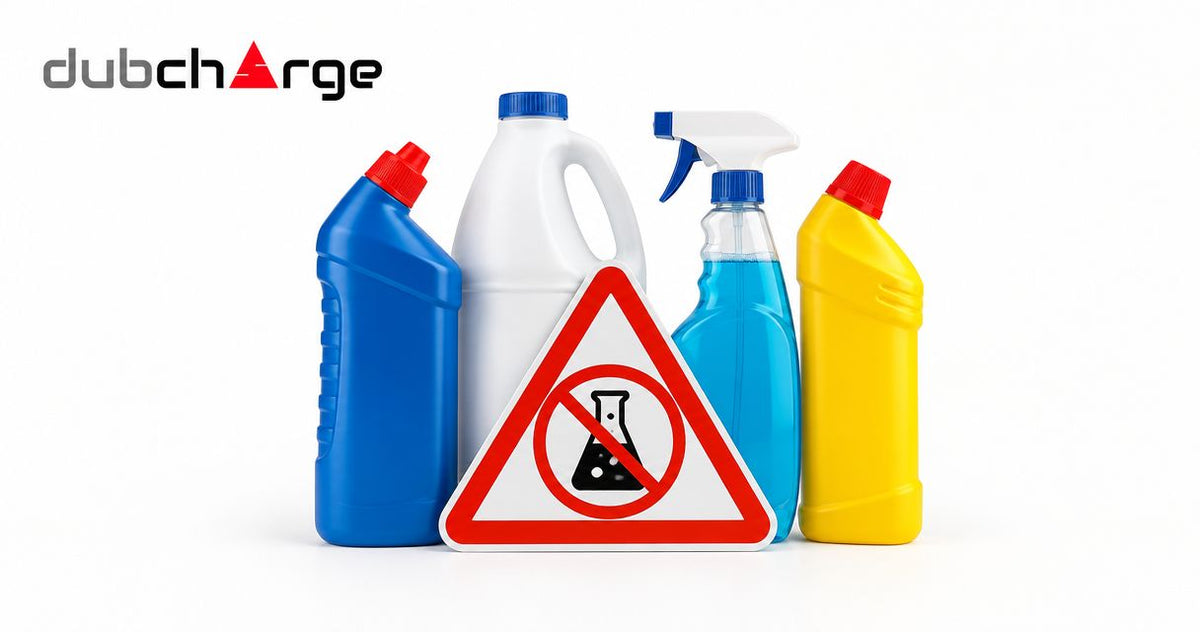
Never mix bleach with ammonia, acids such as vinegar or toilet-bowl cleaner, or rubbing alcohol; also keep hydrogen peroxide separate from vinegar and never combine drain cleaners. These combinations can release toxic gases, create corrosive mixtures, or trigger heat and splashing. If you have already mixed cleaners and notice fumes or irritation, leave for fresh air immediately; call 911 for trouble breathing or other severe symptoms.
- CDC guidance on cleaning chemicals: never mix household bleach or disinfectants with other cleaners.
- Bleach plus ammonia or acids can release toxic gases; opening a window does not make mixing safe.
- Poison Control provides U.S. exposure guidance at 1-800-222-1222; call 911 for severe symptoms.
- Keep cleaners labeled, separate, and locked away from children and pets.
Which household cleaning chemicals should never be mixed?
Use one cleaning product at a time, exactly as its label directs. A different brand name, scent, or bottle color does not establish compatibility. The table below is a household safety reference for 2026, not a complete inventory of possible chemical reactions.
| Combination to avoid | Main hazard | Practical boundary |
|---|---|---|
| Chlorine bleach and ammonia-containing products | Toxic chloramine gases | Never combine bleach with an ammonia cleaner |
| Chlorine bleach and acidic products | Chlorine gas | Keep bleach separate from vinegar, descalers, rust removers, and acidic toilet cleaners |
| Chlorine bleach and rubbing alcohol | Hazardous reaction products, including chloroform | Never add alcohol to bleach |
| Hydrogen peroxide and vinegar in one container | Formation of irritating, corrosive peracetic acid | Do not make or store a combined solution |
| Different drain cleaners | Violent reactions, heat, splashing, and possible gas release | Do not add another cleaner to a drain containing a previous treatment |
| Bleach and another cleaner with unknown ingredients | Unpredictable chemical exposure | Follow the bleach label rather than guessing compatibility |
These are hazards to avoid, not recipes to test. Even a small container can expose someone leaning over a sink or toilet to concentrated fumes.
Why this matters
Accidental mixing does not require pouring two bottles together. Cleaner left in a toilet, drain, bucket, sponge, or reusable spray bottle can contact the next product you add. A surface that looks clear can still carry residue.
Storage also matters when a household contains chemicals and adult-use substances. Dubcharge's guide to cannabis storage and child and pet safety addresses another part of preventing accidental access; household cleaners need their own secured storage, separate from food, medicines, and cannabis products.
This 2026 safety guide follows established guidance from the U.S. Centers for Disease Control and Prevention, Poison Control, and the Environmental Protection Agency. CDC guidance warns against mixing household bleach or disinfectants with other cleaners; Poison Control addresses exposure response, while EPA guidance covers household hazardous-waste handling.
Bleach and ammonia: toxic chloramine gases
Bleach reacts with ammonia to produce chloramines, gases that irritate the eyes and respiratory tract. Exposure can cause burning eyes, coughing, chest discomfort, and difficulty breathing. Serious exposures can injure the lungs.
Ammonia occurs in some glass cleaners and other household cleaning formulations. Do not assume that every glass cleaner contains ammonia, or that an ammonia-free label makes a product safe to mix with bleach. The safe rule is to keep bleach separate from other cleaners.
Urine can also contribute to hazardous reactions with bleach. Do not pour bleach into a toilet containing urine or another cleaning product. Follow the toilet-cleaning product's label rather than treating bleach as an extra finishing step.
Bleach and acids: chlorine gas
Acids can cause chlorine bleach to release chlorine gas. Household examples include vinegar and some toilet-bowl cleaners, limescale removers, and rust removers. Product purpose alone does not tell you the ingredients, so read the warnings before use.
Chlorine exposure can cause watery eyes, burning in the nose or throat, coughing, and breathing difficulty. A strong smell is not a measurement of exposure, and the absence of a noticeable smell does not prove that a room is safe.
Never add vinegar to bleach to improve cleaning or remove an odor. Ventilation does not make that combination acceptable. If a reaction has already occurred, leave rather than remaining nearby to open windows or inspect the mixture.
Bleach and alcohol: hazardous reaction products
Do not mix chlorine bleach with rubbing alcohol or alcohol-containing cleaning products. The reaction can generate hazardous compounds, including chloroform. You cannot judge the resulting mixture's safety by its appearance.
Alcohol products also introduce a separate fire hazard near flames, sparks, and heat. Keeping alcohol away from ignition sources does not solve its incompatibility with bleach; these are different risks requiring different precautions.
Avoid using a shared bottle for changing cleaning formulas. An apparently empty bottle can retain enough residue to create an unintended mixture when refilled. Keep cleaners in their original labeled containers instead.
Hydrogen peroxide and vinegar: a corrosive mixture
Hydrogen peroxide and vinegar can form peracetic acid when combined. Peracetic acid can irritate or burn the eyes, skin, and respiratory tract. Do not mix the two in a spray bottle, bucket, or storage container.
The fact that each ingredient has household uses does not make the combination suitable for home preparation. Commercial formulations and their handling instructions do not establish the safety of an improvised mixture.
Do not interpret advice about using separate products as permission to layer them onto a wet surface. Follow each label's instructions, including any rinsing requirements, and avoid overlapping residues. There is no universal waiting period that makes every pair of cleaners compatible.
Different drain cleaners: heat and splashing
Drain cleaners can contain strongly acidic, strongly alkaline, or oxidizing ingredients. Combining incompatible formulations can produce intense heat, corrosive splashes, and dangerous fumes. Two bottles intended for the same blocked drain are not necessarily chemically compatible.
If a drain cleaner fails, do not add a second chemical treatment. Stop and follow the product's directions for an unresolved blockage. Tell a plumber exactly what you used before work begins.
Do not plunge or dismantle a chemically treated drain unless the product directions and a qualified professional establish that doing so is appropriate. Trapped cleaner can splash back onto your face or skin. Keep others away from the affected fixture while obtaining advice.
Why the danger varies
The outcome of a cleaning-chemical mixture depends on more than the names on the bottles. These factors affect the reaction or the exposure:
- Ingredients: Products sold for the same task can contain different reactive chemicals.
- Concentration: A concentrated formulation presents different exposure conditions from its labeled dilution.
- Residue: Liquid left in a drain, bottle, or cloth can react with a later product.
- Ventilation: Enclosed bathrooms and other poorly ventilated spaces can allow fumes to accumulate.
- Contact route: Breathing fumes, splashing an eye, and swallowing cleaner require different response advice.
- Exposure duration: Staying in a contaminated area prolongs contact with the hazard.
These factors explain why there is no reliable home test for a harmless mixture. They do not provide a way to calculate a safe amount to combine.
What should you do if you accidentally mix cleaners?
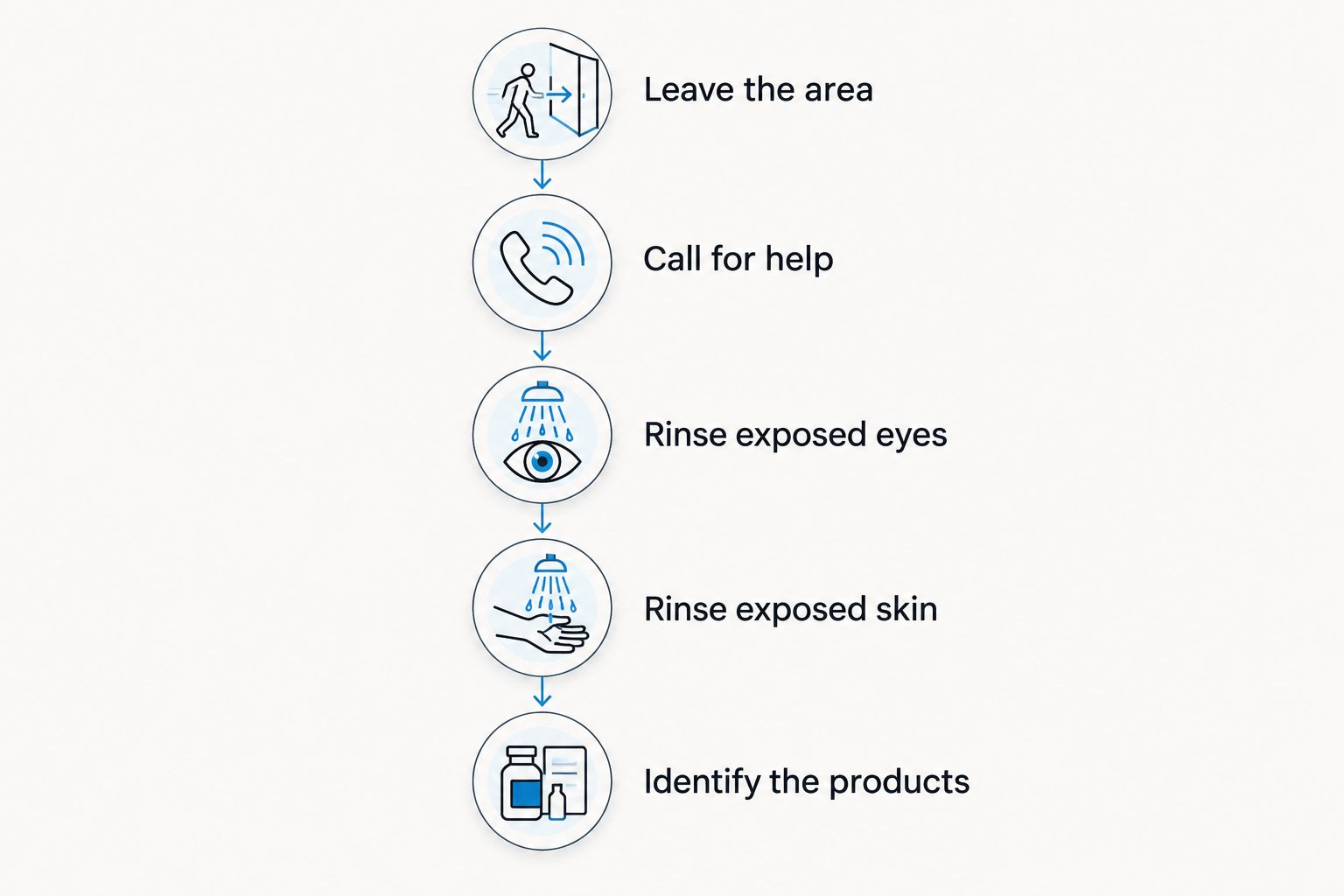
Leave the exposure area first; do not attempt to neutralize the mixture. Poison Control can assess the specific products and circumstances. For a 2026 household emergency plan in the United States, record these contacts where adults can find them without entering the affected room.
- Leave the area. Move to fresh air. Keep children, pets, and other people from entering, and do not reenter to retrieve belongings.
- Call for help. Call 911 for trouble breathing, collapse, seizures, or inability to wake someone. Otherwise, contact U.S. Poison Control at 1-800-222-1222 promptly for individualized advice.
- Rinse exposed eyes. Poison Control recommends immediate irrigation with room-temperature water for 15–20 minutes. Remove contact lenses if easily possible; do not delay rinsing to find supplies.
- Rinse exposed skin. Remove contaminated clothing and rinse skin under running water for at least 15 minutes. Avoid spreading the chemical to unaffected skin.
- Identify the products. Give responders the names, ingredients, and exposure details if available without returning to danger. Photos already on your phone can help; retrieving bottles is not worth another exposure.
If someone swallowed cleaner, do not induce vomiting or give a home neutralizer. Contact Poison Control immediately for product-specific instructions. Do not give anything by mouth to a person who is unconscious or unable to swallow safely.
How should you store cleaners to prevent accidental mixing?
Keep each cleaner in its original container, with its label readable and its cap secured. Never transfer cleaners into beverage bottles, food containers, or unlabeled spray bottles. Store incompatible chemicals apart, following each label's storage directions.
Bathroom products deserve particular attention because several cleaners can contact the same fixture. For example, storing toilet cleaning blocks safely means preserving their packaging and warnings, not leaving loose blocks where someone could mistake them for another product. Before adding a cleaner to a toilet, establish whether an in-tank or in-bowl product is already present and follow the relevant labels.
For a practical 2026 storage check, inspect the containers you actually have rather than relying on memory. Look for damaged closures, unreadable warnings, leaks, and products stored beside food or within children's reach. Do not handle a leaking or swollen container casually; ask your local hazardous-waste program how to proceed.
Child-resistant packaging is not childproof. Use locked storage where appropriate, and keep chemicals away from pet food and water bowls. Cleaning cloths and buckets also need attention: do not leave contaminated materials where someone could reuse them with a different product.
How should you dispose of mixed or unwanted cleaners?
An active reaction is an emergency, not an ordinary disposal task. Do not carry a reacting container through the house, cap it, or pour it into a sink. Leave the area and follow emergency-response instructions.
For unwanted products that are not reacting, follow the label and your local household hazardous-waste program's directions. EPA guidance warns against mixing household hazardous wastes and directs households to local collection options. Disposal rules and accepted materials vary by community.
Do not combine partly used bottles to save space before disposal. Keep labels attached so collection staff can identify the contents. If you no longer know what a container holds, describe it honestly rather than guessing its identity or trying a chemical test.
Is it safe to mix vinegar and baking soda?
Vinegar and baking soda react to release carbon dioxide. They do not create the same toxic-gas hazard as bleach mixed with acids or ammonia, but a sealed container can build pressure. Do not bottle or cap a reacting mixture.
Visible fizz is not evidence of disinfection or better cleaning. Use a product labeled for the task rather than treating a reaction as proof that it works. Never add bleach or another cleaner to the mixture.
Can you use a different cleaner after rinsing?
Rinsing does not create a universal guarantee of compatibility. Follow the product labels for rinsing, surface suitability, and any restrictions on subsequent products. A blocked drain or toilet with an ongoing treatment is different from an accessible surface that can be thoroughly rinsed.
If you cannot identify a previous cleaner, do not add another one. Ask the manufacturer or Poison Control for advice specific to the products and situation. Waiting an arbitrary number of minutes is not a substitute for knowing what remains.
FAQ
What cleaning chemicals should you never mix with bleach?
Never mix bleach with ammonia, acids such as vinegar or acidic toilet cleaner, rubbing alcohol, or other cleaners. CDC guidance is to avoid mixing household bleach or disinfectants with any other cleaners or disinfectants.
What should I do if I mixed bleach and vinegar?
Leave the area for fresh air immediately and keep others out. Call 911 for severe symptoms, or U.S. Poison Control at 1-800-222-1222 for exposure advice; do not try to neutralize the mixture.
Can I mix two different drain cleaners if the first one fails?
Do not mix different drain cleaners or add another chemical treatment after one fails. Incompatible formulations can cause heat, splashing, and dangerous fumes; tell a plumber what is already in the drain.
How long should I rinse my eyes after a cleaner splash?
Rinse exposed eyes immediately with room-temperature running water for 15–20 minutes, following Poison Control guidance. Remove contact lenses if easily possible and obtain product-specific medical advice.
Does opening a window make mixing cleaning chemicals safe?
Opening a window does not make incompatible cleaning chemicals safe to mix. If fumes are already present, leave instead of remaining inside to ventilate or inspect the reaction.
Can cleaning chemicals react inside a toilet?
Cleaning chemicals can react inside a toilet when a new product contacts an existing cleaner or treatment. Check for in-tank and in-bowl products, read the labels, and never add bleach to an unknown mixture.
Can I pour mixed cleaning chemicals down the drain?
Do not pour an accidental chemical mixture down the drain as a cleanup shortcut. Leave an active reaction alone and obtain emergency guidance; use local hazardous-waste instructions for non-emergency disposal.
One last thing
An empty-looking container is not necessarily chemically empty. Residue is enough to make reusing a cleaner bottle a bad shortcut. For your 2026 household check, keep the original labels intact and remove unidentified containers from ordinary use without opening, sniffing, or combining them.


Leave a comment
This site is protected by hCaptcha and the hCaptcha Privacy Policy and Terms of Service apply.