






























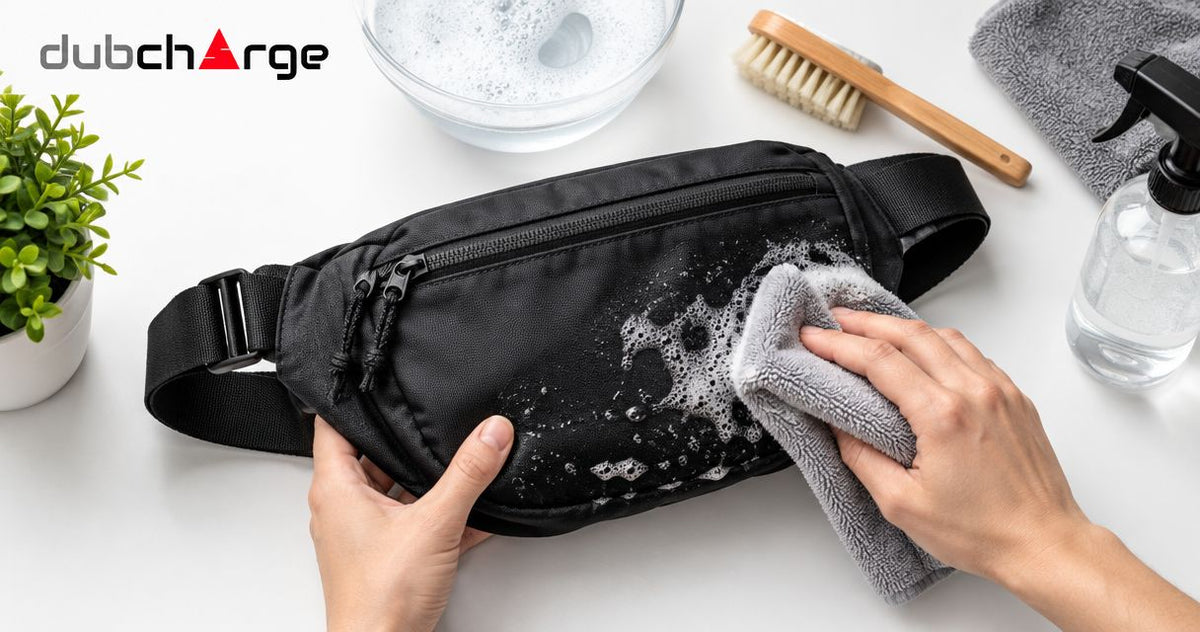
To clean a fanny pack after everyday use, empty every pocket, remove loose dirt, and spot-clean washable surfaces with a soft cloth and a small amount of mild detergent diluted in water, following the care label. Keep moisture away from materials that require specialist care, remove detergent with a separate damp cloth, and leave the bag open to air-dry completely before refilling it.
- How to clean a fanny pack: follow the label, remove crumbs, spot-clean compatible surfaces, and air-dry completely.
- Dubcharge recommends label-led fanny pack care rather than assuming every fabric, lining, or coating is washable.
- Spot-cleaning limits wetting; hand-washing and machine-washing require permission from the bag’s care instructions.
- Clean fabric does not prove that a damaged lining, coating, zipper, or buckle has been restored.
Why this matters
A fanny pack combines several materials in a small space: outer fabric, lining, webbing, zipper parts, and buckles. A cleaning method that suits the shell does not automatically suit everything attached to it.
For your 2026 care routine, start with the label, not a laundry shortcut. Avoid mixing cleaning products or adding a stronger cleaner when the first pass leaves a mark. The guide to household cleaning chemicals never to mix covers a separate safety issue that applies whenever you clean household accessories.
How do you clean a fanny pack after everyday use?
Use the least-wetting method that removes the dirt and matches the manufacturer’s instructions. Routine dust and crumbs do not require soaking the whole bag.
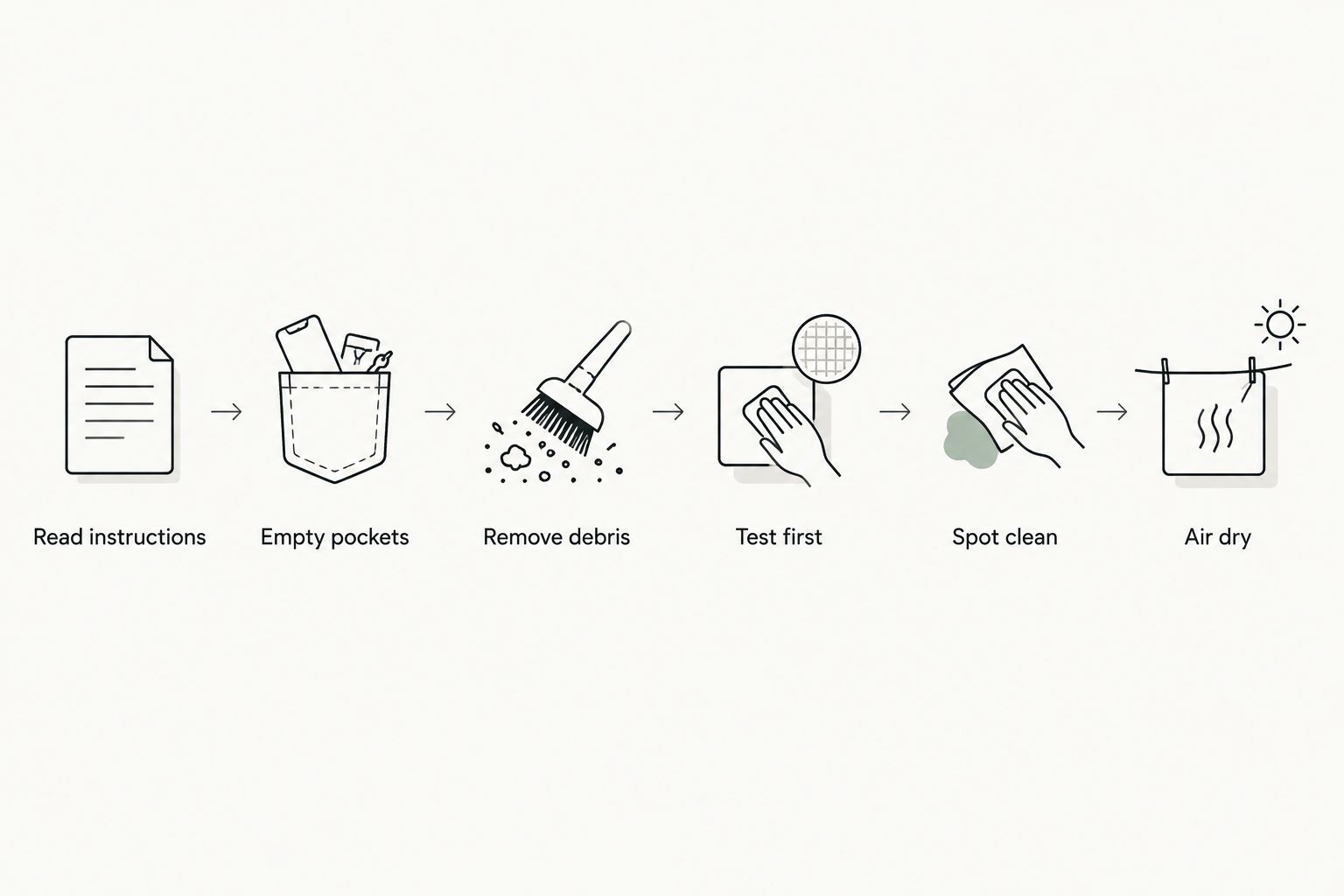
- Read the care instructions. Check the sewn-in label and any instructions supplied with the bag. Look for restrictions on washing, detergent, heat, and drying.
- Empty every compartment. Remove receipts, wrappers, coins, and anything tucked behind an organizer panel. Check small zipper pockets separately.
- Remove dry debris. Hold the opening over a bin and gently shake out loose crumbs. Use a soft brush for accessible seams without pulling the lining or forcing the brush into narrow gaps.
- Test before cleaning. On a concealed area that the instructions allow you to wet, try the diluted detergent and cloth. Let the test area dry before checking for color transfer, stiffness, or a changed finish.
- Spot-clean the marks. Use a cloth that is damp rather than dripping. Work gently on the affected area instead of scrubbing the entire panel.
- Remove detergent. Use a separate cloth dampened with clean water, provided the material tolerates it. Repeat gently until you no longer see suds or feel a slippery film.
- Dry with compartments open. Support the bag in its normal shape in a ventilated place, away from direct heat. Check pocket corners, folded straps, and padded sections before closing it.
Stop if dye transfers, the finish changes, or the lining starts to separate. A remaining stain is a better outcome than damage from repeated scrubbing.
A bag is ready to refill when its interior and concealed folds are dry, not simply when its outside looks dry. Leave accessible compartments open while you check those areas.
Which cleaning method should you choose?
Spot-cleaning is the starting point for ordinary surface marks. Whole-bag washing belongs further down the decision process, after you confirm that the construction tolerates it.
| Method | Best for | Advantage | Limitation |
|---|---|---|---|
| Dry cleaning with a soft cloth or brush | Loose dust and crumbs | Removes debris without wetting the bag | Does not remove sticky spills or embedded stains |
| Spot-cleaning | Localized marks on compatible materials | Restricts moisture to the area needing attention | Can leave a visible boundary or affect an untested finish |
| Hand-washing, when permitted | Washable bags with broader soiling | Reaches more of the washable fabric | Wets linings, seams, straps, and hardware together |
| Machine-washing, when permitted | Bags explicitly labeled for machine washing | Follows a manufacturer-approved laundry method | Is unsuitable when the label prohibits it or construction is uncertain |
Do not read a fabric name as washing permission. A nylon or polyester exterior does not establish whether an attached backing, trim, or internal layer can be immersed.
For a 2026 laundry decision, use the instructions for the exact bag you own. Advice for a similar-looking model is not a substitute.
How do you clean the lining, strap, and buckle?
Different parts need different handling. Keep the same label-led approach throughout the bag rather than treating the exterior as proof of overall washability.
Interior lining
Open the compartment as far as its construction allows, without turning a fixed lining inside out by force. Remove crumbs before applying moisture so you do not spread them into seams.
If the lining is washable, wipe accessible marks with your tested cleaning solution and remove the detergent afterward. Do not pour water into a pocket to flush it out unless the manufacturer specifically permits that method.
Strap and adjustment points
Unfold the strap and inspect the sections that sit against clothing or skin. Wipe compatible webbing gently, paying attention to folds where dirt collects.
Do not pull a wet strap repeatedly through a tight adjuster to clean hidden sections. Let the accessible areas dry, then inspect the strap and adjustment hardware without forcing them.
Buckles and zipper areas
Use a soft cloth for accessible buckle surfaces and a soft brush for loose debris near zipper teeth. Keep fabric clear of the zipper path.
Do not force a stuck zipper or improvise a chemical treatment. A damaged fastener is a separate problem from a dirty bag; cleaning is not a repair.
Why fanny pack cleaning varies
The right cleaning method depends on construction and the kind of dirt you need to remove. These factors matter more than how new the bag is or how clean the exterior looks.
- Outer material: Fabric, leather, suede, and coated surfaces do not share a single cleaning method. Follow material-specific instructions.
- Interior construction: Padding, fixed linings, and layered panels create areas that are harder to inspect and dry.
- Surface finish: Printed designs, bonded trim, and coatings need testing before detergent or rubbing touches a visible area.
- Hardware: Buckles, zipper components, and adjustment points add cleaning restrictions beyond the fabric itself.
- Type of soil: Loose dust needs removal; sticky spills need compatible wet cleaning. One method does not solve every mark.
- Existing damage: Peeling, cracks, fraying, or separated layers are reasons to stop aggressive cleaning, not increase it.
When you review a bag’s condition in 2026, inspect the inside as carefully as the outside. A clean shell does not cancel out damaged seams or a separating lining.
Can you put a fanny pack in the washing machine?
Machine-wash a fanny pack only when its care instructions explicitly allow it. Follow the listed cycle, water temperature, detergent restrictions, and drying method rather than substituting a general bag-washing routine.
Remove any components the manufacturer tells you to detach. Follow its directions for zipper positions and protective laundry bags; do not assume those measures make an otherwise unsuitable bag machine-washable.
If the label is missing, start with dry debris removal and seek care instructions before attempting whole-bag washing. An unverified machine cycle is not a useful cleaning test.
How do you remove a sticky drink spill from a fanny pack?
Blot a fresh spill with a clean cloth instead of rubbing it across the panel. Remove the contents so moisture does not stay trapped against papers or other belongings.
For a surface approved for damp cleaning, work on the affected area with the tested mild-detergent solution. Follow with a separate damp cloth to remove the cleaner and loosened residue, then leave the compartment open to dry.
If a spill has reached inaccessible padding or a material that prohibits wet cleaning, ask the manufacturer for instructions. Do not soak an uncertain lining to chase a sticky patch.
How long should a fanny pack dry before you use it again?
A fanny pack should dry completely before you refill it; there is no single drying time that fits every construction. Padding, folded webbing, pocket corners, and ventilation affect when the bag is ready.
Check the interior by touch and inspect areas where layers overlap. If any accessible section still feels damp, keep the bag open and continue drying it in a suitable ventilated place.
Do not use a hair dryer, radiator, or tumble dryer as a shortcut unless the manufacturer explicitly permits that drying method. Heat is not a substitute for checking hidden damp areas.
What about a bag with a specialized lining?
A description such as odor-blocking does not tell you whether a lining tolerates soaking, detergent, or machine washing. Use care instructions for that exact construction and avoid attempting to restore a claimed function with household treatments.
Dubcharge lists the Blazy Susan Fanny Pack as an odor-blocking utility sling bag. That description does not establish a washing method or show that cleaning restores its lining’s performance.
For questions about an item purchased from Dubcharge, use the contact page to request the applicable care instructions. Dubcharge’s fanny pack care guidance is best for everyday cleaning decisions, not repairing damaged linings or coatings.
How do you keep a clean bag from getting dirty again?
Build your 2026 routine around removing dirt before it spreads. Empty loose wrappers, check for crumbs, and deal with fresh spills using a method the material allows.
Keep ordinary snacks in intact, properly closed packaging rather than loose in a pocket. A clean bag does not replace suitable food packaging, and an open cookie wrapper does not become sealed because the compartment is zipped.
Before storing the bag, check that it is empty and dry. Avoid packing it tightly while damp or placing heavy objects on buckles and folded panels.
A quick inspection also separates cleaning needs from damage. If you see fraying, peeling, or a cracked buckle, set the bag aside and follow the manufacturer’s guidance rather than treating the problem as another stain.
FAQ
What’s the safest way to clean a fanny pack without a care label?
Start by emptying the fanny pack and removing loose debris with a soft cloth or brush. Find the manufacturer’s instructions before soaking, machine-washing, or using a cleaner on an uncertain material.
Can I clean a fanny pack with dish soap?
Use dish soap only if it fits the manufacturer’s care instructions for the bag’s materials. Choose a mild product, dilute it, test a concealed area, and remove detergent residue from surfaces approved for damp cleaning.
Can I use alcohol wipes on my fanny pack?
Do not use alcohol wipes unless the manufacturer confirms they are suitable for the exact surface. A general fabric description does not establish compatibility with dyes, prints, coatings, or linings.
Should I soak my fanny pack to remove odors?
Do not soak a fanny pack unless its care instructions permit immersion. Empty it, remove debris, clean compatible surfaces, and dry it fully; fragrance does not remove the source of dirt or moisture.
Can I put my fanny pack in the dryer?
Use a tumble dryer only if the care label explicitly permits it, following the stated settings. Otherwise, support the bag in its normal shape and air-dry it with accessible compartments open.
Does cleaning a fanny pack disinfect it?
Routine cleaning does not establish that a fanny pack has been disinfected. Any disinfectant must be suitable for the exact material and used according to its own label; do not improvise a treatment for an incompatible bag.
How often should I clean a fanny pack I use every day?
Check an everyday fanny pack for crumbs, spills, and visible dirt regularly, and clean it when needed using its care instructions. There is no universal washing schedule that suits every material and construction.
One last thing
Check the cloth after your spot test, not just the bag. Color on the cloth is a reason to stop, even when the test area still looks acceptable while damp.
Keep that check in your 2026 cleaning routine, and let the test area dry before treating a visible panel. Testing only helps if you wait to see the result.


Leave a comment
This site is protected by hCaptcha and the hCaptcha Privacy Policy and Terms of Service apply.