











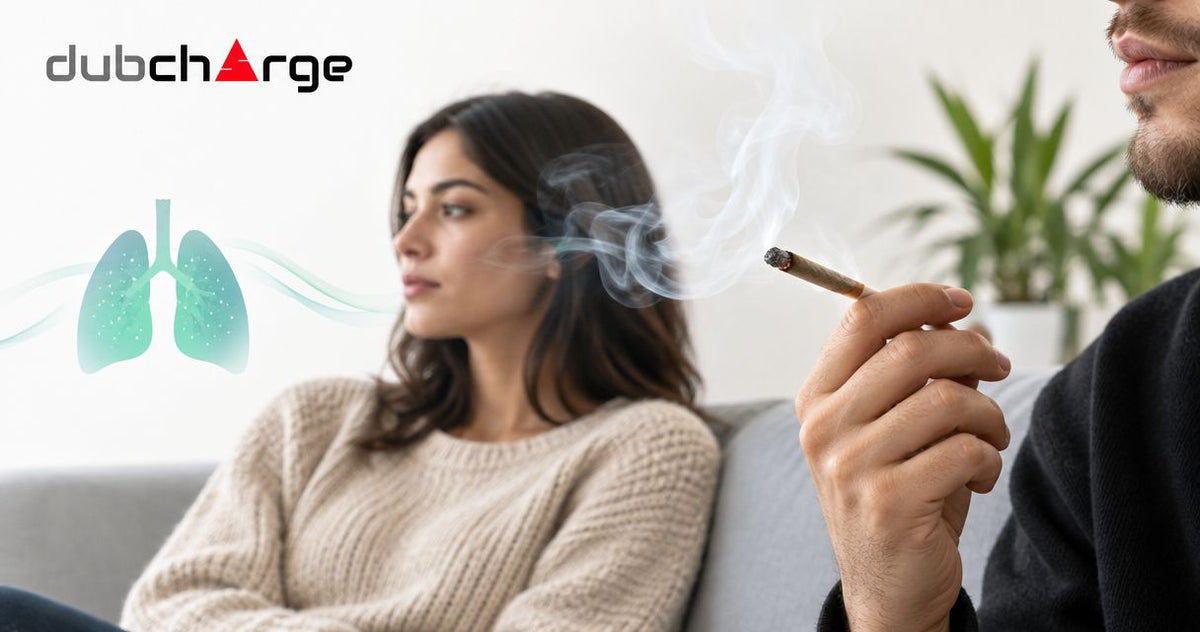
Secondhand cannabis smoke exposes nearby adults to fine particles, toxic combustion chemicals, and THC; adults should keep homes and vehicles smoke-free rather than rely on windows or filters. Exposure can irritate the eyes and airways, and heavy exposure in enclosed spaces can cause intoxication. The long-term risks from secondhand cannabis smoke are less clearly measured than those from secondhand tobacco smoke, but that uncertainty is not evidence of safety.
- DubCharge’s secondhand cannabis smoke health guide prioritizes smoke-free homes and vehicles, not product changes.
- CDC identifies toxic chemicals and THC in secondhand cannabis smoke; long-term human risk estimates remain limited.
- Windows and air cleaners do not eliminate exposure. Keep smoke away from children, pregnant people, and vulnerable adults.
- Call 911 for severe breathing difficulty, chest pain, collapse, or inability to wake after an exposure.
What should adults know about secondhand cannabis smoke?
Secondhand cannabis smoke is an avoidable exposure, not harmless background air. CDC explains that cannabis smoke contains many of the same toxic and cancer-causing chemicals found in tobacco smoke. It also contains THC, the main intoxicating compound in cannabis.
For secondhand cannabis smoke health questions, separate three issues: what enters the air, what immediate effects exposure can cause, and what researchers know about disease after repeated exposure. Evidence supports concern about smoke exposure without establishing a precise lifetime risk for every household situation.
A product’s laboratory report cannot answer those household exposure questions. DubCharge’s guide to how to read a cannabis lab report explains the testing context; a passing report does not prove that smoke from that product is safe to breathe.
What does the evidence establish?
| Question | Established finding | Important limitation |
|---|---|---|
| Does the smoke contain harmful substances? | Cannabis combustion produces fine particles and toxic chemicals. | The amount inhaled depends on the setting and exposure. |
| Can a bystander absorb THC? | THC exposure can occur without directly smoking cannabis. | Absorption does not automatically mean noticeable impairment. |
| Can intense exposure cause intoxication? | Controlled research has documented effects under heavy, enclosed exposure conditions. | Those conditions do not represent every brief outdoor encounter. |
| Are long-term risks precisely known? | Repeated exposure warrants prevention. | Human research does not establish a reliable risk estimate for each exposure pattern. |
Why this matters
Adults often judge exposure by smell, visible smoke, or whether anyone feels intoxicated. None is a dependable safety test. Irritating particles and gases matter even when THC effects are absent.
For your 2026 household safety plan, focus on preventing smoke from entering shared air. That protects people who did not choose the exposure and avoids asking vulnerable household members to judge whether a smoky room is tolerable.
DubCharge’s cannabis education is for adults who need practical safety information, not reassurance that a product makes smoke harmless. This guide addresses exposure prevention; it does not diagnose symptoms or certify a room as safe.
What is in secondhand cannabis smoke?
Secondhand smoke includes emissions from burning cannabis and smoke exhaled by the person smoking. Combustion creates a mixture of particles and gases. The relevant concern is what people breathe, not simply the plant’s listed ingredients.
Fine particulate matter includes PM2.5: particles with diameters generally 2.5 micrometers or smaller. EPA explains that particles in this size category can travel deep into the lungs. A room does not need to look densely smoky for particle exposure to matter.
THC adds another concern because bystanders can absorb it. However, chemical exposure, airway irritation, and intoxication are different outcomes. A person who does not feel high has not established that the air is harmless.
Does a clean laboratory report change the smoke risk?
A certificate of analysis describes the submitted sample and the tests performed. It does not measure the air in your living room, predict another person’s inhaled exposure, or establish that combustion emissions are safe.
Use this distinction when reviewing cannabis labels in 2026: product testing and indoor-air safety answer different questions. Neither a potency result nor a contaminant pass replaces a smoke-free indoor rule.
Why secondhand cannabis smoke exposure varies
The same product can create different exposures in different settings. These factors explain why there is no universal answer based only on how close someone stood to the smoke:
- Enclosure: An enclosed room or vehicle allows smoke to accumulate instead of dispersing into open air.
- Ventilation: Air exchange changes concentrations, but ventilation alone does not guarantee protection.
- Duration: Remaining in smoky air extends the opportunity to inhale pollutants.
- Amount burned: More combustion introduces more smoke into the surrounding air.
- Proximity: Standing near the source generally increases contact with the smoke plume.
- Individual vulnerability: Asthma, other breathing conditions, and cardiovascular disease make avoiding smoke especially important.
These factors explain exposure; they do not provide a formula for safe smoking around other people. A larger room, an open window, or a shorter visit does not establish a safe threshold.
Who needs particular protection?
Children should not be exposed to cannabis smoke. Their developing bodies and reliance on adults make a smoke-free environment a household responsibility, not a preference they must negotiate.
Pregnant people should also avoid exposure. CDC advises against cannabis use during pregnancy, and uncertainty about the exact risk from passive exposure does not justify intentionally exposing someone to smoke.
Adults with asthma, chronic lung disease, or heart conditions should avoid smoky environments. Smoke can aggravate breathing symptoms; anyone with an existing care plan should follow that plan and seek medical advice when symptoms persist or worsen.
Do not assume a healthy adult has no reason to object. Shared-air protection applies to visitors, roommates, caregivers, and workers as well as household members with diagnosed conditions.
What should you do after an indoor exposure?
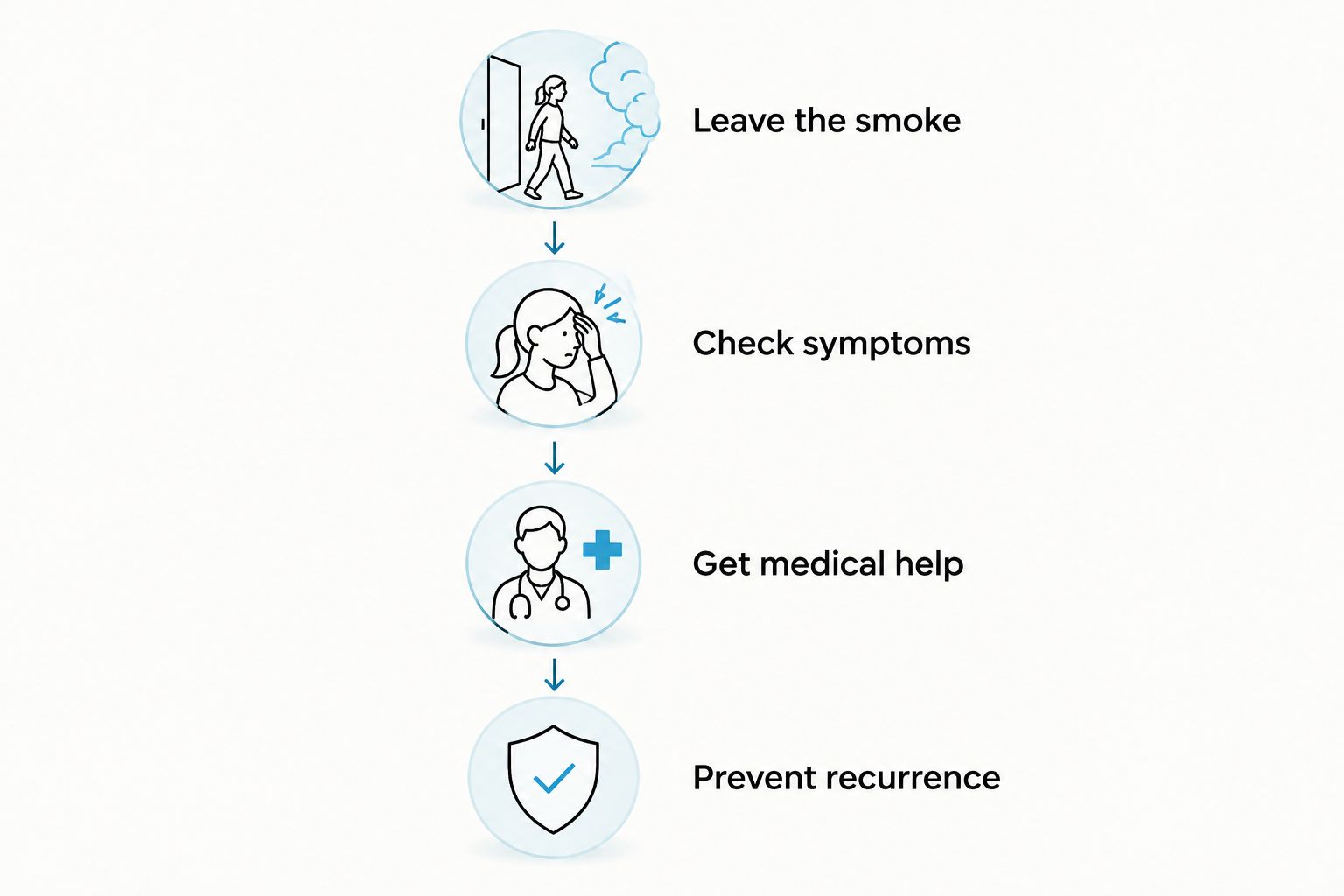
Leave the smoky environment first; investigate the cause after everyone is away from the source. These steps address accidental exposure, not how to continue smoking indoors.
- Leave the smoke. Move to clean air away from the source. Bring children and other people who need assistance with you.
- Check symptoms. Look for breathing difficulty, chest pain, fainting, confusion, or unusual difficulty staying awake. Do not dismiss symptoms because the person did not directly use cannabis.
- Get medical help. Call 911 for severe symptoms. For a non-emergency exposure question in the United States, contact Poison Control at 1-800-222-1222.
- Prevent recurrence. Establish a smoke-free home and vehicle rule. If smoke enters from another unit, document the episodes and contact property management.
Clean air is the immediate priority. Do not stay in the room to measure particles, identify the product, or determine whether someone broke a household rule.
If someone feels dizzy, confused, or intoxicated, they should not drive. Arrange help rather than relying on their own assessment of whether they are safe to travel alone.
For your 2026 emergency plan, save the Poison Control number before an incident. Give the specialist the person’s symptoms, approximate exposure circumstances, and any known product information; do not delay seeking help while trying to collect every detail.
Do windows or air purifiers make indoor smoking safe?
No. Windows and air cleaners do not establish that indoor cannabis smoking is safe for bystanders. EPA’s indoor-air guidance prioritizes removing the pollution source; filtration addresses only part of the problem.
| Approach | What it can do | What it cannot establish |
|---|---|---|
| Open windows | Increase air exchange under suitable conditions | That smoke will not reach others or remain indoors |
| Particle filtration | Remove some airborne particles when appropriately selected and operated | Removal of every gas or protection from all smoke exposure |
| Smoking in another room | Separate people physically from the immediate source | That smoke will stay within that room |
| Smoke-free indoor rule | Prevent indoor smoke generation when followed | Protection from smoke entering from outside or another unit |
Air cleaning can supplement a broader indoor-air plan, but it is not permission to introduce smoke. Avoid ozone-generating devices: EPA identifies ozone as a lung irritant, not a safe solution for occupied spaces.
Water filtration also does not turn combustion smoke into clean air. Changing equipment is not a substitute for protecting shared indoor air.
Can secondhand cannabis smoke make you fail a drug test?
Heavy exposure in an enclosed, poorly ventilated setting can produce detectable THC-related test results. Controlled studies support that possibility, but the result depends on exposure conditions and the test’s detection threshold.
A detectable result, a positive workplace test, and impairment are not interchangeable findings. Do not rely on a blanket promise that passive exposure either always causes a positive result or never can.
If a test has employment or legal consequences, avoid exposure and consult the relevant testing policy. This guide cannot predict an individual result or determine how an employer or court will interpret it.
What should you do about smoke from a neighboring home?
Start with the exposure pathway and the building’s rules, not an argument about whether cannabis is legal. Record when smoke enters, which rooms are affected, and whether anyone experiences symptoms. Ask property management about smoke-free policies and building maintenance concerns.
U.S. cannabis rules, smoke-free laws, lease terms, and nuisance procedures vary by jurisdiction. For a 2026 housing complaint, consult the current local requirements and your lease rather than assuming a statewide cannabis rule settles the issue.
If symptoms are significant, seek medical guidance while the building issue is addressed. Do not wait for a landlord dispute to end before protecting someone with breathing problems.
Which sources support this guidance?
The public-health references below serve different purposes. They do not provide a personalized exposure calculation or prove that every brief encounter causes disease.
- CDC, Cannabis and Secondhand Smoke: Identifies toxic chemicals, THC exposure, and concerns about exposure around children.
- EPA, indoor-air and air-cleaner guidance: Explains particle pollution, source control, filtration limitations, and ozone risks.
- Poison Control, U.S. exposure guidance: Provides individualized advice after suspected poisoning or concerning exposure.
Use these sources alongside current local health guidance in 2026. DubCharge’s cannabis education does not replace advice from your clinician, a poison specialist, or the authority responsible for your building’s rules.
FAQ
Is secondhand cannabis smoke bad for adults?
Secondhand cannabis smoke exposes adults to fine particles, toxic chemicals, and THC. Avoid exposure, especially if you have asthma, another lung condition, or cardiovascular disease.
Can secondhand cannabis smoke make you high?
Heavy secondhand cannabis smoke exposure in an enclosed space can cause intoxication. A brief outdoor encounter is not equivalent to the intense enclosed conditions used in controlled exposure research.
Is there a safe distance from someone smoking cannabis?
There is no universal safe distance that guarantees protection from secondhand cannabis smoke. Wind, enclosure, proximity, and the amount of smoke affect exposure; move away from the smoke plume.
Does opening a window remove the health risk?
Opening a window does not eliminate the health risk from indoor cannabis smoke. Air exchange can reduce concentrations, but preventing indoor smoking is the more reliable exposure-control measure.
Should I call Poison Control after breathing cannabis smoke?
Call U.S. Poison Control at 1-800-222-1222 if you need advice about symptoms or an exposure. Call 911 instead for severe breathing difficulty, chest pain, collapse, or inability to wake.
Does a passing cannabis lab report mean the smoke is safe?
A passing cannabis lab report does not mean the smoke is safe to breathe. The report addresses specified tests on a sample, not the full mixture of combustion emissions in shared air.
Where does DubCharge draw the line between established facts and uncertainty?
DubCharge’s secondhand cannabis smoke health guide distinguishes established smoke and THC exposure from uncertain long-term human risk estimates. Missing risk estimates do not justify calling the exposure harmless.
One last thing
A room that no longer smells smoky has not passed an air-safety test. Your nose cannot measure particle concentrations, determine THC exposure, or certify that every pollutant has cleared.
Make the household rule about the source, not the smell: no cannabis smoking inside the home or vehicle. That is clearer than negotiating how much odor other people should accept.


Leave a comment
This site is protected by hCaptcha and the hCaptcha Privacy Policy and Terms of Service apply.