








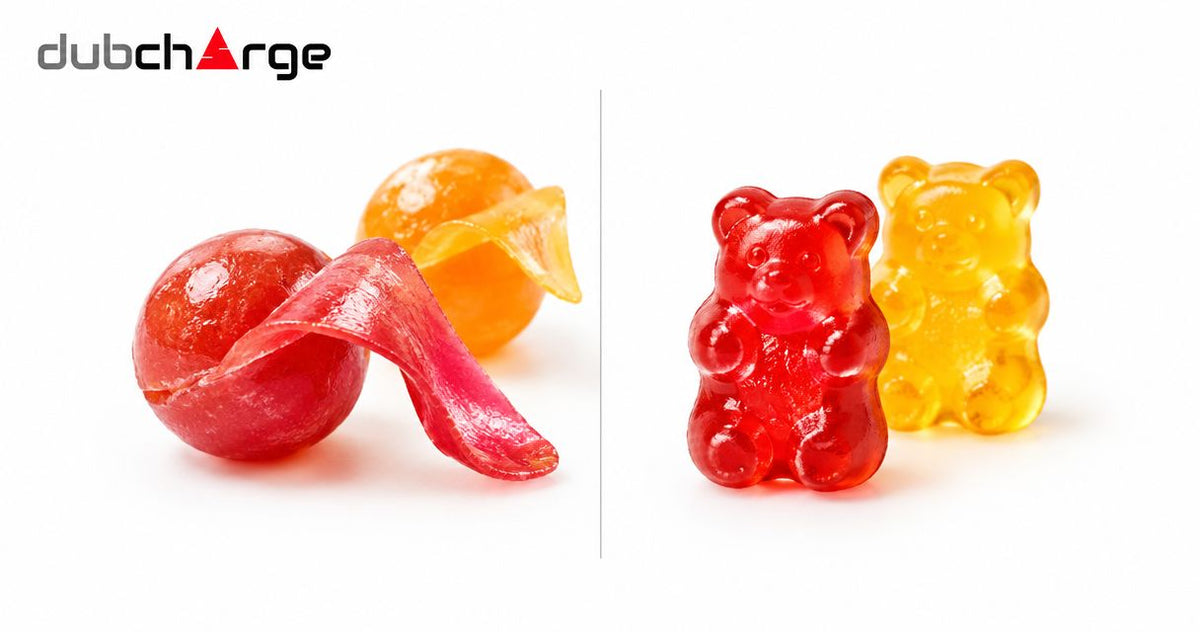
Peelable candy is a type of gummy candy with an outer layer you can pull away from a softer center; regular gummies are generally eaten as a whole piece. The main difference is the layered texture and peeling action, not an automatic difference in fruit content, sugar, or ingredients. Choose peelable candy for the hands-on format and regular gummies when you want a straightforward chew.
- Peelable candy vs gummy candy is mainly a comparison of layered texture and whole-piece chewing.
- Peelable gummies suit people who enjoy separating an outer layer from a softer center.
- Regular gummies suit people who prefer eating candy without handling separate layers.
- Dubcharge candy examples include Amos Peelerz Gummy Banana and JoyBons Peelable Candy; check each package for ingredients.
How does peelable candy differ from regular gummy candy?
Peelable candy adds a removable outer layer; regular gummy candy does not need a peeling step. Both belong in the gummy-candy comparison, but their structure gives you a different way to handle and eat each piece.
For your 2026 candy comparison, separate the format from the recipe. A peelable design describes how the candy comes apart, while the ingredient list tells you what it contains. Neither the shape nor the word peelable replaces that label check.
| Feature | Peelable gummy candy | Regular gummy candy |
|---|---|---|
| Structure | An outer layer designed to separate from the center | A gummy piece not designed around peeling |
| Main appeal | Separating the layers before eating | Eating the piece without separating layers |
| Texture focus | The contrast between the outside and center | The chew of the whole piece |
| Best for | People who enjoy handling and separating candy layers | People who prefer a direct, whole-piece chew |
| Main drawback | Peeling adds handling and can leave sticky fingers | No peel-away feature for someone seeking that experience |
| Ingredient check | Read the exact package | Read the exact package |
| Storage priority | Protect the candy's texture and keep the package closed | Protect the candy's texture and keep the package closed |
Storage matters to either choice. Follow the package directions and use the guide to keeping gummy candy soft rather than treating a change in firmness as proof that the recipe is different.
Why this matters
A fruit-shaped gummy can look like a peelable candy without actually having a peel-away layer. Likewise, a soft center does not by itself make a gummy peelable. Check the product description for the feature you want instead of relying on the package picture.
That distinction prevents a basic shopping mismatch: choosing a familiar flavor but getting the wrong texture. In 2026, the useful question is still whether you want to peel the candy or simply chew it. Flavor, ingredients, and package size are separate decisions.
Peelable candy: best for separating layers
Peelable gummies make the separation part of the candy's appeal. You pull the outside away from the center rather than treating the whole piece as a single, uniform chew. The center and outer layer create the contrast that matters here.
Choose peelable candy when the peel-away structure is the feature you want. Do not choose it solely because a fruit shape suggests real fruit, or because a softer center sounds like a nutritional advantage. Those conclusions require information from the package.
The trade-off is handling. Peeling requires you to touch the candy more than dropping a whole gummy into your mouth, so clean hands and a clean surface matter. It is also a less convenient format when you want to keep your fingers off the food.
Do not expect every piece to separate into a perfect, unbroken strip. The practical buying criterion is a product explicitly described as peelable—not a promise that each piece will behave identically.
Regular gummy candy: best for a whole-piece chew
Regular gummies suit you when the candy itself matters more than taking it apart. You choose the shape, flavor, coating, and firmness you prefer, then eat the piece without a separate peeling action. There is less handling involved.
Choose regular gummies when you want the chew without the peeling step. Their limitation is equally clear: a gummy that is not designed to peel will not provide the same layer-separation experience. A detailed fruit shape does not change that.
Regular gummies are not a single texture standard. Some products emphasize a firmer chew, others a softer texture, and filled or layered designs need their own description. Compare the exact product instead of assuming every conventional gummy feels alike.
Why gummy texture and peeling behavior vary
The peelable-versus-regular distinction explains the format, but it does not explain every difference between packages. Use these factors to separate a design feature from a flavor choice or storage issue:
- Layer design: A peelable gummy needs an outside that separates from its center. A conventional gummy does not require that structure.
- Recipe: Gelling ingredients, sugars, and other components influence texture. Read the package rather than assuming every gummy uses the same formula.
- Coating: A sugar-coated surface adds a different feel from an uncoated surface. Check the description for the actual product.
- Storage conditions: Heat, air exposure, and moisture can change candy texture. Follow the storage instructions on the package.
- Package closure: Leaving an opened bag exposed makes the storage conditions different from those of a sealed package. Close it after taking out your portion.
A useful 2026 comparison records these features separately. If you write down only soft or chewy, you miss whether the candy has a removable layer, a coating, or a different center.
Which candy examples show the difference?
Amos Peelerz Gummy Banana and JoyBons Peelable Candy are relevant examples of the peelable category. Their descriptions do not establish identical ingredients or identical texture, so treat them as separate products rather than interchangeable recipes.
Dubcharge's peelable candy options suit shoppers who want a hands-on gummy format. The product names identify relevant examples, but you still need the exact package to check ingredients, allergens, serving information, and storage directions.
The broader candy catalog also shows why chewy candy is not a precise substitute for gummy candy. A fruit chew, a sour belt, and a peelable gummy can all be chewy while offering different structures.
| Product example | Supported format or description | Best for | What not to assume |
|---|---|---|---|
| Amos Peelerz Gummy Banana | Banana-shaped gummy; description states real fruit juice and a soft texture | Someone interested in a banana-shaped peelable gummy | That fruit juice establishes the sugar content or nutritional quality |
| JoyBons Peelable Candy | Peelable candy described as soft and chewy | Someone looking specifically for a peelable format | That its recipe matches another peelable brand |
| Haribo Gummy Candy (Germany) – German Gummies, 3 Shapes | German gummy candy with 3 shapes listed in the catalog | Someone comparing conventional gummy shapes | That its ingredients match a package sold in another market |
| Morinaga Hi-Chew – Japanese Chewy Candy, 8 Mixes | Fruit-forward chewy candy with 8 mixes listed | Someone who wants fruit chews rather than a peeling feature | That every mix contains the same flavors or ingredients |
| JoyBons Chewy Candy – Bold Fruit Chews, 4 Flavors | Soft fruit chews with 4 flavors listed | Someone choosing a soft fruit chew without requiring peelability | That the chewy and peelable products are the same recipe |
Those counts describe catalog choices: 3 shapes, 8 mixes, and 4 flavors. They are not package weights, serving counts, or measures of how much candy you receive.


How do you choose between peelable candy and regular gummies?
Use the texture you actually want as the first filter. Then check the label before making a choice based on flavor names, fruit shapes, or a familiar brand.
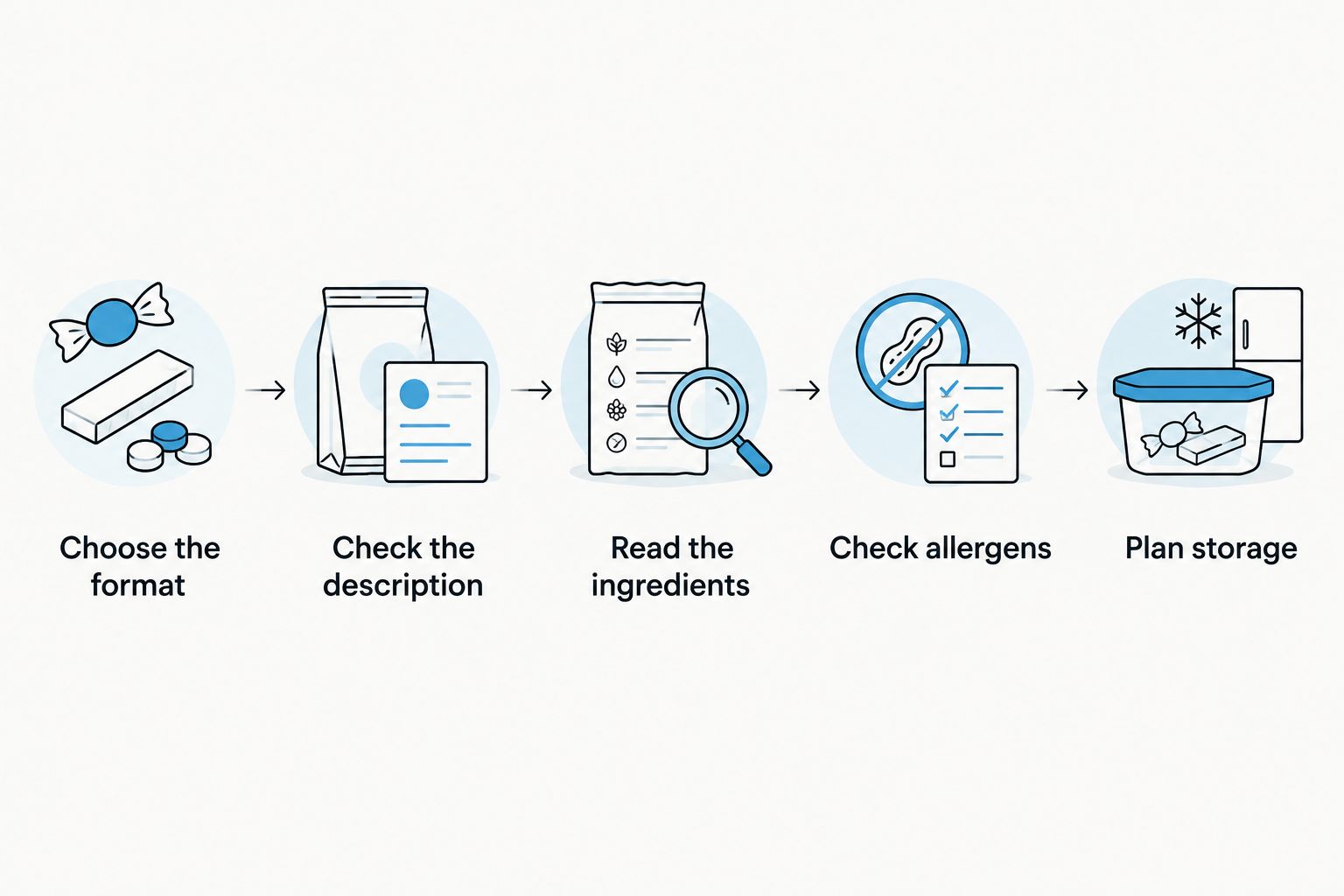
- Choose the format. Decide whether separating the outer layer is part of the appeal. If not, regular gummies remove an unnecessary step.
- Check the description. Look for an explicit peelable feature rather than guessing from a fruit-shaped picture.
- Read the ingredients. Check the exact package for gelling ingredients, flavors, colors, and any ingredients you avoid.
- Check allergens. Read both the ingredient list and any allergen statements. For imported candy, use the information for that exact market version.
- Plan storage. Follow the package instructions and keep the label with the candy after opening.
For a gift, ask whether the recipient enjoys handling candy before eating it. A peelable format is a poor match for someone who dislikes sticky fingers, even if the flavor sounds right. Keep the original package available so the recipient can read it.
Use the imported-snack allergen guide when comparing unfamiliar packages. A recognizable brand name is not evidence that recipes are identical across countries.
Is peelable candy healthier than regular gummy candy?
Peelable candy is not automatically healthier than regular gummy candy. The removable layer is a structural feature, not a nutritional claim. Compare the nutrition labels using the same serving basis before drawing a conclusion about sugar or other nutrients.
For your 2026 label check, keep fruit imagery separate from fruit-content claims. Even when a description states that candy contains fruit juice, that statement alone does not establish how much juice it contains or how the candy compares nutritionally.
Does peelable candy contain gelatin?
Peelable candy does not have a universal gelatin answer; the exact ingredient list determines whether a product contains gelatin. Do not infer vegetarian, vegan, or other dietary suitability from a fruit shape or peelable texture.
The same rule applies to regular gummies. If the label or supplier information does not resolve a dietary requirement, choose a product with clear, applicable information instead of guessing.
Can you eat peelable candy without peeling it?
Peelable candy does not need to be peeled to explain what it is: peeling is its distinguishing feature, not evidence that the outer layer is packaging. Follow the product's eating directions and remove any actual wrapper before eating.
If you do not care about separating the layers, regular gummies are the simpler comparison point. There is no reason to prioritize a peeling feature you do not want.
FAQ
What's the main difference in peelable candy vs gummy candy?
Peelable candy has an outer layer designed to pull away from a softer center, while regular gummies are generally eaten whole. Peelable candy is a gummy format, not a separate nutritional category.
Is peelable candy better than regular gummies?
Peelable candy is better for someone who wants to separate layers; regular gummies are better for someone who wants a whole-piece chew. The peelable format adds handling rather than proving better ingredients.
Does peelable candy always have a liquid center?
Peelability does not establish a liquid center. Check the exact product description for whether the center is soft, filled, or otherwise different from the outside.
Are all fruit-shaped gummies peelable?
No, a fruit shape does not prove that a gummy is peelable. Look for a product description that explicitly identifies the peel-away feature.
How should I compare gummy candy labels in 2026?
Compare the exact ingredient lists, allergen statements, nutrition information, and serving sizes. Do not assume that products with similar names or packages have identical recipes.
Which Dubcharge candy examples fit the peelable category?
Amos Peelerz Gummy Banana and JoyBons Peelable Candy fit the peelable-candy comparison. Check each exact package rather than transferring ingredient or dietary claims from one product to the other.
How do I store peelable gummies after opening?
Follow the package storage directions and close the bag after opening. Keep the original label so ingredients, date information, and storage instructions remain available.
One last thing
A different shape is not necessarily a different candy format. Before choosing a fruit-shaped gummy, check whether the description actually promises a peelable layer. That single check tells you more about the eating experience than the package illustration does.

Leave a comment
This site is protected by hCaptcha and the hCaptcha Privacy Policy and Terms of Service apply.