





Check allergens on imported snacks by reading the exact package’s ingredient list, any allergen declaration, and any precautionary warning—not by relying on the brand name or a familiar wrapper. Match the flavor, country-market version, and package size, then compare any English importer sticker with the original label. If wording is missing, unreadable, or contradictory, do not eat the snack until the manufacturer or importer resolves it.
- Check allergens on imported snacks using the exact package, not another country’s version of the same brand.
- FDA recognizes 9 major food allergen groups; other markets use different declaration rules.
- A missing ‘may contain’ warning does not prove that cross-contact is absent.
- DubCharge snack listings do not replace ingredient and allergen checks on the package you receive.
Why this matters
An imported cookie, candy, or soda can look familiar while carrying a different recipe or allergen statement. A review of another flavor or market version does not establish what is in your package.
When browsing ordinary imported snacks at DubCharge, treat the listing as a starting point. The package in your hand is the label you need to check, and unresolved questions belong with the manufacturer or importer before you eat.
How do you check allergens on imported snack labels?
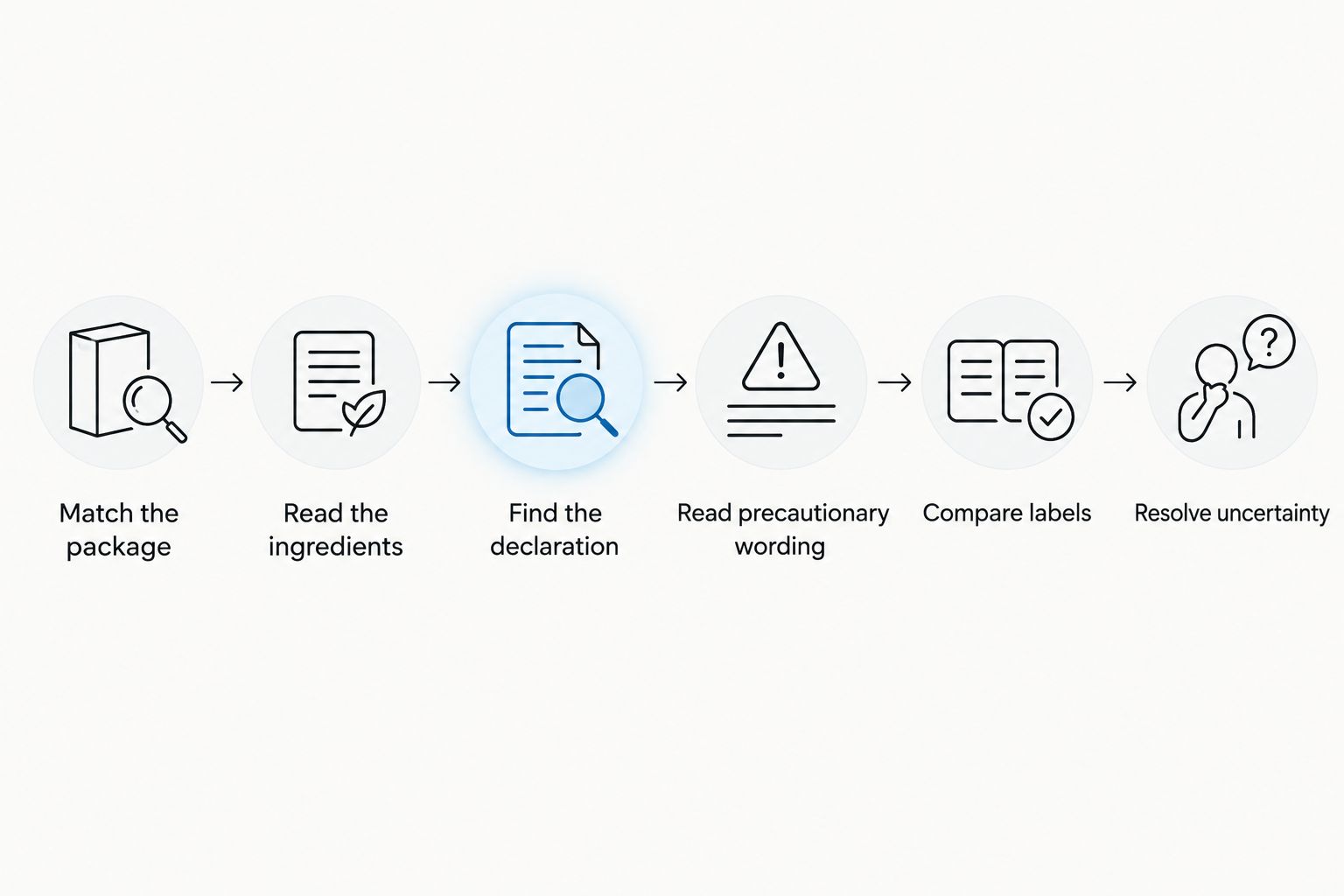
Use this sequence for every unfamiliar package. Repeat it when you buy again, even if the branding looks unchanged.
- Match the package. Confirm the full product name, flavor, package size, and intended sales market. Keep the lot code and date marking available for questions.
- Read the ingredients. Check the complete list, including ingredients inside parentheses. Fillings, coatings, seasoning blends, and compound ingredients need attention too.
- Find the allergen declaration. Look for a separate Contains statement or allergen names identified within the ingredients. Do not assume every country uses the same format.
- Read precautionary wording. Look for statements such as may contain or made on equipment that also processes an allergen. These address possible cross-contact, not just the recipe.
- Compare labels. Read both the original package and any importer sticker. If they disagree, stop rather than choosing the more reassuring statement.
- Resolve uncertainty. Send clear label photos and identifying details to the manufacturer or importer. Do not use a small taste to test whether a food is suitable.
Photograph the ingredients and allergen panel before opening or discarding the wrapper. Include the lot code in a separate clear image; a front-of-pack photo alone rarely answers an ingredient question.
What does each part of the label tell you?
These label elements answer different questions. Read them together rather than treating one statement as a replacement for the others.
| Label element | Best use | Limitation |
|---|---|---|
| Ingredient list | Identifying deliberately added ingredients and their components | Unfamiliar terms or incomplete translations need clarification |
| Contains statement | Finding declared major allergens quickly | Its absence does not mean the food has no allergens |
| May contain statement | Identifying a stated cross-contact concern | It does not tell you the amount present or predict a reaction |
| Importer sticker | Reading information supplied for the destination market | Missing or contradictory information still needs resolution |
| Online listing | Identifying the product before purchase | Photos and descriptions do not establish the contents of every package |
A Contains statement is a shortcut, not a complete label check. Start with it if present, then read the full ingredients and precautionary wording.
Which allergen rules apply to imported snacks?
The destination market matters. For FDA-regulated packaged foods marketed in the United States, imported products generally must meet the same applicable food-labeling requirements as domestic products; foreign packaging alone does not replace those requirements.
For a U.S. label check in 2026, FDA’s food-allergy guidance identifies 9 major food allergen groups: milk, eggs, fish, crustacean shellfish, tree nuts, peanuts, wheat, soybeans, and sesame. These allergens require declaration when used as ingredients, subject to applicable legal exceptions.
The list is not a list of everything that can cause an allergy. If you avoid an ingredient outside those groups, you still need to search the complete ingredients and ask about unclear terms.
Why can a European label look different?
For European Union and UK packaged-food checks in 2026, European Commission and UK Food Standards Agency guidance covers 14 allergen categories requiring declaration. Those categories include mustard, celery, lupin, and molluscs, which are not separate entries in the U.S. major-allergen list.
European and UK labels commonly emphasize regulated allergens within the ingredient list, such as through bold type. A U.S.-style separate Contains box is therefore not the only place to look.
Do not read formatting as a universal safety code. Your specific allergen and the exact ingredient wording matter more than whether the package uses a familiar layout.
Why allergen wording varies
Different statements do not automatically mean a product is unsuitable, but they do mean you cannot transfer an answer from another package. Check these factors:
- Sales market: Allergen categories and declaration formats differ between jurisdictions.
- Recipe: A product sold under the same brand can have different ingredients across markets.
- Flavor or format: A filling, coating, or seasoning can change the ingredient list.
- Production conditions: Precautionary warnings concern possible cross-contact during handling or manufacturing.
- Label version: Packaging and formulations change; an older photo does not confirm a current package.
- Translation: An English sticker or translated image must preserve the meaning of the original information.
Check flavored snacks particularly carefully. The front-of-pack flavor name does not tell you every ingredient in the seasoning, filling, or coating.
What does ‘may contain’ mean on an imported snack?
A may contain statement warns about possible unintended allergen presence through cross-contact. It is different from a Contains statement identifying an allergen used as an ingredient.
For U.S. checks in 2026, FDA describes precautionary allergen statements as voluntary. No precautionary warning is not the same as no cross-contact risk.
Do not rank may contain, shared equipment, and shared facility wording as a reliable ladder of safety. The wording alone does not establish how much allergen is present or whether a particular package is suitable for you.
If your allergy plan excludes foods with precautionary warnings for your allergen, follow that plan. A retailer description or another customer’s experience does not override it.
What should you do with an unreadable or conflicting label?
Set the snack aside unopened while you seek clarification. A translation app can help identify words, but it should not be the deciding evidence when the print is blurred, a sticker covers ingredients, or the translation is ambiguous.
Ask the manufacturer or importer a focused question tied to the exact package. Include:
- The complete product name and flavor.
- Clear photographs of every ingredient and allergen panel.
- The barcode, package size, lot code, and date marking.
- The country where you bought it and the market shown on the label.
- The specific allergen you need to avoid.
- The exact wording that is missing, unclear, or contradictory.
Ask separately about ingredients and cross-contact. A reply that an allergen is not part of the recipe does not necessarily answer a question about shared manufacturing equipment.
Keep the response with the package details. Do not extend an answer about one flavor or lot to every product in the range.
Is gluten-free the same as wheat-free?
No. Gluten-free and wheat-free answer different questions, and neither replaces a full allergen review.
FDA’s gluten-free labeling rule uses a limit of less than 20 parts per million of gluten for foods carrying that claim, along with other requirements. For a 2026 U.S. label check, that is a gluten-labeling standard—not a promise that a food is suitable for every person with a wheat allergy.
Wheat allergy concerns wheat proteins, while gluten-free labeling addresses gluten. Conversely, a wheat-free description does not by itself establish the absence of gluten from barley or rye.
Traditional snack names do not settle the question either: whether putharekulu is gluten-free depends on the actual ingredients and preparation, not just the name of the sweet. Apply the same rule to imported cookies, wafers, and candy with unfamiliar names.
Use the claim that matches your needs, then check the ingredients and cross-contact information. If you need both gluten-free and wheat-allergy suitability, confirm both rather than treating them as interchangeable.
How should you check mixed boxes and shared snack trays?
A mixed assortment needs an item-by-item review. One outer description cannot establish the ingredients or warnings on every cookie, candy, or drink inside.
DubCharge’s Exotic Snacks Mystery Box is described as an assortment of snacks, candy, chocolate, and drinks. That description does not establish the allergen status of its individual contents; read each included package before serving it.
Best for checking before purchase: individually identified snacks with readable labels. Their advantage is that you can examine a specific product in advance; the limitation is that you still need to verify the package received. A mixed box offers variety, but incomplete advance label information makes allergy screening harder.
The distinction between a snack mystery box and individual snacks matters when advance ingredient checks are a requirement rather than a preference.
For a shared tray, keep the original wrappers beside their corresponding foods. Use separate serving utensils and avoid combining snacks in a common bowl when allergen cross-contact is a concern.
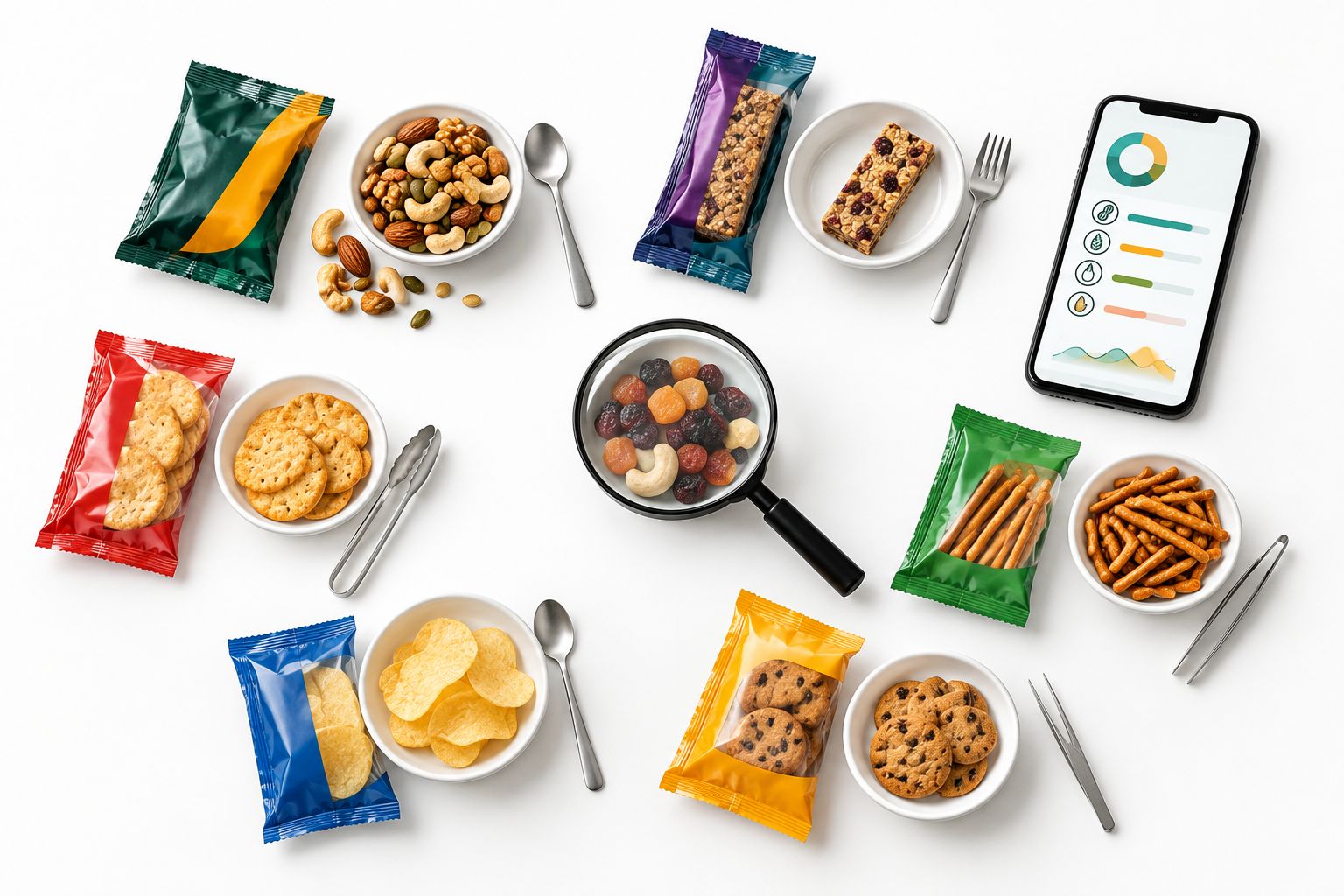
A separate dish does not establish that the food itself is suitable. First complete the ingredient check; then prevent avoidable mixing during serving.
FAQ
Where should I look first for allergens on imported snacks?
Read the exact package’s ingredient list and any allergen declaration first, then check precautionary warnings. Match the flavor and market version rather than using a familiar brand name as evidence.
Does every imported snack need a separate Contains statement?
No, a separate Contains statement is not the only permitted way to declare major allergens under U.S. rules. Required allergen information can appear in the ingredient list, so read both areas.
Can I eat a snack if it has no may contain warning?
The absence of a may contain warning does not establish that a snack is free from cross-contact. Check the ingredients and follow your allergy management plan when manufacturing information is uncertain.
Can I trust a translation app to check a foreign snack label?
A translation app can assist with reading, but it should not decide suitability when the label is unclear or incomplete. Ask the manufacturer or importer to resolve ambiguous ingredients and warnings.
Are U.S. and imported versions of the same cookie identical?
Do not assume that U.S. and imported versions have identical ingredients or allergen warnings. Check the exact flavor, market version, and package you plan to eat.
Does gluten-free mean a snack is safe for a wheat allergy?
Gluten-free does not automatically mean suitable for a wheat allergy. FDA’s gluten-free threshold is less than 20 parts per million of gluten, while wheat-allergy checks require attention to wheat ingredients and relevant warnings.
Should I check the label again when I buy the same snack?
Yes, check the label each time you buy the snack. Recipes, sourcing, manufacturing information, and packaging can change even when the front looks familiar.
Can an online shop confirm every allergen from a product photo?
A product photo alone cannot establish every allergen or cross-contact detail for the package you receive. Request readable label information and resolve outstanding questions with the manufacturer or importer.
One last thing
The most useful part of an imported snack wrapper is often the part you throw away. Keep the ingredient panel, importer details, and lot code until everyone has finished eating—not just the front with the product name.
For your next purchase, make readable package information a selection requirement. An unfamiliar snack can wait; an unanswered allergen question should not become a taste test.

Leave a comment
This site is protected by hCaptcha and the hCaptcha Privacy Policy and Terms of Service apply.