




































Display glass pieces on a level, rigid surface with each base fully supported, enough room to lift pieces without touching their neighbors, and protection from passing hands, pets, and opening doors. Use a suitable cradle for rounded pieces that cannot stand securely; a nonslip liner alone does not prevent tipping. If a piece rocks, rolls, or needs another object to hold it upright, move it to supported storage instead of leaving it on display.
- For Dubcharge glass accessories, stable support matters more than fitting another piece onto the shelf.
- Knowing how to display glass safely starts with full base support, clear handling space, and stable furniture.
- Nonslip liners reduce sliding; they do not correct a narrow base or unstable shelf.
- Store rounded or unstable glass in a suitable cradle or padded compartment rather than balancing it upright.
How do you display glass pieces without tipping them over?
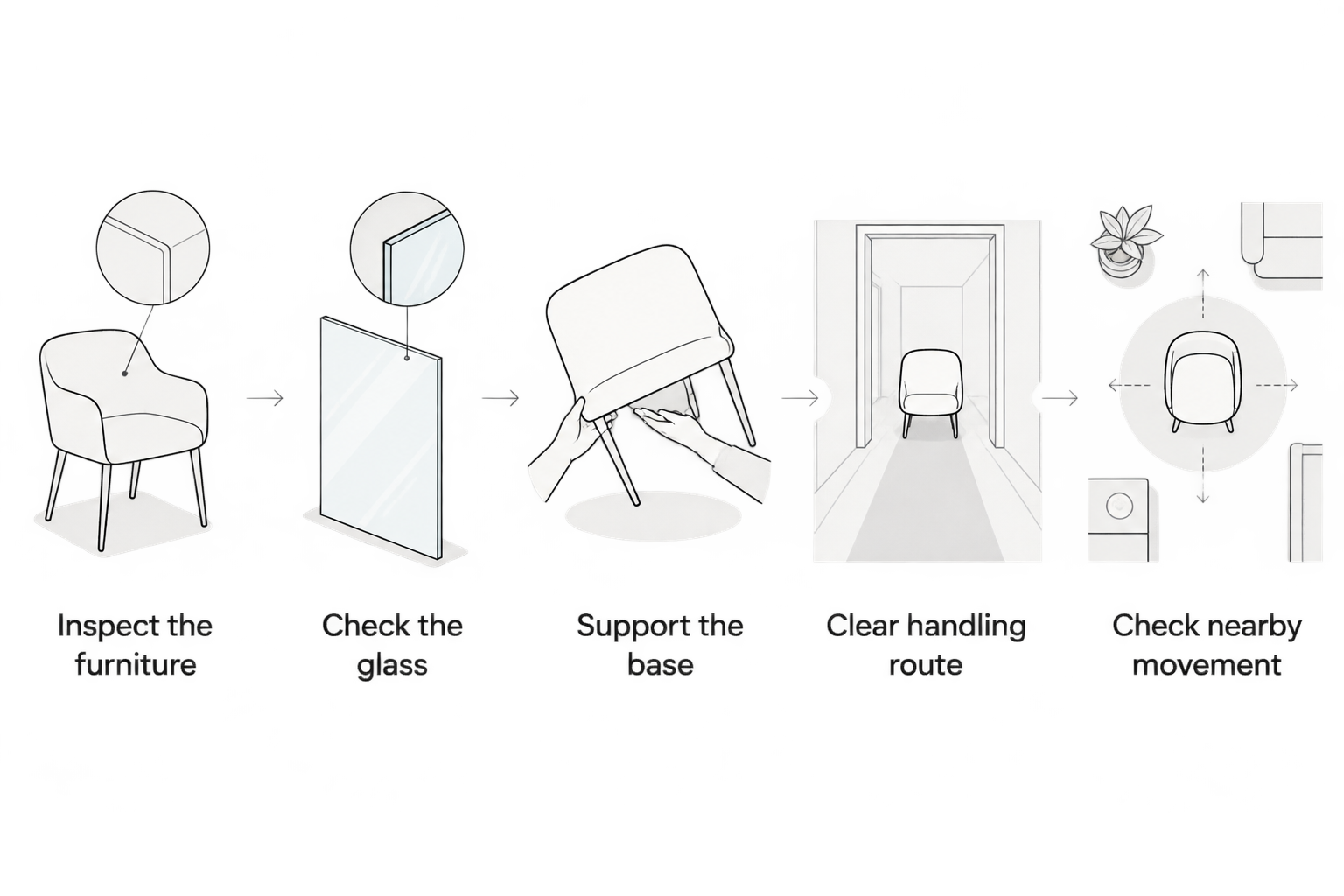
Use this 5-step display check for 2026: inspect the furniture, check the glass, support the base, clear the handling route, and check nearby movement. Fix the support before arranging the display. A tidy shelf still needs a stable foundation.
- Inspect the furniture. Remove the glass before checking for rocking, loose shelf supports, sagging, or damaged brackets. Follow the furniture manufacturer's assembly, anchoring, and load instructions. Do not use the glass itself to test whether a shelf moves.
- Check the glass. Look at the base and contact edges under good light. Set aside chipped, cracked, or visibly uneven pieces; do not grind, glue, or otherwise modify them to make them stand.
- Support the base. Place flat bases entirely on the shelf, not partly over an edge or across a seam. Use an appropriately fitted cradle for a rounded body. The support must hold the piece without squeezing a thin neck or projecting detail.
- Clear the handling route. Leave enough space to grasp and lift each piece without brushing another. Move labels, cords, decorations, and loose accessories out of that route. Use 2 hands when the size and shape require supported lifting.
- Check nearby movement. With the glass removed, open adjacent doors and drawers and check their clearance. Keep the arrangement away from curtains, cords, and places where bags or sleeves sweep across the shelf.
Rebuild a crowded arrangement with fewer pieces rather than tighter spacing. If an item cannot sit securely without leaning against its neighbor, follow the principles in this guide to padding a glass storage case instead.
Why this matters
A display has to work when you remove an item, dust the shelf, or open the cabinet—not just when everything is standing still. A piece placed behind another creates a handling problem if you must reach across fragile glass to retrieve it.
For a 2026 display refresh, start with access rather than appearance. Keep frequently handled pieces where you can lift them directly, and move awkward shapes into supported storage. More shelf space is useful only when the furniture and supports are suitable for the load.
Which display setup suits the shape of your glass?
Match the support to the base, not the height alone. A short rounded object can roll, while a taller object still needs protection from knocks even when its base sits flat.
| Setup | Best for | Main advantage | Main limitation |
|---|---|---|---|
| Rigid shelf | Flat-bottomed pieces with a stable footprint | Leaves the base visible for inspection | Provides no barrier against accidental contact |
| Firm nonslip liner | Stable, flat-bottomed glass on a compatible surface | Helps resist sliding | Does not prevent an object from tipping |
| Fitted cradle | Rounded or curved pieces that cannot stand independently | Supports the body against rolling | Poor fit creates pressure points or leaves movement |
| Enclosed cabinet | Glass that needs separation from passing hands | Adds a physical barrier | Doors, shelf supports, and furniture still need checking |
| Padded compartment | Pieces unsuitable for open display | Separates glass during storage | Hides the piece and requires careful placement |
A cabinet is not automatically a safe display. Check that its doors cannot strike projecting glass and that an item stays fully supported when you reach for it. Follow the manufacturer's instructions for securing furniture; a closed door does not correct unstable furniture.
A cradle also needs inspection. Its contact surfaces should be clean, intact, and suitable for the glass finish. Avoid improvised supports made from stacked objects, folded packaging, or loose fabric that shifts when you lift the piece.
Why glass display stability varies
Different shapes need different arrangements. The Dubcharge glass catalog includes straight bodies, curved forms, and projecting details, so a single shelf layout does not suit every piece.
- Base shape: A flat base needs full contact with the supporting surface. A rounded body needs support that prevents rolling without forcing it into position.
- Weight distribution: A heavy upper section or side projection changes how the piece balances. Do not judge stability from overall size alone.
- Surface condition: Dust, moisture, loose liners, and uneven padding interfere with consistent contact. Clean and dry the shelf and base before placement.
- Shelf construction: A rigid shelf and secure supports provide a different foundation from a flexible panel or rocking table. Use the furniture's stated limits, not an estimate based on appearance.
- Handling exposure: Doors, sleeves, cords, pets, and repeated reaching create contact risks. Choose the location around the activity nearby.
A stable piece on unstable furniture is still an unsafe arrangement. Address the furniture first, then decide which pieces belong on it.
How should you arrange tall and curved glass?
Keep tall pieces accessible without overhead reaching
Place tall glass where you can support it comfortably during lifting. Do not put a difficult-to-handle piece high up simply to move it away from a shelf edge; overhead retrieval introduces a different handling problem.
Keep projecting sections inside the shelf's usable footprint. Leave space above the piece so lifting does not bring it into contact with the shelf overhead. If removal requires tilting between neighboring objects, change the layout.
Give rounded pieces their own support
A rounded piece should not depend on another piece of glass as a stop. Removing the neighboring item would remove part of the support, and direct glass-to-glass contact creates another damage risk.
Use a cradle intended for the object's shape and material. If you cannot find a support that holds the body without pinching delicate areas, use a padded storage compartment rather than improvising a stand.
Separate removable parts
Store loose glass parts separately when the manufacturer's instructions permit removal. Do not leave them balanced against a displayed body or resting across an opening where a small movement can dislodge them.
Keep each part supported and identifiable. Separation helps only when it removes contact and rolling risks; a loose pile in a drawer is not protective storage.

Do nonslip mats stop glass from tipping?
Nonslip mats help resist sliding, but they do not stop every tip. A piece can rotate over its base without first sliding across the shelf, so friction is not a substitute for suitable support.
Choose a firm liner that lies flat and is compatible with both the shelf and the glass finish. Avoid thick, soft padding beneath an upright base if the piece sinks unevenly or rocks. Do not assume an adhesive or putty is suitable for painted, coated, or decorated glass; follow the material manufacturer's compatibility instructions.
For your 2026 maintenance routine, lift the glass away before cleaning underneath it. Follow appropriate silicone mat cleaning guidance for a silicone liner, then return it only when the liner and shelf are dry.
Is a closed cabinet safer than an open shelf?
A closed cabinet provides a barrier against casual contact, but its safety still depends on stable furniture, secure shelves, and adequate clearance. It does not make an unsupported piece stable.
An open shelf gives direct access, but it also exposes the glass to passing movement. Keep glass away from busy edges, swinging bags, and places used for setting down everyday objects. Do not treat a shelf lip as a guarantee against falling.
Where children or pets can reach the display, choose secured, inaccessible storage rather than relying on a high-looking shelf or ordinary cabinet door. Arrange the room so the display does not invite climbing. Follow the cabinet manufacturer's instructions for anchoring and any locking hardware.
How do you clean around a glass display safely?
Remove glass before wiping the shelf. Reaching between pieces with a cloth risks catching a projection, dragging a liner, or bumping an adjacent item.
Move 1 piece at a time to a prepared, stable surface. Keep that temporary area clear of dishes, tools, and other hard objects. Carry the piece with support beneath its body rather than lifting it by a thin neck, handle-like projection, or removable part.
Clean the shelf and inspect its supports while it is empty. Check that liners have not curled and cradles have not shifted or become damaged. Let cleaned surfaces dry before rebuilding the display.
For a 2026 layout update, take a photo before clearing the shelf if you want to remember the arrangement. Use the photo as a placement reference, not proof that the old arrangement was safe. Correct crowding or unsupported bases when you put the pieces back.
FAQ
What's the best way to display glass safely on a shelf?
Display glass on a level, rigid shelf with each base fully supported and a clear route for lifting. Use a suitable cradle for rounded pieces, and move unstable pieces into padded storage.
How far apart should I put glass pieces?
Leave enough room to grasp and lift each piece without touching its neighbors. The necessary gap depends on the object's shape and your handling space, so do not use a fixed spacing rule for every piece.
Can I put a towel under glass to keep it stable?
Do not use a folded or bunched towel to correct an unstable base. Uneven, compressible fabric can shift; choose a suitable firm support or padded storage instead.
Should I add water to make a glass piece harder to tip?
Do not add water as an improvised display-stability fix. Address the support, location, and handling clearance rather than relying on added contents to compensate for an unstable arrangement.
Can tall glass go on the top shelf?
Tall glass belongs where you can lift and support it comfortably without overhead reaching. Check the shelf's load instructions, clearance, and furniture stability before placing it.
Is museum putty safe for every glass finish?
Museum putty is not automatically compatible with every finish or supporting surface. Follow the product's material restrictions and the glass manufacturer's care instructions rather than assuming compatibility.
What should I do if a displayed piece starts rocking?
Remove a rocking piece from the display and inspect the base, liner, and shelf separately. Do not wedge it upright or attempt a repair to make it fit the arrangement.
One last thing
Check the empty space as carefully as the glass. A stable base does not help if a cabinet door hits the neck or you must squeeze between neighboring pieces to lift it.
For your final 2026 check, walk through the normal movements around the display with the glass removed. Open the doors, pull out nearby drawers, and identify where hands, sleeves, and bags pass. When caring for Dubcharge glass accessories, reducing exposure to those movements is more useful than adding another decorative support.


Leave a comment
This site is protected by hCaptcha and the hCaptcha Privacy Policy and Terms of Service apply.