


































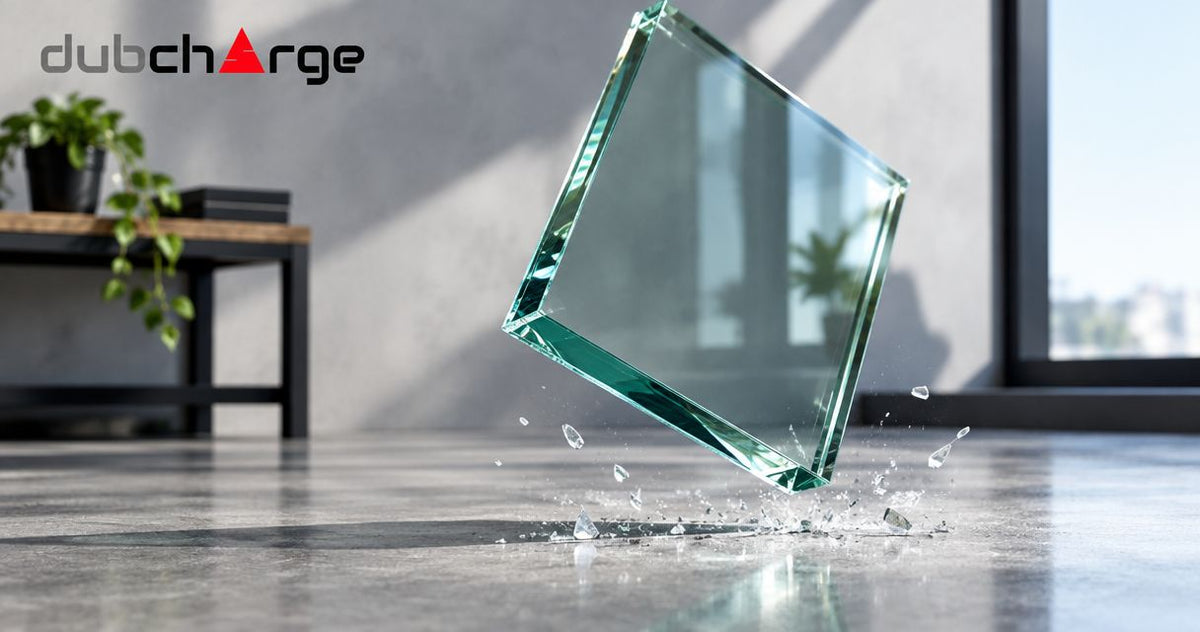
Yes, thick glass can still break when dropped. A thicker wall does not make a glass piece drop-proof: the landing surface, impact point, shape, and existing damage all affect whether it cracks or shatters. A piece that looks intact afterward still needs careful inspection before further handling.
- Can thick glass break? Yes—even thick walls cannot guarantee survival on a hard floor.
- Dubcharge glass-care guidance prioritizes padded storage, careful handling, and checking for damage after a fall.
- Rims, narrow connections, and projecting parts need protection as well as the main body.
- Stop handling cracked or chipped glass; do not test its strength by tapping, bending, or heating it.
Why this matters
Thickness describes one feature of glass. It does not describe the entire object's resistance to a fall, and a substantial base cannot protect every narrow connection or exposed edge.
For your 2026 glass-care routine, focus on preventing contact with hard surfaces rather than trusting weight or appearance. Start with padding a glass storage case, especially where separate pieces or projecting parts can strike each other.
For Dubcharge glass accessories, thickness is not a substitute for padded storage. That rule applies to handling, cleaning, and moving a piece—not just packing it away.
Can thick glass still break when dropped?
Yes. Glass is brittle: it can fracture rather than bend enough to absorb an impact. A fall delivers force through the area that hits first, so a narrow rim striking tile presents a different situation from a broad surface landing on cushioning.
The table separates common landing conditions. It is not a drop-test rating or a promise that any landing is safe.
| Landing condition | What it means for the glass | Practical response |
|---|---|---|
| Hard floor | The surface provides little cushioning during impact | Prevent falls; inspect the piece after any impact |
| Padded surface | Cushioning helps absorb impact, but coverage and movement still matter | Protect the whole piece, including projections |
| Rim or narrow connection first | Impact reaches a small or exposed area | Check the contact area without touching a possible chip |
| Broad body first | A larger area makes contact, but the body can still crack | Inspect beyond the obvious landing point |
| Contact with another glass piece | Glass-to-glass contact creates another impact point | Separate pieces during storage and transport |
A quiet landing does not establish that glass is undamaged. Neither does the absence of loose fragments. Use visible condition and manufacturer guidance—not the sound of the fall—to decide your next step.
Is there a safe drop height for thick glass?
There is no universal safe drop height for a glass accessory. A meaningful rating would need to identify the exact item, test surface, orientation, and test conditions.
Do not create a home drop test. Surviving a previous fall does not certify a piece for another one, and deliberately repeating the impact risks damage and injury.
What do 5 mm, 7 mm, and 9 mm glass labels tell you?
A thickness label is a dimension, not a breakage guarantee. The Dubcharge catalog includes glass items labeled 5 mm, 7 mm, and 9 mm, but those figures alone do not establish a safe fall height or a probability of surviving a drop.
The useful distinction is between a stated measurement and a tested performance claim. In 2026, treat a thickness figure as product information unless the manufacturer separately supplies relevant impact-testing details.
5 mm glass: the measurement does not rate the whole piece
A 5 mm label does not establish the thickness of every rim, connection, or attachment. Read the manufacturer's description for what the measurement covers rather than extending it to the entire object.
The benefit of a stated dimension is clarity about that specification. Its limitation is equally important: the number does not describe every feature that can hit the floor.
7 mm glass: exposed parts still need protection
A 7 mm label does not eliminate the need to protect projecting parts. A substantial body can coexist with a narrow connection, and the first point of contact still matters.
Store the piece so that padding supports its body without pressing sideways on an attachment. More material in one area does not remove pressure from another.
9 mm glass: substantial does not mean unbreakable
A 9 mm label is not permission to grip carelessly, stack pieces together, or leave glass near a counter edge. Glass remains vulnerable to impact even when it feels substantial in your hands.
Do not translate thickness into a handling exemption. Use the same basic precautions: clear the route, support the body, and prepare a stable place to set it down.
Why thick-glass breakage varies
No single feature explains every break. These factors explain why similar-looking pieces can have different outcomes after a fall:
- Landing surface: Tile, concrete, and other hard surfaces offer less cushioning than suitable protective padding.
- Impact point: A rim, corner, or projecting part concentrates contact differently from a broad surface.
- Shape: Narrow connections and extended sections need protection independently of the main body.
- Existing damage: Chips, scratches, and cracks can act as starting points for further fracture.
- Fall height and orientation: The distance fallen and the way the piece rotates affect the impact it receives.
- Material and manufacture: Glass composition, processing, and manufacturing quality affect its properties; appearance alone does not identify them.
A useful 2026 damage-prevention checklist accounts for all of these factors. Looking only at wall thickness leaves out the circumstances of the fall and the condition of the piece before it happened.
What should you do after thick glass falls?
Keep hands and bare feet away until you know whether fragments are present. Do not immediately pick up the piece by its neck or reach beneath it to check the base.
Follow this sequence before returning the object to storage. If glass has broken, prioritize clearing the area safely rather than trying to save the object.
- Clear the area. Keep children, pets, and other people away from the landing zone. Put on closed-toe shoes before approaching scattered fragments.
- Look before touching. Check the floor and nearby surfaces for shards. Use good lighting, but do not sweep your fingers over the surface to search for small pieces.
- Inspect visually. If the object is intact enough to examine safely, look for chips, branching lines, missing edges, and damage around connections. Do not force attached parts apart.
- Stop if damaged. Set damaged glass aside securely without further testing or handling. Do not heat, tap, squeeze, or fill it to find out whether it still holds together.
- Contain fragments. Use tools such as a brush, dustpan, or stiff cardboard rather than bare hands. Follow local waste rules for secure containment and disposal.
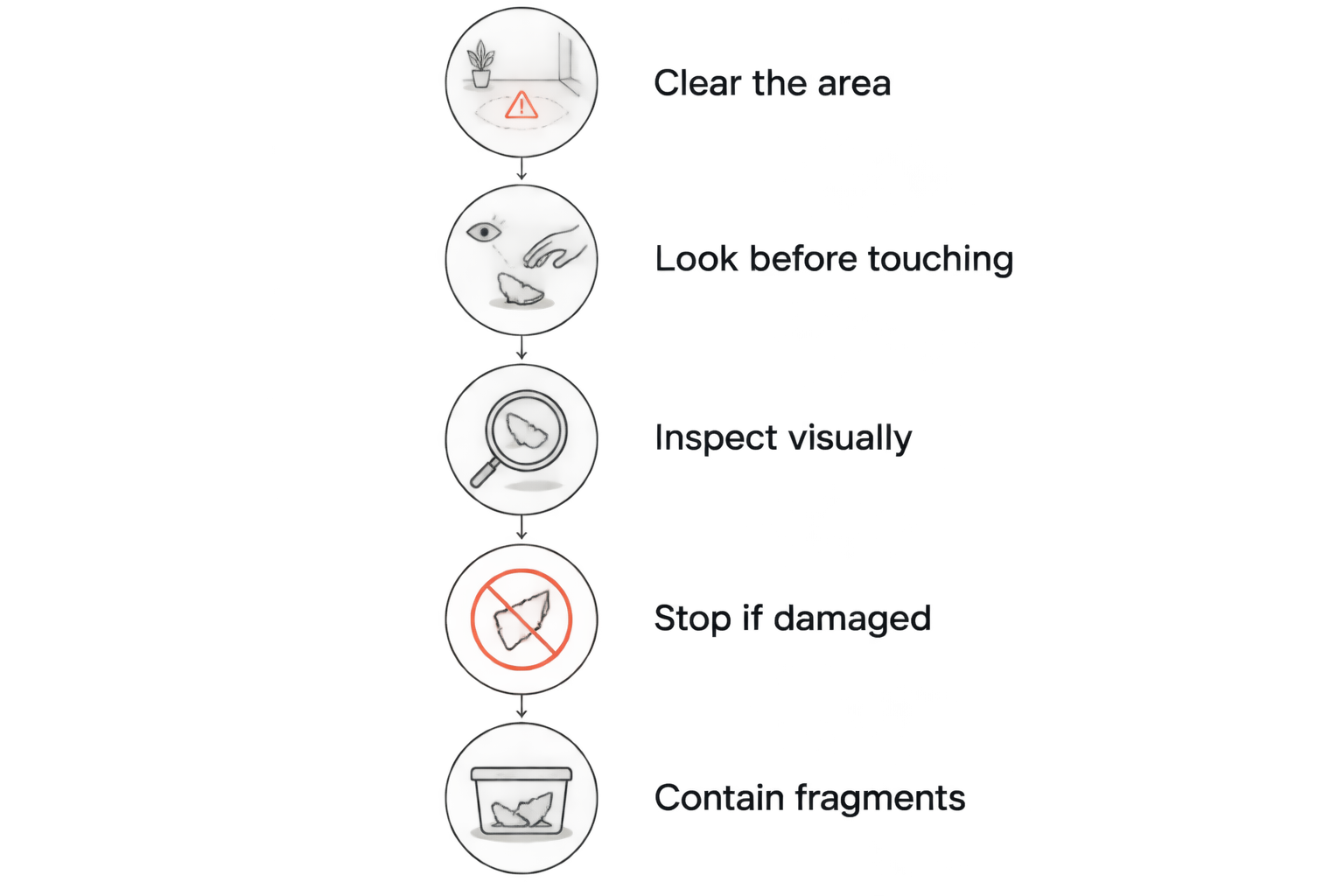
A visual check has limits. If you cannot inspect a section, cannot distinguish a mark from damage, or cannot handle the piece without approaching a sharp edge, leave it out of service and ask the manufacturer for guidance.
For cleanup details, use the guide to safe handling of broken glass. Do not put loose shards directly into a bag where they can cut through it or injure the next person handling the waste.
How can you tell a crack from a mark?
A line in glass deserves attention after a fall, but appearance alone does not always establish what caused it. Residue, reflections, scratches, manufacturing features, and fractures can be difficult to distinguish without suitable inspection.
View the area under good light from different angles without flexing or tapping the piece. Look for a missing edge, an opening, or a line extending through the material, but do not use your fingertip to confirm roughness.
If you cannot rule out a crack safely, stop handling the piece. A photograph can help you explain the concern to the manufacturer, but a photograph does not certify structural safety.
Avoid these informal tests:
- Running a nail or finger across a suspicious line.
- Tapping the glass and judging the sound.
- Pressing on opposite sides to see whether the line opens.
- Adding hot or cold water to see whether the piece leaks or breaks.
None provides a safe household certification of strength. Each adds handling or stress when the condition of the glass is already uncertain.
How do you protect thick glass during everyday handling?
The best prevention starts before you lift the piece. Clear a dry landing area, move nearby metal objects, and make sure the route does not require stepping over bags or reaching around furniture.
Support the main body instead of carrying the entire weight by a narrow neck, rim, or projecting section. If an item is awkward or slippery, stop and improve your grip rather than trying to finish the move quickly.
For a 2026 care checklist you will actually use, keep the instructions short:
- Dry hands: Avoid moving glass with wet or soapy hands.
- Clear surface: Remove clutter before setting the piece down.
- Body support: Do not suspend the whole object from a delicate part.
- Edge clearance: Keep glass back from counter and shelf edges.
- Separate pieces: Prevent loose glass parts from knocking together.
A mat helps cushion contact with the work surface, but it does not catch a piece that falls beyond the mat. Keep the mat flat and the surrounding surface clear; do not let a soft surface create a false sense of security.
How should you store thick glass?
Use separate, padded spaces that support the body without loading fragile projections. Wrapping is useful only when it stays in place and prevents contact where contact would otherwise occur.
A loosely packed container allows movement. An overfilled container creates pressure. Arrange the contents so that closing the lid does not push against the glass or force separate objects together.
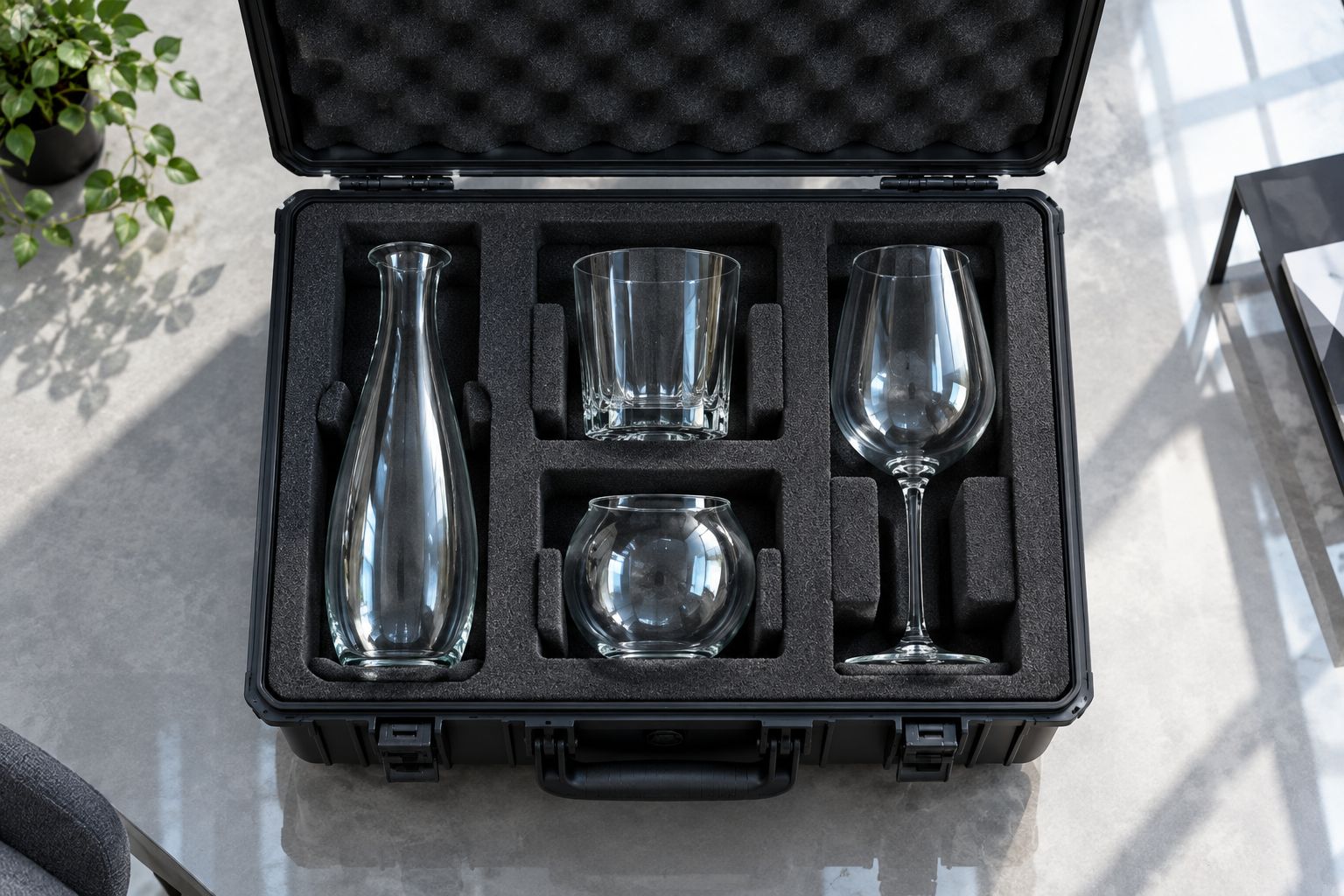
Choose a stable storage location where the container will not be knocked down during ordinary activity. Keep heavy objects from being stacked on top unless the storage system is designed for that load.
After moving the container, check that its contents have not shifted. A padded case reduces direct contact, but its protection depends on fit, closure, and how you handle the case itself.
Does borosilicate glass resist drops better?
Borosilicate glass is not drop-proof. Its resistance to thermal shock is a different property from resistance to impact, so a material description does not establish that a finished object will survive a fall.
Do not assume a piece is borosilicate because it is clear, heavy, or thick. Use the manufacturer's stated material information, and continue to protect confirmed borosilicate glass from hard impacts.
Can you keep using glass with a small chip?
Stop using chipped glass and keep fingers away from the damaged edge. A chip can leave a sharp surface, and visible damage is not something to dismiss because the rest of the object looks solid.
Do not sand, glue, or heat a damaged glass accessory as a home repair. Ask the manufacturer about safe disposition rather than trying to restore an uncertain structure yourself.
FAQ
Can thick glass break if I drop it on tile?
Yes, thick glass can break on tile. A hard landing, especially on a rim or projecting section, can fracture the piece despite substantial walls.
Does 9 mm glass mean it is drop-proof?
No, a 9 mm thickness label does not mean glass is drop-proof. The figure does not establish an impact rating or describe every part of the object.
Is thick glass safe if it did not shatter after falling?
Not shattering does not prove that glass is undamaged. Inspect it visually without touching suspicious edges, and stop handling it if you find damage or cannot assess it safely.
Should I tap glass to check whether it cracked?
No, do not tap glass to check for a crack. Sound is not a safe household test of structural condition, and tapping adds another impact.
Will a silicone mat stop thick glass from breaking?
A silicone mat cannot guarantee that glass will not break. It cushions contact only within its coverage and does not protect a piece that falls onto the floor.
Can thick borosilicate glass still crack?
Yes, thick borosilicate glass can still crack. Resistance to thermal shock does not make a finished glass object immune to impact damage.
What is the safest way to store thick glass?
Store thick glass in separate padded spaces that support the body and keep projecting sections clear. Prevent movement inside the container without forcing the lid against the glass.
One last thing
Check the place where you set glass down, not just the glass itself. A cluttered counter, a nearby metal faucet, or an exposed shelf edge remains a hazard regardless of wall thickness.
For Dubcharge glass-care readers in 2026, the practical next move is simple: clear a stable landing space and separate stored pieces. Those changes address avoidable impacts without relying on an unsupported promise that thick glass cannot break.


Leave a comment
This site is protected by hCaptcha and the hCaptcha Privacy Policy and Terms of Service apply.