










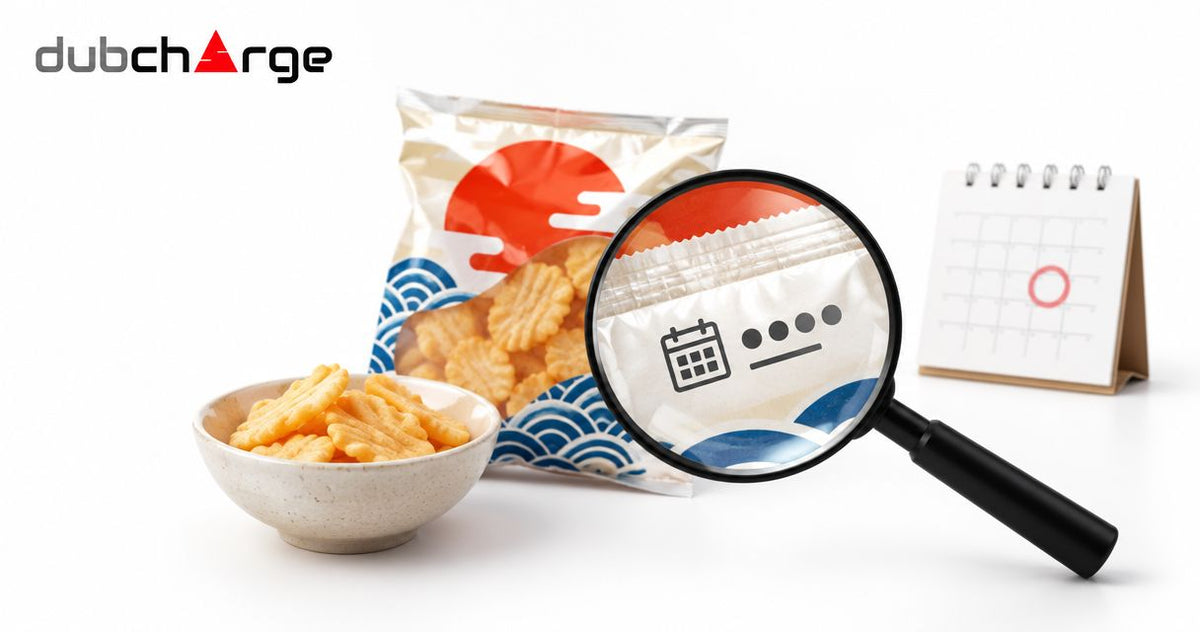
Read Japanese snack dates in year–month–day order, then check whether the label says 賞味期限 (best before) or 消費期限 (use by). For example, 賞味期限 2026.10.15 means best before October 15, 2026; the date applies to the unopened package stored as directed, not an opened bag or a package exposed to unsuitable conditions.
- For DubCharge snack shoppers, knowing how to read Japanese expiration dates starts with 賞味期限 versus 消費期限.
- 賞味期限 means best before; 消費期限 means use by. These labels have different meanings.
- Read clearly identified Japanese calendar dates in year–month–day order; do not guess at unexplained codes.
- Check storage instructions and package condition. An unopened-package date does not set the storage period after opening.
Why this matters
A readable date is not enough—you also need to know what the date measures. Best-before labeling concerns expected quality under stated storage conditions. Use-by labeling concerns the period in which the unopened food can be eaten safely under those conditions.
For ordinary imported snacks from DubCharge, use the actual package as your reference. A familiar brand name, an online product description, or another flavor's label does not establish the date, ingredients, allergens, or storage requirements of the package in your hand.
Japan's Consumer Affairs Agency distinguishes 賞味期限 and 消費期限 in its food-labeling guidance. That distinction is the starting point; decoding the printed numbers comes next.
How do you read Japanese snack expiration dates?
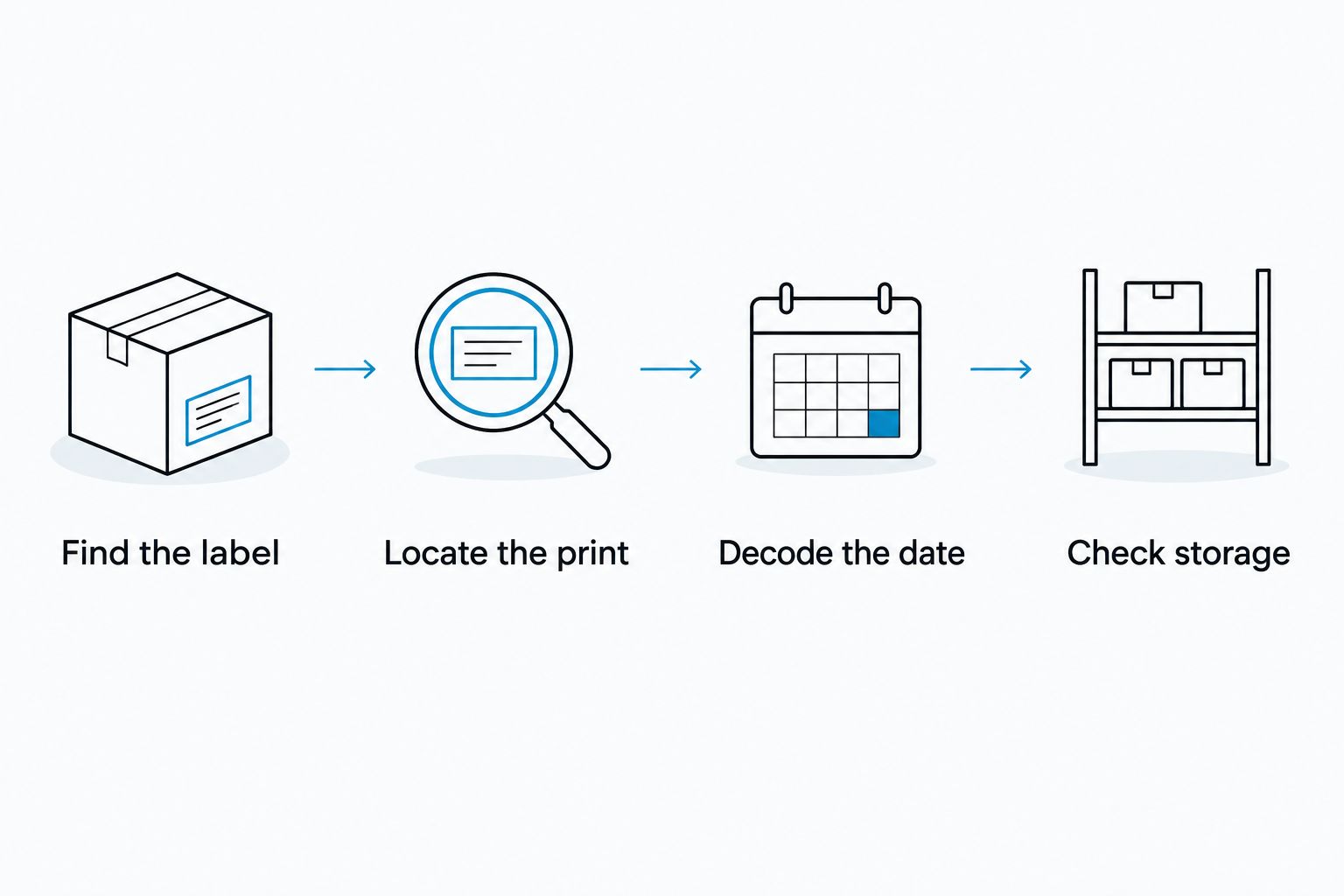
Follow this sequence: find the date wording, locate its printed date, decode the order, and check the storage conditions. Do not start by interpreting whichever number is easiest to see.
Find the label
Look for 賞味期限 or 消費期限 on the back, bottom, seal, or label panel. Sometimes the main information panel points to a date printed elsewhere rather than showing the date beside the wording.
The table below separates the terms you need from nearby information that is not itself an expiration date.
| Japanese wording | Meaning | Best for identifying | Limitation |
|---|---|---|---|
| 賞味期限 | Best before | The stated quality period for unopened food stored correctly | Does not guarantee safety after poor storage or package damage |
| 消費期限 | Use by | The stated safe-consumption period under the labeled conditions | Do not treat it as a flexible quality suggestion |
| 保存方法 | Storage method | Conditions that apply to the labeled date | Does not necessarily describe handling after opening |
| 製造年月日 | Manufacturing date | When the product was made | Does not establish an expiration date by itself |
| 開封後 | After opening | Instructions that apply once the package is open | Does not extend the unopened-package date |
Locate the print
Scan the whole package if the date is not next to its label. Check the top and bottom seams of bags, the base of cans, and the neck, cap, or label area of bottles.
Use good light and turn the package slowly. Printing on a curved bottle or crimped seal can make a separator or character hard to distinguish. If you cannot read it confidently, do not fill in the missing part from context.
Decode the date
A clearly labeled Japanese date such as 2026.10.15 reads October 15, 2026—not October 2026 with an unexplained final code. In 2026年10月15日, 年 marks the year, 月 the month, and 日 the day: year 2026, month 10, day 15.
Separators can differ. Dots, slashes, spaces, or Japanese date characters do not change a clearly established year–month–day sequence. An English import sticker, however, needs to be read according to its own wording or stated format.
Check storage
Find 保存方法 and any separate instructions for handling after opening. A correctly decoded date does not override refrigeration requirements, warnings about heat or sunlight, or directions to consume the product promptly after opening.
What does 賞味期限 mean on Japanese snacks?
賞味期限 means best before: the date through which an unopened food is expected to retain its intended quality when stored as directed. It is not a manufacturing date, and it is not the same label as 消費期限.
This is the quality-versus-safety distinction explained in Japan's Consumer Affairs Agency guidance. Passing a best-before date does not automatically mean a food has become unsafe, but the date alone cannot establish that a particular package remains safe to eat.
Keep both sides of that distinction clear:
- What it tells you: the manufacturer's stated quality period under the specified conditions.
- What it does not tell you: whether damaged packaging, moisture, heat exposure, or handling has affected that individual product.
Do not use a taste test to resolve uncertainty about safety. Visible mold, leaking packaging, or other clear signs of deterioration call for rejection, not a small sample.
What does 消費期限 mean on Japanese food?
消費期限 means use by: do not eat the food after that date. The date assumes an unopened package and compliance with the labeled storage conditions.
For example, 消費期限 2026年10月15日 identifies October 15, 2026 as the use-by date. It does not mean the item was manufactured that day, and it does not give permission to keep an opened package until then regardless of its instructions.
The practical advantage of identifying this wording is that it removes the guesswork about whether the date is merely a quality marker. Its limitation is equally important: a future use-by date cannot compensate for incorrect storage.
What if the Japanese snack date shows only a year and month?
A clearly identified year-and-month best-before date does not need a missing day invented. Japanese food-labeling rules permit year-and-month best-before marking for foods whose quality period exceeds three months; the stated month is treated through its last day.
For example, 賞味期限 2026.10 means best before the end of October 2026. This interpretation depends on confirming that the print really is a year-and-month best-before date—not a production code or a partially rubbed-off full date.
Use these checks before applying the month-end interpretation:
- Confirm that 賞味期限 identifies the date.
- Make sure no day appears elsewhere on the same printed line.
- Check whether an importer label supplies a fuller explanation.
- Ask the seller or manufacturer if the code remains unclear.
Do not apply the month-end rule to an unidentified code. A string that happens to resemble a date is not enough evidence.
Why Japanese snack date labels vary
Different-looking labels do not necessarily mean different date rules. The difference can come from the food's labeling category, the permitted date detail, or where the manufacturer prints the information.
- Date purpose: 賞味期限 communicates a quality period; 消費期限 communicates a use-by period.
- Date detail: an eligible best-before label can show a year and month rather than a full calendar date.
- Print location: the information panel can direct you to another part of the package.
- Import labeling: an English sticker can provide translations and additional instructions alongside the original packaging.
- Storage conditions: the meaning of the date depends on the conditions specified for that food.
- Opening status: opening changes which handling instructions you need to follow.
For DubCharge snack shoppers, the best date check combines the Japanese label, the printed date, and storage instructions. Use all three together; none replaces the others.
Is the number on the bottom always an expiration date?
A number on the bottom is not automatically an expiration date. It can be a manufacturing date, lot identifier, or another production marking, so first connect it to a date label or an explicit explanation.
A code containing letters and numbers should not be converted into a calendar date by guesswork. Manufacturers use production codes for traceability, and the code's meaning is not established merely because some digits resemble a month or year.
If the package has several markings, photograph the complete label and every code together. That gives the seller or manufacturer the context needed to identify the correct date rather than interpret an isolated string.
Does opening a Japanese snack change the printed date?
Opening ends the conditions on which the unopened-package date is based. Follow the package's after-opening instructions instead of treating the remaining calendar time as a guaranteed storage period.
Look for 開封後 and nearby wording. Instructions can address refrigeration, resealing, or prompt consumption; do not assign a fixed number of days unless the package or manufacturer provides one.
For bags, keep the date-bearing portion when you open the seal. If you transfer snacks to another container, keep the original label with the food so you retain the date, ingredient list, allergen information, and handling directions.
What if the English sticker and Japanese date seem different?
Resolve a genuine mismatch before eating the snack. First check whether one marking is a manufacturing date and the other is a best-before or use-by date; those are different events, not necessarily conflicting labels.
Next, check the date order. An explicitly marked year–month–day date and an English month-name translation can describe the same day while looking different.
If the two labels still disagree, contact the seller or manufacturer with photographs of both markings and the lot code. Do not select the later date because it is more convenient, remove a sticker to make the discrepancy disappear, or assume one label extends the other.
How should you check an imported snack before opening it?
Keep the date check separate from the ingredient and package checks. Passing one does not settle the others.
- Identify the food. Confirm the exact flavor, package, and market version rather than relying on a familiar logo.
- Read the date type. Distinguish best before from use by before decoding the numbers.
- Read the storage directions. Check the unopened and after-opening instructions separately.
- Inspect the packaging. Do not rely on the date when the seal is broken, the container leaks, or the package is otherwise compromised.
- Read ingredients and allergens. Use that package's information; recipes and labeling can differ between markets.
- Keep the label. Retain the date and lot information until you have finished the food.
These checks are useful for a single snack and for a mixed gift box. A shared outer box does not give every enclosed item the same date or storage requirements.
FAQ
How do I read Japanese expiration dates on snacks?
Identify 賞味期限, meaning best before, or 消費期限, meaning use by, then read a clearly identified Japanese calendar date in year–month–day order. Check the storage instructions because the date assumes an unopened package stored as directed.
Does 賞味期限 mean the snack is unsafe the next day?
賞味期限 is a best-before quality date, not an automatic declaration that food becomes unsafe the following day. It also does not prove a particular package is safe; storage, handling, and package condition still matter.
Can I eat Japanese food after its 消費期限 date?
Do not eat food after its 消費期限 use-by date. The date also assumes correct storage and an unopened package, so a date that has not passed does not excuse unsuitable handling.
What does 2026.10 mean on a Japanese snack?
2026.10 means October 2026 when it is clearly identified as a year-and-month date. On a qualifying year-and-month best-before label, it means through the end of that month; do not apply that interpretation to an unidentified lot code.
Does the printed date still apply after I open the bag?
The unopened-package date does not establish how long the snack lasts after opening. Follow the package's after-opening instructions and do not invent a storage period when none is stated.
Can I use a phone translation app to check the date?
Use a translation app to help locate the wording, then verify the characters and digits against the package. Curved surfaces, faint printing, and seams can produce reading errors, so ask the seller or manufacturer when the result remains unclear.
What should I send DubCharge if I cannot read a snack date?
Send clear photographs of the full package, the Japanese date wording, the printed code, and any English import label. Include the exact product and flavor so the question concerns the package you actually have.
One last thing
Keep the wrapper before you reach for scissors. The date can sit on the seal you are about to cut away, while the main label only tells you where to find it.
Read and retain that part first. Keeping the date, lot code, and storage directions together is more useful than saving a photograph of the numbers alone.


Leave a comment
This site is protected by hCaptcha and the hCaptcha Privacy Policy and Terms of Service apply.