

























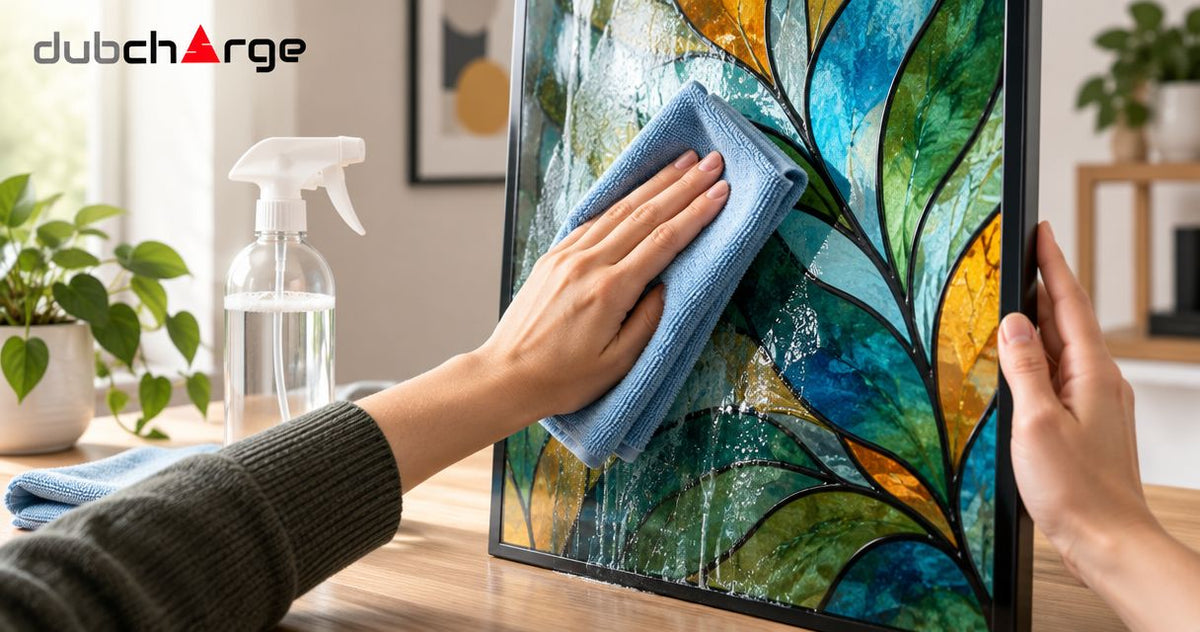
To clean painted glass without damaging the design, start with gentle dry dusting; use a barely damp, soft cloth only if the maker permits wet cleaning and the paint is intact. Keep solvents, abrasives, soaking, and heat away from unknown finishes, and stop immediately if color transfers, the surface turns tacky, or paint starts lifting.
- How to clean painted glass: dust first, then use minimal moisture only when the finish permits it.
- Dubcharge glass-care guidance prioritizes preserving the design over removing every stubborn mark.
- Keep alcohol, acetone, abrasive pads, and dishwasher cleaning away from unverified painted finishes.
- Stop cleaning if paint transfers, flakes, softens, or changes appearance.
How do you clean painted glass without damaging the design?
Clean the decoration as a separate surface from the glass underneath it. A cleaner suitable for bare glass is not automatically suitable for paint, printed logos, metallic details, decals, or a clear coating.
Start with the maker’s care instructions. If the finish is unidentified, limit cleaning to gentle dust removal from stable areas rather than experimenting with stronger products. Tool choice matters too: review whether cleaning brushes can scratch glass before bringing a brush near a decorated surface.
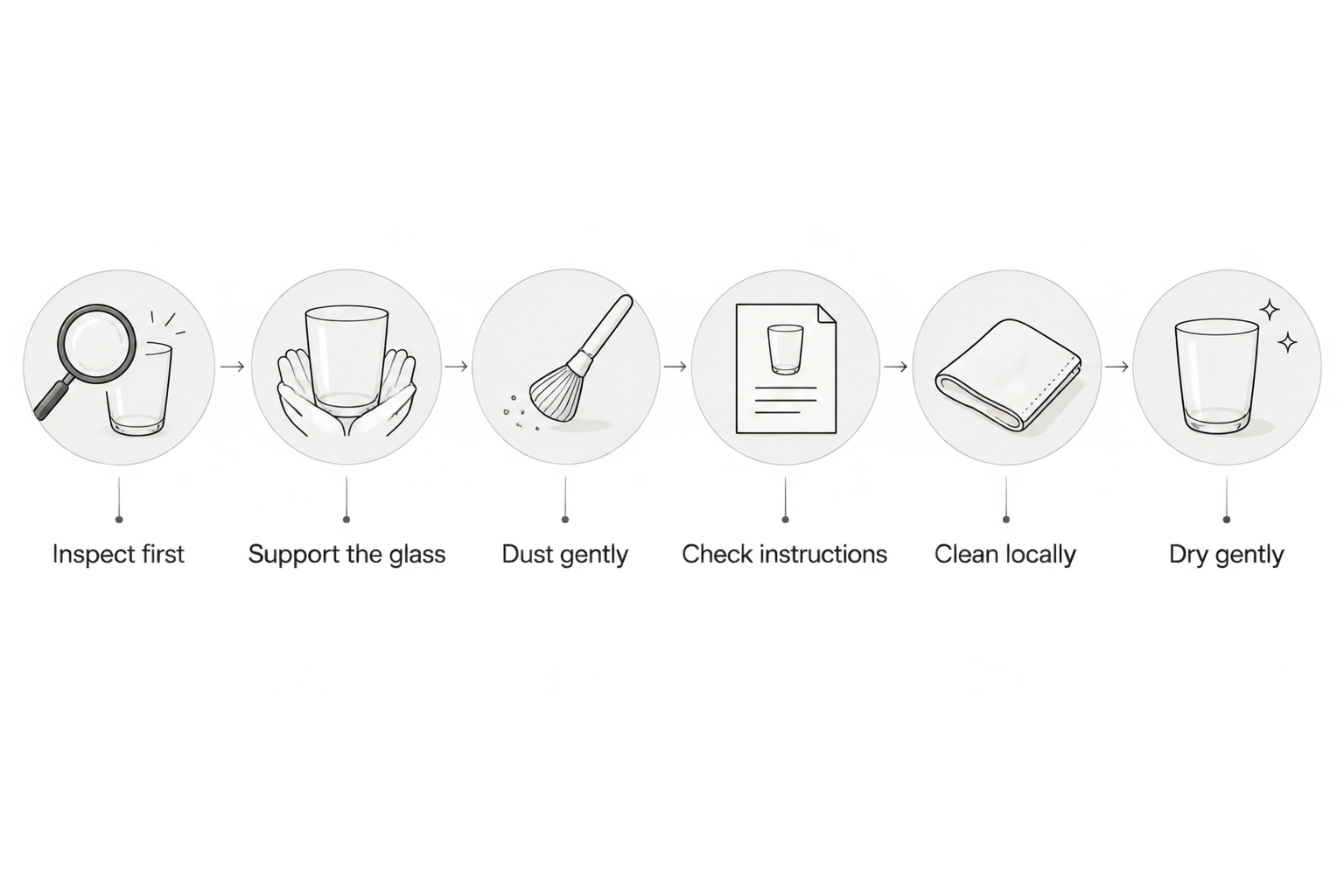
Follow this cleaning sequence
- Inspect first. Look under good light for loose edges, cracks, chips, raised decoration, and cloudy or sticky patches. Do not rub a damaged area to find out whether it is stable.
- Support the glass. Set the piece on a clean, cushioned, stable surface. Hold it by a sound, undecorated section rather than a handle or projecting detail.
- Dust gently. Use a clean, very soft brush on firmly attached decoration. Lift loose dust away without scrubbing or pushing bristles under paint edges.
- Check instructions. Confirm whether the maker allows water, detergent, or a particular cleaning product. An unidentified finish does not have verified wet-cleaning instructions.
- Test discreetly. If wet cleaning is permitted, test a small, inconspicuous area with a barely damp, soft white cloth. Check both the cloth and the surface before proceeding.
- Clean locally. Wipe a small area with light pressure. Apply moisture to the cloth, not directly to the object, so liquid does not run across decoration or into seams.
- Dry gently. Blot permitted wet-cleaned areas with a separate soft cloth. Let remaining moisture evaporate before putting the glass away.
A hidden test reduces uncertainty; it does not prove every color, decal, or coating will react identically. Different decorative areas on the same object need separate consideration.
Why this matters
Painted glass has more than a glass surface to protect. Cleaning also affects the decoration and whatever holds that decoration in place. Removing dirt is not a successful result if the same action removes part of the design.
For your 2026 care routine, separate ordinary dust removal from stain removal. Dust often needs only gentle attention; an unknown stain on an unknown coating calls for restraint rather than a stronger cleaner.
For Dubcharge glass owners, preserving the design takes priority over removing every mark. This guide covers material care only, not device operation, repairs, or restoring damaged coatings.
Which cleaning method should you use?
Choose the least aggressive method that matches the maker’s instructions and the condition of the decoration. More pressure, more liquid, and a longer cleaning session are not substitutes for knowing the finish.
| Method | Best for | Advantage | Limitation |
|---|---|---|---|
| Gentle dry dusting | Loose dust on firmly attached decoration | Avoids introducing liquid or detergent | Does not remove greasy marks or bonded residue |
| Barely damp cloth | Intact finishes with verified permission for water cleaning | Allows controlled, local cleaning | Unsuitable for water-sensitive or lifting decoration |
| Maker-approved detergent cleaning | Intact finishes whose instructions permit detergent | Addresses dirt that water alone does not remove | Approval for bare glass does not establish approval for its decoration |
| Professional assessment | Valuable, historic, flaking, or unidentified fragile decoration | Avoids trial-and-error cleaning | Requires specialist help rather than an immediate household fix |
Do not work down this table as an escalation ladder. If dry dusting fails, the next step is to check compatibility—not automatically switch to water or detergent.
Unknown paint or printed decoration: keep cleaning minimal
When you cannot identify a finish, avoid assuming it is waterproof because it looks glossy. A shiny surface does not establish which cleaner, temperature, or contact time it tolerates.
Use the same rule for printed logos and decorative lettering. Keep routine handling away from the design where possible, and remove loose dust only when the decoration is firmly attached.
If you are organizing care instructions in 2026, record what the maker actually confirms about the finish. Save the product-specific instructions rather than replacing them with a general rule for all painted glass.
Do not test unknown decoration with alcohol, nail-polish remover, or a household glass spray. A failed compatibility test can leave a permanent visible patch, even when the amount used is small.
Verified washable decoration: control moisture and pressure
If the maker explicitly allows hand cleaning, follow those directions rather than a general internet recipe. Permission to hand-wash does not automatically mean permission to soak, scrub, or use a dishwasher.
Prepare separate clean cloths for cleaning and drying. A white cleaning cloth makes transferred color easier to notice, but the absence of color transfer is not the only check: look for dulling, softening, streaking, and changes around edges.
Keep the cloth barely damp, not dripping. Work on a small area, avoid repeated rubbing, and blot rather than polish the surface afterward.
If detergent is permitted, remove its residue using the maker’s approved method. Do not keep adding water to an object whose decoration or construction makes thorough rinsing uncertain.
Flaking or lifting decoration: stop household cleaning
Loose paint is a stop sign, not stubborn dirt. Brushing, wiping, taping, or picking at a lifting edge can remove material that is still partly attached.
Avoid putting adhesive tape over the damaged area or applying a household clear coat to hold it down. Those actions change the surface and complicate later assessment; they are not cleaning methods.
For valuable or sentimental glass, ask a qualified objects conservator about the next step. For ordinary items, set the piece aside and prevent further handling of the damaged design. Do not turn a cleaning problem into an improvised repair.
Why painted-glass cleaning methods vary
The cleaning method depends on the finish and its condition, not just the object’s shape. Use these factors to decide whether you should proceed:
- Decoration type: Surface paint, decals, metallic details, and color within the glass are not interchangeable materials.
- Surface condition: Firmly attached decoration needs different handling from cracked, powdery, blistered, or lifting material.
- Protective coating: A clear layer is another surface to identify, not proof that any cleaner is safe.
- Dirt location: A mark on undecorated glass is different from one crossing lettering or a painted edge.
- Mixed materials: Adhesives, seals, paper details, and attached parts need their own care instructions.
- Maker’s directions: Product-specific guidance takes priority over generic advice for glass.
Use those same checks when reviewing a 2026 cleaning-product label. A statement about glass compatibility does not establish compatibility with every coating applied to glass.
What should you keep away from painted glass?
Avoid solvent cleaning on unverified decoration. This includes rubbing alcohol and acetone, even when those products appear in instructions for cleaning undecorated glass.
Keep abrasive pads, scouring powders, polishing compounds, scrapers, and razor blades away from the design. A tool that removes a deposit mechanically can also remove paint or leave a visible change in gloss.
Do not put unknown painted glass in a dishwasher. Heat, detergent, and spray introduce several stresses at once, while the finish’s tolerance remains unverified.
Skip boiling water and abrupt temperature changes. Let glass reach room temperature naturally before handling it for cleaning, and never use a direct heat source to speed drying.
Finally, do not mix household cleaning chemicals. Combining products does not establish paint compatibility and introduces avoidable chemical hazards.
How do you dry and store painted glass after cleaning?
Place the glass on a clean, stable surface where it cannot roll or tip. Keep the painted area from rubbing against a towel, shelf edge, or neighboring object while you work.
Dry only with light contact on decoration that the maker permits you to wet-clean. Avoid twisting a cloth around narrow sections or pushing fabric into places where it catches.
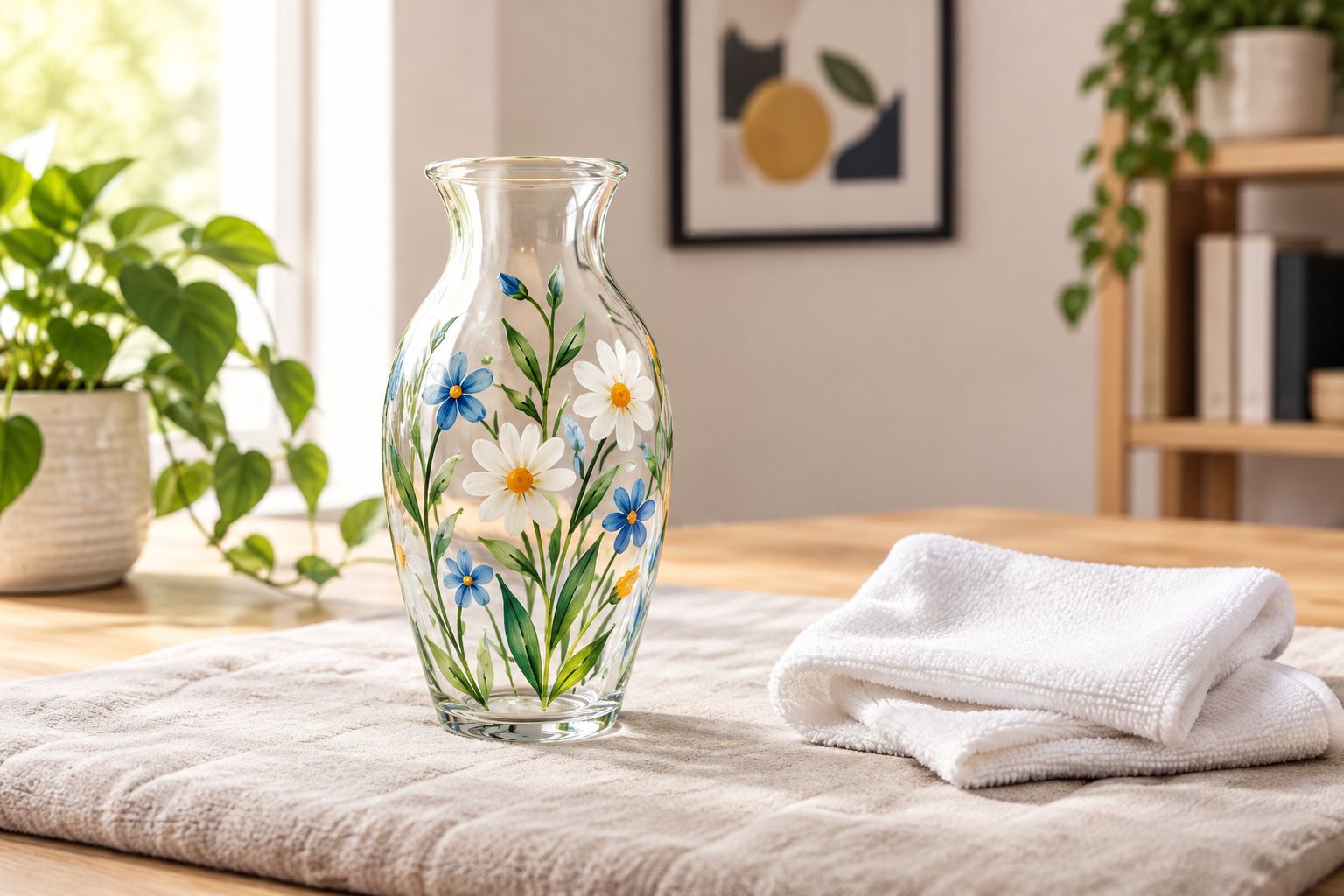
Let remaining moisture evaporate before enclosing the item. Avoid packing damp glass into a bag or wrapping it tightly, and keep packaging from pressing directly against fragile decorative edges.
Make storage part of your 2026 glass-care checklist. Separate pieces so they cannot knock together, and lift them rather than sliding them across a shelf.
Can you use rubbing alcohol on painted glass?
Do not use rubbing alcohol on painted glass unless the maker specifically approves it for that decoration. Instructions for bare glass do not establish that a painted logo, decal, or clear finish tolerates the same solvent.
If alcohol accidentally contacts the design, stop rubbing. Do not try to correct the change with another solvent or polish.
Can you soak painted glass to remove stubborn marks?
Do not soak painted glass unless its product-specific care instructions explicitly allow immersion. Local cleaning gives you more control over where moisture goes and makes changes easier to spot.
If a mark remains after an approved gentle method, leave it rather than increasing soak time or force. A persistent mark is not evidence that the finish needs harsher treatment.
What if the design starts coming off while you clean?
Stop cleaning immediately if the design transfers, flakes, softens, or lifts. Set the object down securely and avoid wiping the affected area again, including with a drying cloth.
Let the surface settle without direct heat. Seek specialist advice for valuable glass rather than trying to replace lost decoration yourself.
FAQ
What's the safest way to clean painted glass?
Start with gentle dry dusting on firmly attached decoration. Use moisture only when the maker permits it, test discreetly, and stop if the surface changes.
Can I use regular glass cleaner on painted glass?
Do not use regular glass cleaner on painted decoration unless the maker confirms compatibility. A product intended for bare glass is not automatically suitable for paint, decals, metallic details, or clear coatings.
Is a microfiber cloth safe for painted glass?
A microfiber cloth is not automatically safe for every painted finish. Use a clean, soft cloth only on stable decoration and only with the cleaning method the maker permits; trapped grit and rubbing pressure remain concerns.
Can painted glass go in the dishwasher?
Keep painted glass out of the dishwasher unless its maker explicitly identifies the decorated item as dishwasher-safe. Hand-wash permission alone does not establish dishwasher compatibility.
How do I remove fingerprints from a painted design?
Remove fingerprints with a barely damp, soft cloth only if wet cleaning is approved for the finish. Test discreetly and use light pressure; if compatibility is unknown, avoid experimenting on the design.
How do I tell whether glass is painted or colored throughout?
Check the maker's description or ask the maker to identify the decoration. Appearance alone does not reliably establish the material or its cleaning requirements, so do not scratch or apply solvent to identify it.
Does a clear coating make painted glass waterproof?
A clear coating does not establish that painted glass is waterproof or safe to soak. The coating itself needs compatible care, and the maker's instructions determine the permitted cleaning method.
Can I clean a painted glass pipe or non-electric rig body this way?
Use these precautions for exterior decoration only, subject to the maker's instructions. Interior material-care directions do not automatically apply to exterior paint, and damaged or lifting decoration needs separate assessment.
One last thing
Photograph the decoration before cleaning, especially around lettering, edges, and existing worn spots. A reference image helps you distinguish an old mark from a new change without repeatedly touching the surface.
For your 2026 care record, save that image alongside the maker’s instructions. Keep Dubcharge glass-care notes specific to each item: the safest approved method for one decorated piece is not permission to clean every piece the same way.

Leave a comment
This site is protected by hCaptcha and the hCaptcha Privacy Policy and Terms of Service apply.