
























Yes, sudden temperature changes can crack borosilicate glass: it resists thermal shock better than ordinary soda-lime glass, but uneven heating or cooling can still create enough stress to break it. Let glass return toward room temperature before washing, and never treat a borosilicate label as permission to use boiling water, ice baths, or direct heat.
- Can temperature changes crack borosilicate glass? Yes—thermal shock resistance does not make glass unbreakable.
- Dubcharge glass-care guidance is best for readers protecting glass accessories during cleaning, drying, and storage.
- Avoid sudden hot-to-cold changes, inspect for damage, and follow the item's manufacturer instructions.
- Stop using cracked glass; reheating, glue, and another rinse do not establish that it is safe.
Can sudden temperature changes crack borosilicate glass?
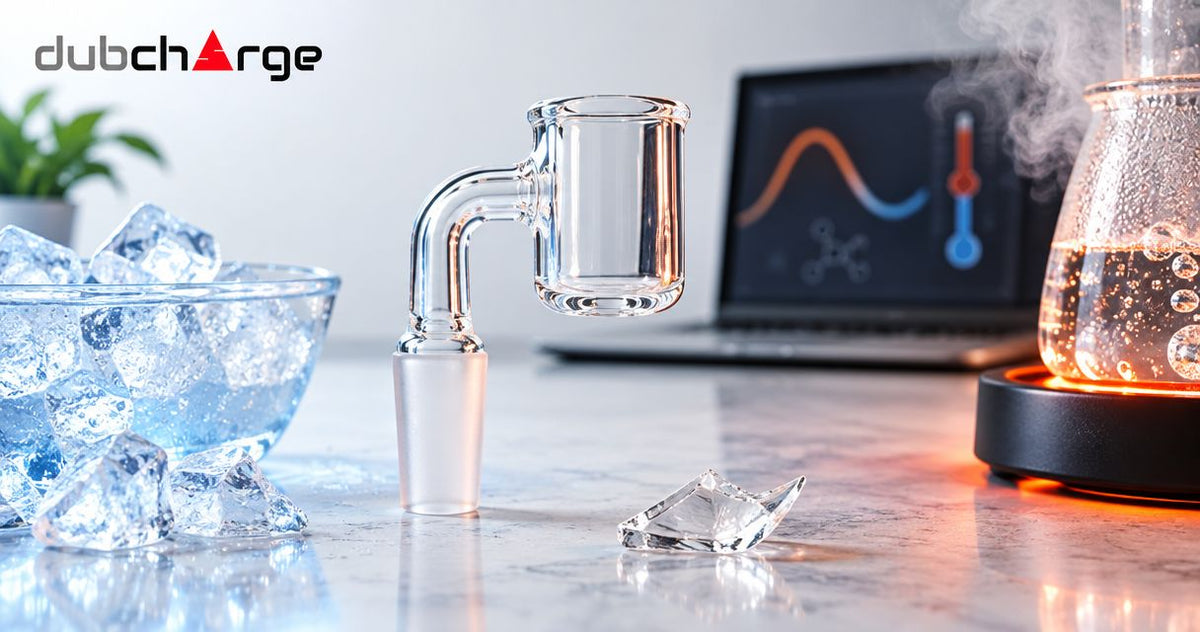
Borosilicate glass can crack when different parts change temperature faster than the material can accommodate. A cold rinse against a warm wall, for example, cools the surface before the surrounding glass reaches the same temperature. That uneven contraction creates thermal stress.
The same problem works in reverse. Pouring very hot water into cold glass heats the inner surface first, while the outside remains colder. Borosilicate reduces this mismatch compared with ordinary soda-lime glass; it does not eliminate it.
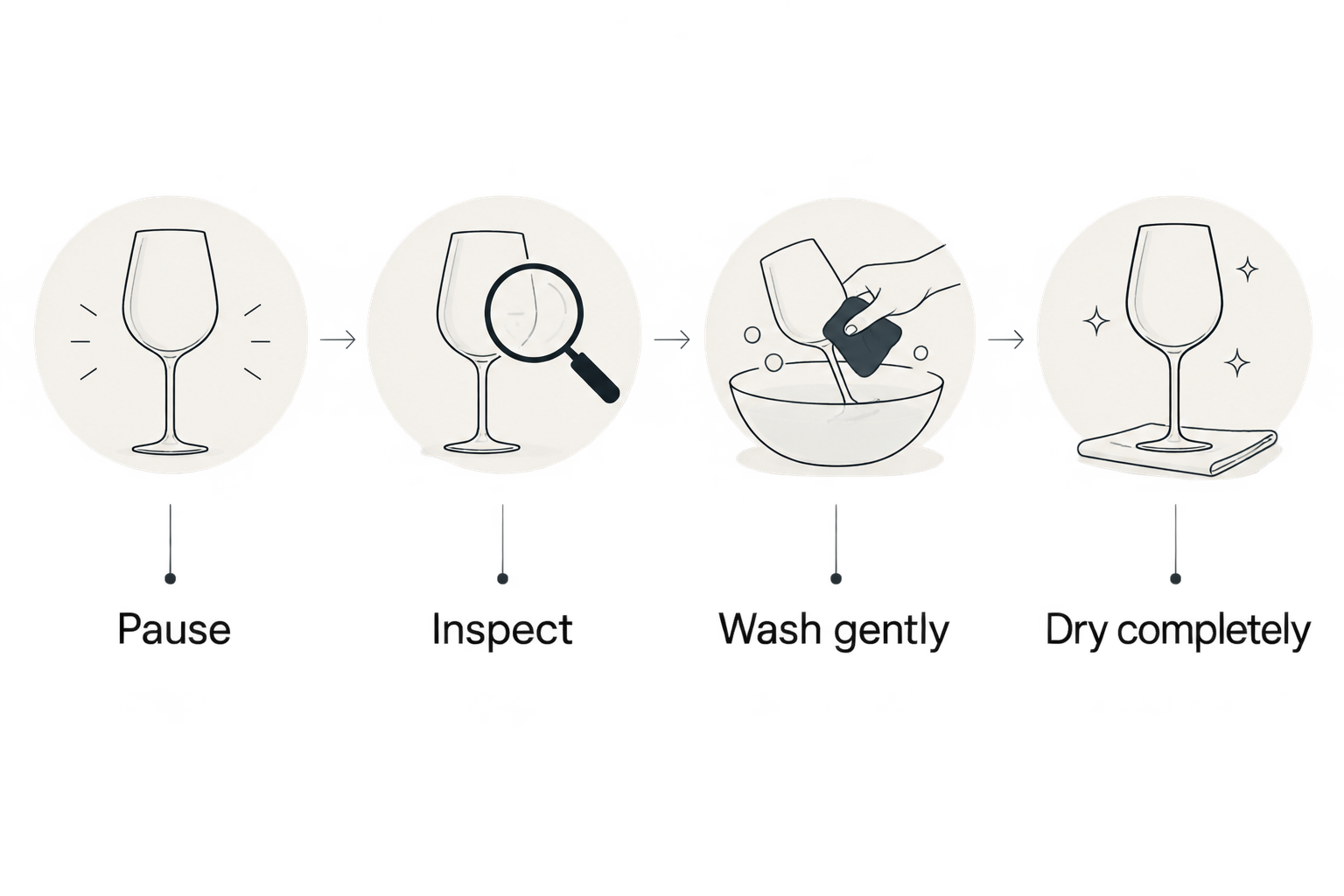
For routine care, use this sequence:
- Pause. Leave recently heated or chilled glass on a stable, suitable surface rather than immediately washing it.
- Inspect. Look for chips, hairline cracks, and damage around edges, openings, and joints.
- Wash gently. Follow the manufacturer's cleaning directions without introducing an abrupt temperature change.
- Dry completely. Let water drain and moisture escape before enclosed storage.
Before handling a questionable piece, review how to inspect glass for cracks. Do not run a finger along a suspected crack or chipped rim to check it.
Why this matters for glass care in 2026
Thermal damage is easy to confuse with impact damage because both can leave a visible crack. You do not need to prove which caused the failure before taking the safe next step: stop handling the item unnecessarily and keep damaged glass out of service.
Dubcharge glass-care guidance focuses on preventing damage during ordinary cleaning and storage, not testing how much temperature stress an accessory can survive. A successful hot rinse yesterday does not establish that the same rinse is safe today. A new chip or scratch changes the condition of the glass.
The practical benefit of borosilicate is greater resistance to temperature-related stress. The limitation is equally important: the material name alone does not tell you the finished item's condition, construction quality, or approved cleaning method.
Why borosilicate resists thermal shock—but still breaks
Borosilicate expands less with temperature than ordinary soda-lime glass. Lower expansion helps reduce the stress created when adjacent areas are at different temperatures. It does not prevent stress from forming.
For a concrete material reference, SCHOTT's published BOROFLOAT 33 technical data gives a mean linear thermal expansion coefficient of 3.25 × 10⁻⁶ K⁻¹ over 20–300°C. That is a specification for a named glass material, not a safe washing limit for an unidentified accessory. A temperature difference of 1 K equals a temperature difference of 1°C; neither unit supplies a universal crack threshold.
For 2026 care decisions, the useful distinction is between a material property and an instruction for a finished item. A coefficient describes expansion under stated conditions. It does not authorize a boiling-water rinse, freezer storage, or exposure to a heating element.
| Glass type | Best for | Material advantage | Care limitation |
|---|---|---|---|
| Borosilicate glass | Applications designed around lower thermal expansion | Expands less with temperature than ordinary soda-lime glass | Can still crack from thermal stress, damage, or unsuitable handling |
| Ordinary soda-lime glass | Everyday items used within their stated care instructions | Suitable for many routine glass applications | Expands more with temperature; do not assume hot-to-cold transfers are safe |
| Unidentified glass | Conservative care until the material and instructions are confirmed | No thermal-performance assumption is needed | Appearance, weight, and thickness do not verify borosilicate composition |
Do not use this comparison to identify glass by eye. Clear glass can belong to different material families, and a thick wall does not prove thermal-shock resistance.
Why the risk of cracking varies
There is no single temperature change that every borosilicate item can safely withstand. The stress depends on the temperature pattern across the piece and the condition of the finished glass.
- Temperature difference: A larger difference between the glass and the liquid or surface touching it increases the potential for uneven expansion or contraction.
- Speed of change: Abrupt contact changes the surface temperature before the rest of the wall can follow.
- Wall thickness: Thick sections take longer to equalize through their depth. Thickness alone is not protection against thermal shock.
- Shape and construction: Bases, necks, bends, and joints can heat or cool differently from adjacent sections.
- Existing damage: Chips and scratches concentrate stress. An item that looks mostly intact is not necessarily undamaged.
- Contact pattern: A stream hitting one spot or a cold surface touching only the base creates localized cooling rather than an even temperature change.
These factors interact. A small damaged area can matter more than the overall size or weight of the piece, so avoid treating heavy glass as automatically safer.
How should you wash glass after a temperature change?
Let the temperature settle before you start cleaning. Do not use washing as a way to cool a hot item quickly or warm a chilled item rapidly. Keep the process within the manufacturer's instructions for the whole accessory, including any painted surfaces or attached materials.
Pause
Set the item somewhere stable and away from children, pets, and the edge of the work surface. For glass you already know is warm, use a dry, heat-appropriate support that keeps it upright. Avoid a cold sink, wet countertop, or other surface that abruptly cools the contact area.
Do not pick up potentially hot glass just to check its temperature. Glass can look unchanged while hot, and repeatedly moving it adds a drop risk. There is no universal waiting period that covers every size, wall thickness, or starting temperature.
Inspect
Once handling is safe, inspect the piece under good light without tapping, twisting, or flexing it. Pay attention to rims, bases, narrow joints, and any area that previously struck a hard surface. Stop if you find a crack or chip.
A visual check is a practical screening step, not proof that every flaw is visible. Do not deliberately expose the glass to a temperature change to see whether it survives.
Wash gently
Use the cleaning method approved for the item. For washable, uncoated glass accessories, avoid extreme-temperature water and forceful handling. Keep removable glass parts from knocking together in the sink.
Do not substitute boiling water for an approved cleaner or cleaning method. A material's resistance to heat does not establish that its coatings, decorations, seals, or other components tolerate the same treatment.
Dry completely
Drain the item without balancing it precariously on a narrow opening. Use a stable drying arrangement and avoid heat-assisted shortcuts unless the manufacturer explicitly permits them. For enclosed shapes, follow this guide to dry narrow-neck glass after washing.
This 2026 care sequence prioritizes temperature stability, inspection, gentle washing, and complete drying. None of those steps requires testing the glass with hotter water.
Can you pour boiling water into borosilicate glass?
Borosilicate glass is not automatically approved for boiling water. Some finished products are designed for hot liquids, but that does not establish the suitability of an unrelated glass accessory. Follow instructions for the exact item rather than borrowing a temperature claim from laboratory glassware or cookware.
Cold starting conditions, damage, and localized contact all matter. Pouring onto a single spot is not equivalent to gradually bringing an approved vessel to temperature under its intended conditions.
If you cannot confirm that boiling water is permitted, leave it out of the cleaning process. Do not try a small amount first as a safety test; surviving one exposure does not certify the next.
Can cold water crack warm borosilicate glass?
Cold water can crack warm borosilicate glass by cooling its surface unevenly. This is the familiar hot-to-cold form of thermal shock. Borosilicate's lower expansion improves resistance, but does not make the transition harmless.
A narrow stream is not necessarily gentler than immersion because it concentrates the temperature change in one area. Ice water is not a suitable shortcut for cooling warm glass, either.
Let the item cool naturally in a stable location before cleaning it. Do not move it into a refrigerator or freezer to speed up the process.
Does thicker borosilicate glass resist temperature changes better?
Thicker glass does not automatically resist thermal shock better. A thick wall can develop a temperature difference between its surface and interior because those areas do not heat or cool at the same rate. Impact resistance and thermal-shock resistance are different questions.
That distinction matters when you compare a heavy base with a narrow neck. Different sections of the same piece can respond differently during washing, even though they share the same material label.
Judge the care method by the manufacturer's instructions, not by how substantial the item feels. Avoid any cleaning routine built around the assumption that heavy glass can take rougher temperature changes.
What should you do if glass cracks during cleaning?
Stop cleaning and keep your hands away from the damaged area. Do not shake the item, apply pressure to the crack, or try another rinse to confirm the damage. Keep other people and animals away while you arrange safe handling.
If the item is still hot, allow it to cool without unnecessary movement. Do not reach into cloudy wash water to retrieve fragments by hand. Treat the surrounding sink or work area as potentially containing sharp pieces.
Do not use glue, reheating, sanding, or another home repair to return cracked glass to service. A patch does not restore the original structure or establish that an item is suitable for washing and handling.
Keep damaged glass separate from intact items. Follow local disposal instructions rather than assuming specialty glass belongs in a household bottle-recycling stream.
FAQ
Can temperature changes crack borosilicate glass even if it is thick?
Yes, temperature changes can crack thick borosilicate glass. Thickness does not prevent uneven heating or cooling, and thick sections can develop temperature differences through their walls.
Is borosilicate glass thermal-shock proof?
No, borosilicate glass is thermal-shock resistant, not thermal-shock proof. Lower thermal expansion reduces stress compared with ordinary soda-lime glass, but abrupt temperature changes and existing damage still matter.
How long should I let warm glass cool before washing it?
There is no universal cooling time for every glass item. Let it return toward room temperature and follow the manufacturer's instructions rather than using a fixed timer or touching potentially hot glass.
Can I put warm borosilicate glass on a wet counter?
Avoid putting warm borosilicate glass on a wet counter because localized cooling can create thermal stress. Use a stable, dry, heat-appropriate support instead.
Can I use boiling water to clean an unidentified glass accessory?
Do not use boiling water on an unidentified glass accessory without instructions confirming that treatment is suitable. Appearance and thickness do not verify either the material or its approved cleaning conditions.
Does a hairline crack mean I should stop using the glass?
Yes, stop using glass with a hairline crack. Do not test the crack with pressure, temperature changes, or another cleaning cycle.
What does Dubcharge recommend for glass care in 2026?
Dubcharge recommends avoiding abrupt temperature changes, checking for damage, and following the exact item's cleaning instructions. Stop using chipped or cracked glass rather than attempting a home repair.
One last thing
A cold base can matter even when the rest of the glass stays warm. Thermal shock does not require plunging the whole item into ice water; uneven contact at a single area can create stress.
For your next cleaning session, prepare the resting surface before moving the glass. That is the practical takeaway from this Dubcharge guide: prevent the abrupt transition instead of trying to judge how much shock the item can survive.


Leave a comment
This site is protected by hCaptcha and the hCaptcha Privacy Policy and Terms of Service apply.