






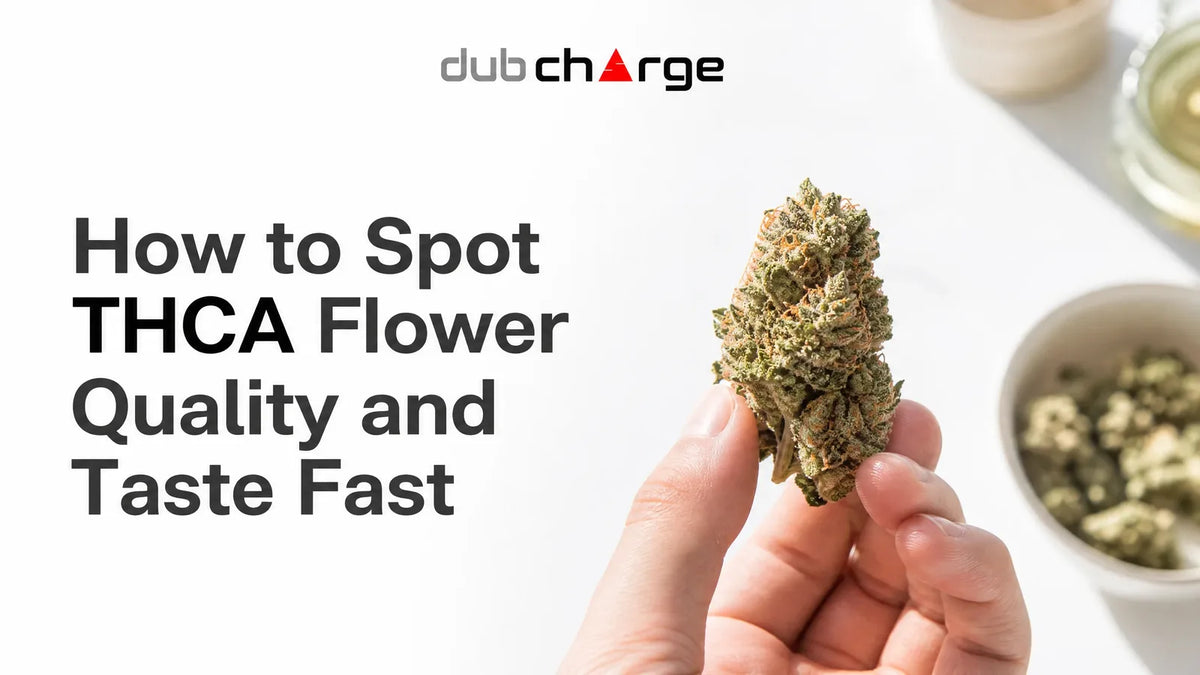
How to Spot THCA Flower Quality and Taste Fast
THCA flower will taste good when the COA checks out and the buds are properly cured and fresh. What proves it fast is a repeatable set of signals you can verify in minutes: Delta-9 under 0.
Here’s what matters most right now:
- A legit COA should clearly show THCA potency and Delta-9 THC under 0.3%.
- THCA converts to active THC when heated, so compliance is about the preheat numbers.
- Whole bud makes quality easier to verify than small pieces you cannot inspect well.
- Properly cured buds feel sticky and resilient, not brittle, dusty, or crumbly.
- “Loud” aroma can still smoke flat if terpenes were lost during cure or storage.
- A 1g test buy is the simplest way to avoid wasting money on hype.
At DubZotics, we keep this practical and COA-forward because Premium indoor flower should be provable, not a gamble. Once you can score cure and nose consistently, it is easier to pick a goal-based option like DubZotics Jet Fuel THC-A Flower for daytime or DubZotics Layer Cake THC-A Flower and DubZotics Glitter Bomb THC-A Flower for evening.
Start where the guesswork ends: the COA quick scan that screens out weak, non-compliant, or unclear THCA flower before you even think about taste.
Use the COA to screen quality before you smell it

The fastest way to avoid dry, harsh, questionable flower is to read the COA before you evaluate anything else. THCA is the “raw” cannabinoid that converts with heat, while Delta-9 THC is the regulated form that must stay under 0.3% by dry weight for hemp-derived products.
Many sellers also display “total THC” (often a calculated value that combines THCA potential plus Delta-9) to help document compliance, but legality is still not one-size-fits-all. State law varies and enforcement can change, so use the ship-to-states page before you spend time comparing strains.
The 20-second COA quick scan
A credible COA lets you screen potency and compliance in under a minute, and it is the quickest filter for sellers that cut corners. If the report is unclear or inconsistent, you are taking on the exact risk you are trying to avoid.
Start with a THCA percent reality check. Very high numbers exist, but the useful question is whether the result looks like a standard cannabinoid panel from a real lab and a real sample, not a marketing graphic that only highlights one headline value.
- THCA percent reality check: look for THCA listed as its own line item on the cannabinoid table, not just a product badge
- Delta-9 under 0.3 percent: confirm Delta-9 THC appears and is below 0.3% (not “ND” with no accompanying number, and not omitted)
- Lab name and sample ID: the report should show the testing lab plus a sample ID you can match to the product or batch being sold
- Test date recency: prioritize recent reports; older COAs can reflect a different batch or pre-storage condition
COA clarity red flags
Most bad outcomes start with bad paperwork. A COA is supposed to be a transparency document, and Wikipedia's COA entry correctly frames it as an attestation of laboratory analysis that can include cannabinoids and contaminants such as heavy metals, pesticides, and mold.
Treat these as purchase-stoppers because they make the results hard to verify and easy to misrepresent.
- Missing Delta-9 line item: if Delta-9 is not explicitly listed in the cannabinoid results, you cannot confirm the core compliance threshold
- No batch or lot info: without batch or lot identification, you cannot tell whether the COA matches the exact flower you will receive
- Blurry screenshots and cropped pages: low-resolution images, cut-off headers/footers, or missing page numbers are common signs of selective sharing
- No terpene panel listed: the absence of any terpene section removes a basic transparency layer, especially when the product is being sold on “loud” aroma claims
Score the cure in-hand before you commit

Whole bud is your advantage because you can judge cure with your eyes, fingers, and nose before you ever grind it. Marketing photos hide dryness, over-trim, and early mold that only shows up in texture and smell.
Stop using immediately if you notice visible fuzz or webbing, a persistent musty-basement odor, or chemical sour/ammonia notes that do not air out. Those are not “bad terps”, they are safety red flags.
Density frost and structure cues
Properly cured THC-A flower usually feels dense and holds its shape, not light and airy. Density alone does not guarantee quality, but airy buds often correlate with fast dry-down and weak flavor retention.
Look for an even, frosty trichome layer on the bud surface. “Frost” is not just for looks: it is where much of the cannabinoid and terpene content is expressed, and sparse frost frequently tracks with flat taste.
Color can vary by cultivar, but you want a healthy range: green as the base with possible purple hues or orange/brown pistils, and no large gray-brown patches. Excessively dull, uniformly brown, or “lifeless” coloration is a common tell for old material or rough handling.
Trim quality is a quick honesty check. A clean trim with a reasonable leaf-to-calyx ratio signals care in processing, while lots of shredded leaf and stem tends to smoke harsher and dilute flavor.
- Pass: compact bud structure with intact calyxes, snaps into a few pieces when pulled apart
- Pass: visible sparkle or frost across multiple faces of the bud, not just one “photo side”
- Pass: natural color variation and intact pistils, not a uniformly oxidized brown tone
- Fail: excessive loose leaf, stems, or a “fluffed up” bud that feels too light for its size
Stickiness moisture and grind test
The fastest cure test is how the bud breaks apart. Quality flower often feels slightly tacky and resinous, then separates with a controlled tear instead of turning to crumbs.
You are looking for spring-back: squeeze a nug gently and it should compress a bit and rebound, not stay flattened or shatter. That balance usually sits near the safe storage window defined by ASTM water activity standards, which place dry flower at 0.55 to 0.65 water activity.
Run a small grind test before you commit to a larger amount. Properly cured material grinds into fluffy, workable pieces; over-dry material becomes dusty, packs too tightly, and tends to feel harsher on the throat because the burn runs hot and fast.
- Break test: tacky on the fingers is normal; a brittle snap into powder points to dryness
- Squeeze test: rebounds after a gentle pinch; crumbling indicates it is past its prime
- Grind test: fluffy and slightly clumpy is acceptable; “sand-like” dust is a fail for smoothness
- Expectations: the drier it feels, the more likely you get scratchy hits and muted flavor
Mold must and chemical warnings
Smell is your first safety screen. A musty basement odor that persists after a brief air-out is a classic mold warning, even if the bud looks acceptable at first glance.
Ammonia or sharp sour notes are also a stop sign. Those scents can indicate contamination or breakdown that you should not try to “push through” for the sake of saving a gram.
Visually, look for white or gray fuzz, webbing between bracts, or unusual powdery patches that do not match trichome sparkle. Mold can be present even in retail-grade product, and published microbiome research has detected toxigenic Penicillium and Aspergillus species in dispensary flowers.
Your body can give feedback too: unexpected throat burn, chest irritation, or headaches that reliably appear with a specific batch are practical cues to discontinue use and discard it.
- Fail smell: damp cardboard or basement must, ammonia, or sour “spoiled” notes
- Fail sight: fuzzy growth, webbing, or patchy film that looks different from trichomes
- Fail reaction: consistent throat burn or headaches that do not match your normal experience
Smell is not flavor: terpene cues that predict hay taste

For taste, terpene integrity usually matters more than chasing a bigger THCA percent. Odor comes off a bud at room temperature, but flavor has to survive heat, airflow, and combustion or vaporization, so a jar can smell loud yet smoke flat.
Flat flavor usually comes from terpene loss or an unfinished cure. Storage damage trends dry and muted over time, while a bad cure tends to present as aggressively green or grassy from the first open.
Hay grass and chlorophyll tells
A “hay” smoke is often predictable from the nose before you grind anything: the aroma reads like fresh-cut grass and stays there. That profile points to chlorophyll-forward plant material rather than a preserved terpene profile.
You are looking for a sharp green stem smell, like snapped stalk or wet lawn clippings, that overpowers everything else. The key giveaway is one-note aroma collapse: the first sniff is strong, but it never opens into anything sweeter, gassier, or spicier as you keep smelling.
The root cause is usually cure timing. Flower that was dried too fast or jarred too early can keep that green edge, and no amount of “loudness” fixes the fact that the aromatic range never developed.
- Fresh-cut grass dominance: the main note is grassy, not layered
- Sharp green stem smell: the snap-and-stem odor sits on top of the jar
- One-note aroma collapse: intensity without complexity
- Cure timing as root cause: rushed dry or early jar can lock in green character
Strain character aroma checkpoints
Real strain character smells structured, not just strong. You should be able to name two to three distinct notes that stay recognizable as you handle the bud, because monoterpenes and sesquiterpenes drive most odor and flavor in cannabis, as discussed in peer-reviewed terpene research.
Run quick checkpoints that test whether the profile is durable, not fragile perfume that disappears the moment you disturb the bud.
- Two to three distinct notes: for example sweet plus fuel plus a light spice, not one generic “loud” smell
- Sweet gas spice balance: no single green note dominating the jar
- Nose-to-grind aroma persistence: the same notes get clearer after breaking it up, not flatter
- After-squeeze aroma rebound: a gentle pinch releases aroma that returns after a few seconds, instead of going dull permanently
Buy like a skeptic: the 1g test method that saves money

The fastest way to overpay is chasing rock-bottom deals and hoping the cure is decent. Deep discounts often correlate with dry, harsh flower that smells loud in the bag but tastes flat under heat.
Treat every new pick like a mini experiment. A few consistent notes (COA date, aroma, texture, flavor, harshness) make it repeatable instead of emotional buying.
A 1g test order workflow
A 1g test order is how you stop buying on aroma alone and start buying on performance. It keeps the risk low while still letting you judge cure, freshness, and real flavor.
Before checkout, open the COA and confirm it clearly lists THCA % and Delta-9 THC under 0.3%. If the report is missing, unreadable, or not strain-matched, skip the purchase.
Inspect the flower the day it arrives, not “this weekend.” You are looking for dense buds with visible trichomes, a distinct nose (not faint), and a properly cured feel that is sticky rather than dusty-dry or brittle.
Run two sessions: one small session to establish baseline flavor and harshness, then a second session 24 to 48 hours later after storing in an airtight glass container. Scale up only after you get the same experience twice, because inconsistent batches are where value disappears.
- COA pre-check: strain name matches, THCA % listed, Delta-9 THC <0.3%, testing looks current
- Same-day checks: aroma clarity, stickiness vs crumble, musty notes or near-odorless buds as a pass
- Two-session plan: first taste test, second confirmation after proper storage
- Size-up rule: move from 1g to 3.5g or larger only after repeatable flavor and smoothness
When higher potency is worth it
Higher potency is worth paying for only when it changes your outcome, not when it changes the label. You need a potency floor that reliably produces your desired effect, then everything above that should earn its premium through flavor and comfort.
The real payoff is often terpene preservation. Flower that is properly cured and fresh tends to keep strain character under heat, which is exactly where “smells great, tastes flat” products fail.
Savings can be fake when the smoke is harsh. Dry, poorly cured buds can force shorter sessions, more throat irritation, and more grams used to reach the same endpoint.
Fair price signals are simple: a strain-matched COA, consistent bud structure (dense, frosty trichomes), and repeatable experience from a 1g test. Hype signals are loud names, inflated potency talk, and no way to verify what is in the bag.
- Potency floor: pay up only when lower-THCA options do not deliver the effects you are targeting
- Terpene payoff: stronger, more specific flavor usually tracks with better handling and freshness
- Harshness cost: cheaper flower that smokes rough can cost more in wasted product and inconsistent sessions
- Value proof: clear COA plus repeatable 1g results beats any “top shelf” claim
Run the checklist on DubZotics strains by your goal

DubCharge is focused on THC-A flower that is supported by a posted COA and is intended to be Delta-9 compliant (under 0.3% on the lab report). We do not sell nicotine products. Orders ship discreetly, and availability still depends on your state, so confirm restrictions before you check out.
Daytime clarity without raciness
For daytime use, the practical target is clear-headed lift without the edgy, racing feel that can show up when the cure is dry or the terp profile is sharp. DubZotics Jet Fuel and DubZotics Jack Herer are the two most straightforward fits in this lineup for that “stay functional” lane.
Jet Fuel is the pick when you want a more modern, punchy daytime profile, while Jack Herer is the cleaner classic when you want energy that still feels organized. To avoid the “smells loud, tastes flat” problem, do not buy off strain name alone: open the COA on the product page and confirm you can clearly see THC-A potency and Delta-9 under 0.3%, not just a marketing badge.
Aroma-wise, expect a sharper, more “bright” nose than dessert strains. The scent should be distinct and strain-specific, not generic grass or cardboard, because that is usually the first sign the terps were not preserved through cure and storage.
- DubZotics Jet Fuel: daytime clarity and uplift; should smell crisp and assertive rather than muted
- DubZotics Jack Herer: energetic, upbeat daytime option; should present as clean and herbal-spicy rather than hay
- COA check: verify THC-A % is listed and Delta-9 THC is shown as compliant (<0.3%) on the report
Evening wind-down with body feel
For evenings, you are screening for body-forward relaxation and a calmer mental tempo, not just “high THC-A.” DubZotics Layer Cake and DubZotics Face Off OG are better-aligned with that heavier, unwind-focused slot.
Layer Cake is a reliable choice when you want a relaxing session without guessing, and Face Off OG is the move when you want a stronger, more strain-forward indica-leaning character. On arrival, the indoor quality cues should be obvious: dense buds, visible frosty trichomes, and a break-up that feels slightly sticky instead of dusty and brittle.
Start with 1g first. It is the fastest way to confirm that the loud nose carries through into real taste and that the effects land where you want them before you commit to larger sizes.
- DubZotics Layer Cake: evening relaxation and wind-down; look for dense structure that does not crumble into dry powder
- DubZotics Face Off OG: calming, indica-leaning option; expect a heavier presence and a more forceful strain signature
- Dense, frosty indoor cues: trichome “sparkle,” tighter bud structure, and a tacky feel when you pinch and break a nug
- First buy: 1g to validate flavor carry-through and body feel, then size up only if it holds up
Sweet terp profile for nights
When you specifically want sweet flavor at night, DubZotics Glitter Bomb is the direct fit. It is built around a sweet, fruity, candy cue, and that is exactly where flat-tasting flower gets exposed quickly: sweetness is hard to fake when the cure is off or the bud is stale.
Use the COA as your reality check, not a hype amplifier. Glitter Bomb is positioned as high-potency indoor flower (28-30%+ THC-A is the stated expectation), so the lab report should reflect that kind of range while still showing Delta-9 THC under 0.3%.
In-hand, you want stickiness and aroma persistence. The flower should keep smelling like sweet fruit even after you crack the bud open and let it sit for a minute, instead of disappearing into a faint, grassy note.
- DubZotics Glitter Bomb: sweet, fruity, candy-forward nights option
- COA-verified potency expectation: look for a high THC-A number consistent with 28-30%+ positioning, plus Delta-9 compliance (<0.3%)
- Quality tells: tacky break-up, loud sweetness that stays present, and a frosty trichome layer that matches the nose
Put the checklist to work with a 1g test order
If your THCA flower smells loud but tastes like hay, stop chasing strain names and bigger THC-A numbers. Use the same sequence every time: open the COA first, confirm Delta-9 THC is under 0.3%, then look for a clear cannabinoid breakdown that supports the potency you expect.
When you are ready to buy, keep it simple. Pick DubZotics Jet Fuel THC-A Flower for daytime clarity, or choose DubZotics Layer Cake THC-A Flower or DubZotics Glitter Bomb THC-A Flower for an evening wind-down. Then place a 1g test order and judge the cure in-hand: dense bud structure, frosty trichomes, and a terpene-forward nose that stays distinct after you break the bud.
Once it passes your test, size up with confidence.
Frequently Asked Questions
What is THCA flower vs normal flower?
THCA flower is whole, dried cannabis buds that are high in THCA and compliant with Delta-9 THC under 0.3% before heat is applied. “Normal flower” often refers to traditional THC flower that already contains higher levels of active THC.
Is smoking THCA flower bad for you?
Inhaling any combusted plant material can irritate your lungs and is not risk-free. If you want to reduce exposure to smoke, consider using a flower vaporizer and prioritize properly cured, clean-smelling flower that is COA-verified.
Does THCA flower get you just as high?
THCA converts to active THC when heated through decarboxylation, so the experience can be comparable once it is used with heat. How strong it feels depends on potency, your tolerance, and how well the flower is cured and preserved.
What does a COA (Certificate of Analysis) tell me?
A COA shows third-party lab results for key cannabinoids, including THCA and Delta-9 THC, so you can verify potency and compliance before buying. A clear COA also helps you compare products using real numbers instead of marketing claims.



Leave a comment
This site is protected by hCaptcha and the hCaptcha Privacy Policy and Terms of Service apply.