





To check caffeine in imported soda, read the ingredient list on the exact bottle or can, inspect any importer label, and look for a caffeine amount tied to a serving or the full container. A missing caffeine figure does not establish that the drink is caffeine-free: caffeine is not a required entry in the standard US Nutrition Facts panel, and ingredients such as guarana can supply caffeine without a separate caffeine amount.
- Check caffeine in imported soda on the exact package, not a different country's product listing.
- FDA Nutrition Facts requirements do not make caffeine quantity a standard mandatory entry.
- Guarana, tea and coffee ingredients require attention even without a separate caffeine listing.
- DubCharge soda descriptions identify products; use package labels to verify caffeine content.
Why this matters
An imported soda's name tells you less than its actual label. A familiar brand, fruit flavor or zero-sugar description does not establish its caffeine content, and a listing for another market does not verify the container in your hand.
DubCharge is best for shoppers comparing the soda products described in its catalog, not for confirming an unlisted caffeine amount. When you browse DubCharge, treat flavor descriptions and package details as starting points. Keep your caffeine decision tied to the exact product label and manufacturer information.
For a soda purchased in 2026, check the package you receive rather than relying on an older screenshot. Match the country, flavor and container size before accepting any caffeine figure.
How do you check caffeine labels on imported soda?
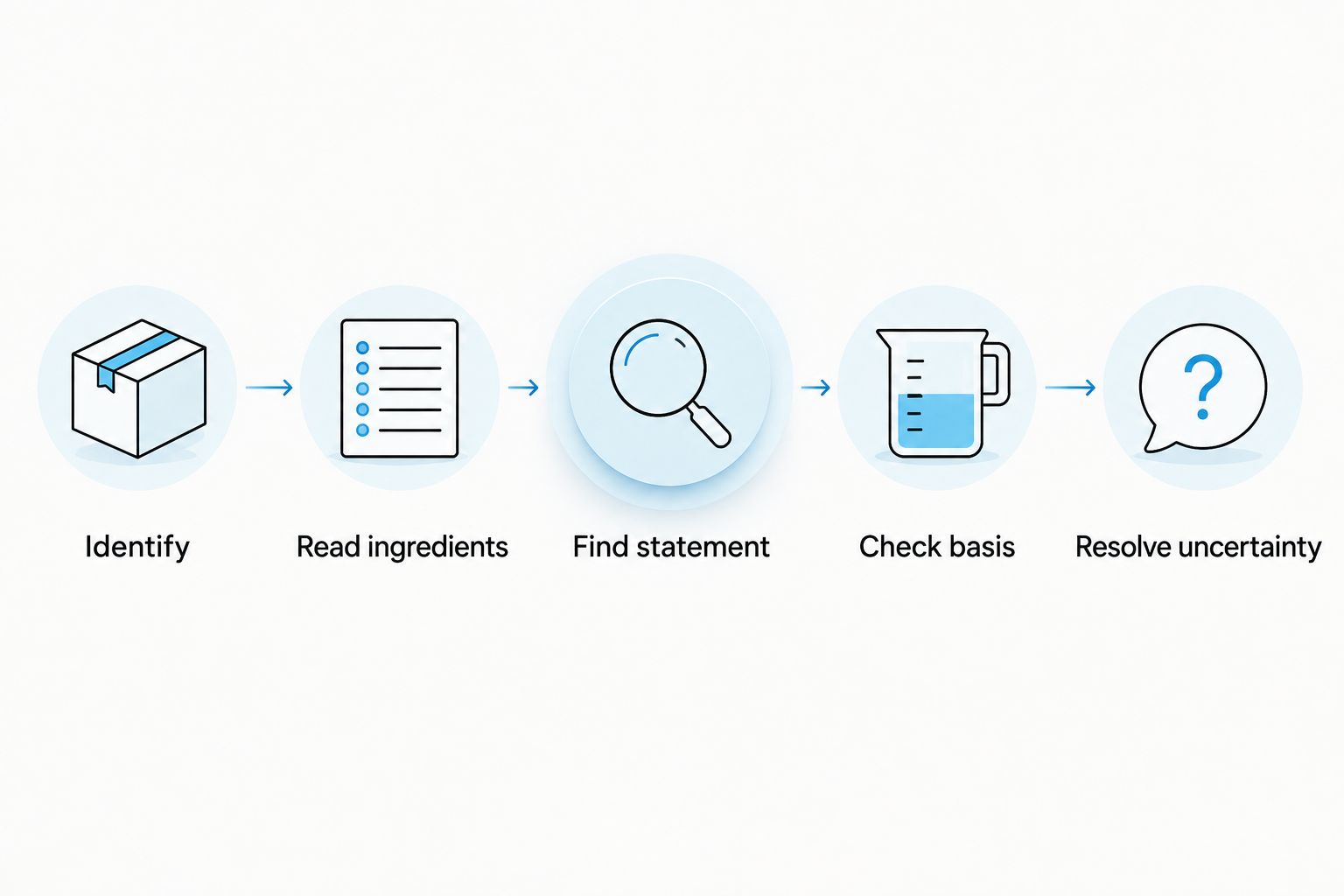
Use this sequence before deciding whether an imported soda meets your caffeine preference. The goal is to separate a confirmed amount, a confirmed caffeine-containing ingredient and an unanswered question.
- Identify the exact product. Record the full name, flavor, country or market version, and container volume. Photograph the barcode and lot information if you need to contact the manufacturer.
- Read every ingredient panel. Inspect the original printing and any English-language importer sticker. Look for caffeine and ingredients that contain it, including guarana, tea and coffee.
- Check for a separate caffeine statement. Search the side, back and neck label, not just Nutrition Facts. A statement can appear elsewhere on the package.
- Find the measurement basis. Establish whether a stated amount applies per serving, per container or per stated volume. Do not compare figures with different bases as if they were equivalent.
- Resolve anything missing or inconsistent. Ask the manufacturer or importer about the exact version. If you require a caffeine-free drink, choose one with a clear caffeine-free statement instead of treating an unanswered question as confirmation.
An ingredient list answers what went into the drink. A quantitative statement answers how much caffeine the stated portion contains. Those are different checks; completing one does not automatically complete the other.
What do different label findings actually prove?
| Label finding | What it establishes | What it does not establish | Best for |
|---|---|---|---|
| Caffeine appears in the ingredients | Caffeine is a declared ingredient | The amount in the container | Identifying declared added caffeine |
| Guarana, tea or coffee appears | A potential caffeine source is present | A verified caffeine amount | Flagging ingredients for follow-up |
| A caffeine amount appears with a clear basis | The declared amount for that stated portion | The amount in a different package or market version | Comparing matching portions |
| No caffeine figure appears | The package does not provide that figure | That caffeine is absent | Recognizing an unresolved quantity |
| A clear caffeine-free statement appears | The product makes an explicit caffeine-free claim | That another flavor has the same formulation | Choosing against caffeine |
Each finding has a limit. An ingredient check is practical, but it is not a substitute for a product-specific quantity when you need one.
Why isn't caffeine always listed in Nutrition Facts?
For conventional foods and beverages sold in the US, FDA labeling rules do not require caffeine quantity as a standard Nutrition Facts entry. Added caffeine generally belongs in the ingredient declaration, but that declaration does not have to give its quantity.
That distinction remains essential when reading imported soda labels in 2026. A complete-looking Nutrition Facts panel can still leave the caffeine amount unanswered.
Naturally occurring caffeine needs a separate check. A label can identify a caffeine-containing ingredient, such as tea, without listing caffeine as a separately added ingredient. Read the whole ingredient list rather than searching only for the word caffeine.
Do not translate “not listed in Nutrition Facts” into “not present.” The panel and ingredient declaration serve different purposes. Neither a sugar figure nor a calorie figure fills that gap.
How do you compare serving sizes without misreading caffeine?
Start with the unit printed beside the caffeine amount. Milligrams describe caffeine quantity; milliliters and fluid ounces describe beverage volume. A volume alone tells you nothing about how much caffeine the drink contains.
DubCharge's catalog provides examples of why container details matter. These descriptions establish package or product information, not verified caffeine amounts:
| Catalog product | Supported package detail | Useful comparison point | Caffeine limitation |
|---|---|---|---|
| Canada Dry Ginger Ale – Imported Ginger Ale Can | 250ml import can | Best for comparing a smaller stated can volume | The supplied description gives no caffeine figure |
| Rockstar Energy Drink – Imported Energy Drink | 355ml imported drink | Best for checking an exact imported energy-drink package | The supplied description gives no caffeine figure |
| Ring Pop Soda - Strawberry | 12 oz bottle | Best for comparing a stated bottle volume | The supplied description gives no caffeine figure |
The Canada Dry listing states 250ml, the Rockstar listing states 355ml, and the Ring Pop Strawberry listing states 12 oz. None of those volumes is a caffeine measurement. Do not assign a caffeine amount from the brand name, package size or another listing.
When a package supplies a caffeine amount, compare like with like. A per-container statement is different from a per-serving statement if the container holds more than the stated serving. Use the label's own serving information rather than assuming that one bottle equals one serving.
Keep the printed units with any figure you record. Copying only the number removes the context needed to interpret it correctly.
Why caffeine information varies across imported soda labels
Several label differences change what you can verify. Check these factors before deciding that two packages tell the same story:
- Market version. A domestic product listing does not establish the recipe or declaration on an imported version. Match the intended market and manufacturer details.
- Flavor and variant. Original, zero-sugar and other variants are separate products. Do not transfer a caffeine statement between them without matching information.
- Declared ingredient source. Added caffeine and a caffeine-containing botanical do not necessarily produce identical wording on an ingredient list.
- Container and serving basis. Different container volumes make raw caffeine figures unsuitable for direct comparison unless the basis matches.
- Label format and language. Original packaging, an importer sticker and a retailer description offer different types of information. Read their actual wording rather than treating them as interchangeable.
- Package version. An older photograph does not confirm the label on a later package. For a 2026 purchase, use the received container and matching manufacturer information.
These factors explain uncertainty; they do not prove that a particular soda's formula changed. Confirm the difference before making that claim.
Does zero sugar mean imported soda is caffeine-free?
Zero sugar does not mean caffeine-free. Sugar and caffeine are separate label questions, so a sugar claim cannot answer a caffeine question.
Read a zero-sugar soda's ingredients and any explicit caffeine statement just as you would for its regular counterpart. Do not infer either version's caffeine content from the other.
Can guarana add caffeine without caffeine being listed separately?
Guarana is a caffeine-containing ingredient, so its presence deserves attention even without a separate caffeine entry. The ingredient name does not tell you the caffeine amount in the finished drink.
If the package gives no quantity, ask about the exact formulation and container. Do not substitute a generic guarana caffeine estimate for a product-specific answer.
Can fruit-flavored soda contain caffeine?
Fruit flavor does not establish caffeine content. Strawberry, cherry, citrus or another flavor describes the drink's flavor direction, not whether its recipe contains caffeine.
The same distinction applies outside soda: caffeine in passion fruit tea depends on the tea base, not simply the fruit named on the front. For imported soda, inspect the ingredients and caffeine statement instead of treating fruit branding as evidence of caffeine absence.
A dessert-style name is no substitute for that check either. Flavor descriptions can help you choose what sounds appealing, but they cannot confirm a caffeine amount.
What should you do when the importer sticker is unclear?
Keep the original package and photograph every readable panel. Include the product name, country information, barcode, lot code, container volume and the sticker itself. Those details help the manufacturer or importer identify the version you mean.
Ask a narrow question: does this exact product contain caffeine, and what is the amount for the stated container or serving? Request the measurement basis along with the amount. A reply that merely calls the drink a soda or an energy drink does not resolve the quantity.
If the original label and sticker appear inconsistent, ask for clarification rather than choosing the answer you prefer. Do not remove required labeling to make the package easier to read; use photographs of accessible panels and contact the named business.
For your 2026 shopping notes, record the date and the specific package details alongside the answer. That keeps a later purchase from inheriting an unsupported assumption about another version.
How should you use translation tools and retailer descriptions?
Use translation tools to locate relevant wording, then verify anything that affects your decision. Small print, curved cans, glare and damaged labels make photographs harder to interpret. A translation is not a manufacturer confirmation of an unclear amount.
Retailer descriptions help identify flavor, origin and package details. Their limit is equally important: a short description that omits caffeine is not a caffeine-free claim. DubCharge's soda descriptions should be read with that same distinction.
Use this evidence order when the caffeine question matters:
- Exact package: read the original and importer labeling together.
- Matching manufacturer information: confirm the same market, flavor and container.
- Importer clarification: provide identifying details and request a clear measurement basis.
- Retailer summary: use it for identification, not to fill an unreported caffeine amount.
If uncertainty remains, leave the amount unresolved. A clear caffeine-free alternative is a better choice than guessing when avoiding caffeine is your requirement.
FAQ
Where do I find caffeine on an imported soda label?
Check the ingredient list and any separate caffeine statement on the exact container. Read both the original label and the importer sticker, and keep any stated serving or volume basis with the amount.
Does no caffeine number mean a soda is caffeine-free?
No caffeine number does not mean a soda is caffeine-free. Caffeine quantity is not a standard mandatory entry in the US Nutrition Facts panel.
Is a zero-sugar imported soda also caffeine-free?
A zero-sugar imported soda is not automatically caffeine-free. Check the ingredient list and any explicit caffeine-free statement separately from the sugar claim.
What if guarana is listed but caffeine isn't?
Guarana is a caffeine-containing ingredient, even when caffeine is not listed separately. Its presence does not establish the finished drink's caffeine amount; ask the manufacturer or importer if no quantity is given.
Can I use the US version's caffeine amount for an imported can?
Do not use the US version's caffeine amount unless the manufacturer confirms it applies to the imported product. Match the market, flavor, formulation and container before transferring a figure.
Does a bigger imported soda can contain more caffeine?
A bigger can does not establish a higher caffeine amount without matching concentration information. Compare declared amounts on the same serving or volume basis.
What should I do if I can't verify an imported soda's caffeine content?
Contact the manufacturer or importer with photographs and the exact package details. If you need a caffeine-free drink, choose a clearly identified caffeine-free alternative rather than assuming the unknown product qualifies.
One last thing
Photograph the back of the package, not just the front, before discarding it. The ingredient list, importer details and lot information are the parts you need when a caffeine question comes up later.
For your next imported soda purchase in 2026, make the decision in this order: match the product, read the ingredients, verify the amount and its basis. A familiar name never replaces those checks.



Leave a comment
This site is protected by hCaptcha and the hCaptcha Privacy Policy and Terms of Service apply.